
Author: C.H. Kwon

  • Why “Just Block Your Calendar” Doesn’t Work When You Have Kids (And What Does)

    Why “Just Block Your Calendar” Doesn’t Work When You Have Kids (And What Does)

    If you’re looking for time management tips for parents, I want to start with the most honest thing I can say:

    Time management with kids is inherently inconsistent. The goal isn’t a perfect system. The goal is a flexible one that survives contact with real life.

    And real life, when you have four boys, includes things no productivity guru has ever put in a YouTube video.

    When Everything Just Stops

    The first thing that breaks any time management system with multiple kids is illness.

    Not just a runny nose. I mean the kind of sick that takes over the whole house.

    When one of our boys gets sick, we go into full quarantine mode immediately. The sick boy goes to Mom. Nobody makes contact. We isolate fast because in a house with four kids, a cold doesn’t just pass through — it sets up camp and rotates through every single person in the house for months if you let it spread unchecked.

    I learned this the hard way during our first year in Cambodia.

    We were at a conference in Sihanoukville — a beautiful coastal city in the south. Then Number 2’s fever spiked to 39 degrees Celsius out of nowhere. We headed back immediately. He was taken to the ER at Khema Hospital. His blood infection levels came back alarming. He was admitted on the spot.

    The diagnosis: Scarlatina. Scarlet Fever.

    And then, one by one, we all got it.

    What followed was an entire month of our family completely isolated from the outside world. No school. No church. No human contact. The boys took turns going back to the ER to manage the fever spikes. Once they were all stabilized, I was the last one standing — on Tylenol, Advil, and prescribed amoxicillin, feeling physically terrible but technically functional.

    Here’s the thing nobody tells you about being a sick dad: you don’t get to be sick the same way everyone else does. The kids get the ER visits. Mom gets the caretaking role. Dad gets the laptop and the responsibility to keep things moving.

    So I worked from quarantine. Deliveries came to the door. The boys got unlimited screen time as the greatest Scarlet Fever consolation prize in history. And I got five hospital visits and a month of forced stillness that, honestly, gave me more uninterrupted work time than a typical month ever does.

    Consistency is a luxury. Adaptability is the actual skill.

    The Sleep Cycle Problem

    The second thing that quietly destroys a parent’s time management is the nap that shouldn’t have happened.

    You know the one.

    A boy depletes his batteries too early in the day — runs too hard, crashes too soon — and goes down for a nap at 4pm. You breathe a sigh of relief. Then 9pm arrives and he’s wide awake, announcing he’s not sleepy, asking for dinner, having fully transformed from a small lamb into a tiny nocturnal creature with opinions about bedtime.

    The domino effect of one wrong nap can shift the entire household schedule by hours. And your 8:30pm work window — the one you were counting on — is now a negotiation.

    I used to panic when this happened. Now I evaluate.

    If it’s Number 4 who’s suddenly wide awake at 9pm — that’s actually an opportunity. The loudest, most energetic one is contained and accounted for, which means the rest of the house is quieter than usual. Open the laptop.

    If it’s Number 2 — same logic, same opportunity. Except Number 2 sometimes doubles his noise output in the absence of Number 4, as if he’s compensating for the missing chaos. In those cases I close the laptop, attend to the kids, and accept that tonight’s work is postponed.

    This is why I try to work ahead of deadlines wherever possible. I know things will change — not maybe, not sometimes, but inevitably. The wrong nap will happen. The schedule will shift. The window will close before it opened. Working ahead means that when it does, I’m managing a delay, not a crisis.

    And if something is genuinely urgent? I’ll get to that in a moment — but there’s a third window that handles exactly that situation.

    This is why I don’t build a rigid schedule. I build windows.

    My Actual Work Windows

    People assume productivity requires large, protected blocks of uninterrupted time. For a dad of four, that’s a fantasy.

    Every time management tip for parents I’ve ever read assumes you control your environment. You don’t.

    What I actually have are three windows — and I use whichever one the day makes available:

    The school window. Our boys attend school in the afternoon here in Cambodia, which means there’s a stretch of morning time that occasionally opens up for focused work. I say occasionally because four boys at home in the morning is not silence. But it’s something.

    The 8:30pm window. This is my primary work time. Once the boys are in their places and the house settles, I open the laptop. Some nights it’s two hours of solid work. Some nights Number 4 has opinions about sleeping and the window closes before it opened. Tonight I’m writing this article at 10:39pm while the boys are finally winding down. It’s just one of those nights.

    The 4am window. This is the one I mentioned earlier as the emergency fallback — but it’s also a planned tool when the work demands it. For tasks that require absolute concentration — the kind where I need my whole brain without interruption — I set an alarm for 4am. The house is completely still. Nobody is asking for anything. It’s the most productive two hours of my entire day. I don’t use it every day. But when the work demands it, I use it without hesitation. Not my favorite window. But the most reliable one.

    Everything I work on lives in the cloud. Google Drive, documents, notes — all of it accessible from my tablet wherever I am, whatever time it is. The Scarlet Fever quarantine taught me that clearly: when your physical location becomes unpredictable, your work has to live somewhere that isn’t tied to a desk.

    The Baton Pass — Handing Off to Mom

    There are moments when I need to hand the family completely to my wife and disappear into a task. Not often. But it happens.

    Here’s exactly how I do it without creating tension:

    I tell her what I need to accomplish. Specifically — not “I have some work to do” but “I need to finish writing this report, it’ll take about ninety minutes, and I need to not be interrupted during that time.”

    I tell her the approximate time it will take. This matters more than most dads realize. Open-ended requests feel like abandonment. A time boundary feels like a negotiation.

    I give her all the information she needs about what I’m doing — even when my brain tells me it’s too much detail. It’s never too much detail for Mom. She’s taking on four boys solo. She deserves to know exactly why.

    A happy wife is a happy life. That’s not a cliché in our house. It’s operational policy.

    ## When Ministry Breaks the Schedule Entirely

    Here’s the layer that most parenting productivity advice never accounts for: I’m a missionary.

    Which means there are stretches where consistency isn’t just difficult — it’s structurally impossible.

    When I travel to another city alone for a conference or a missions meeting, I’m gone for a day or two. Mom holds the house with four insubordinate minions and no backup. I carry the weight of that knowledge the entire time I’m away.

    When a missions team comes to us, I’m with them around the clock — guiding them through Cambodia, sharing the culture and history of the Khmer people, taking them to historical sites, through the weight of the Khmer Rouge history, to Siem Reap to see the ancient ruins of the Khmer Kingdom and Angkor Wat. For that stretch, the family runs without me.

    I’m in church ministry, dormitory ministry, and working toward education ministry at a local international school. Each of those pulls on the schedule differently. None of them run on a nine-to-five.

    The dormitory ministry is worth explaining because most people outside of missions work have never encountered it. In Cambodia, quality education is concentrated in the cities. Students from rural areas — middle school age, high school age — have to relocate to the city just to continue their schooling. Many of them have nowhere to go. So we run a dormitory that houses them, feeds them, and teaches them community and life skills alongside their studies. They attend church. They contribute a small amount for accountability. The rest comes through donations from churches and individuals who believe in the work.

    It’s one of the most meaningful things we do. It’s also one of the most unpredictable in terms of time demands.

    This is the reality of a missionary dad’s time management. The blocks on my calendar don’t always mean what I put there. People need things at unpredictable hours. The work of ministry doesn’t respect the bedtime routine.

    So I’ve stopped trying to manage time the way productivity books describe it. I manage energy instead. I protect the windows I have. I communicate clearly with my wife when I need to borrow hers. I keep everything in the cloud so the work can follow me wherever the day goes.

    But I want to be honest about the times it doesn’t work.

    Preparing a sermon takes me at least ten hours. Not because I’m slow — because it matters. I research, I write, I revise, I build the presentation. AI tools have helped with some of it — finding quotes, building slides — but you can’t hand a sermon to an algorithm. The thinking, the conviction, the delivery — that has to come from somewhere real.

    There have been Sundays where the windows never opened the way I needed them to. Where the boys were unpredictable, the week was chaotic, and I found myself on a Saturday night knowing the sermon wasn’t ready.

    Our church has four pastors — two local, two missionaries. We coordinate sermon schedules, programs, training sessions. When I’ve had to call and ask to swap the order, to ask for leniency — it’s humbling. It doesn’t happen often. But it happens.

    And that’s okay. Missing a deadline tends to become a bigger problem later on, which is why I fight hard to prevent it. But when it’s inevitable, I face the truth, be honest with the people who need to know, and do better next time.

    Failure is the mother of all success. You just have to be willing to try again.

    And when Scarlet Fever hits the whole family at once?

    You order delivery, hand the kids the tablet, open the laptop, and keep going.

    That’s the system.

    It’s not the time management tip for parents you’ll find in a productivity book. But it’s the one that actually survives four boys, a missionary schedule, and Scarlet Fever.

  • The Discipline System We Use for 4 Boys Under 10 (No Yelling — Mostly)

    The Discipline System We Use for 4 Boys Under 10 (No Yelling — Mostly)

    If you’re looking for how to discipline kids without yelling, I want to be upfront with you before we go any further:

    I yell.

    Not as a strategy. Not on purpose. But I am a dad of four boys under ten and sometimes my emotional governor fails and the volume goes up and the message comes out louder than intended. It happens. I’m not proud of every moment of it, and I’m also done pretending it doesn’t exist.

    That said — here’s what I’ve actually built into our house as a discipline system. The stuff that works more often than it doesn’t.

    The Goal of Discipline Is Not Guilt

    This matters before anything else.

    The goal is not to make the child feel bad. It’s not to punish for punishment’s sake. The goal is for them to genuinely understand that what they did was wrong — not because Dad is angry, not because there are consequences, but because the action itself was wrong.

    Getting that understanding into a small boy’s head takes time. Some boys longer than others. And if you’ve read my earlier posts, you already know that my four boys have four completely different operating systems.

    The discipline has to match the boy. One size does not fit all.

    What Dogs Taught Me About Raising Boys

    I’ve grown up with dogs my whole life. Right now we have a puppy poodle at home learning the rules of the house — and watching him go through training reminded me of something important.

    Dogs respond to training because it benefits them. Do something right, get a treat. The repetition builds the behavior. The dog doesn’t do it because it was told to. It does it because it learned that the behavior is good for it.

    I’m not saying boys are dogs. I want to be clear about that.

    But I am saying: we spend a lot of energy disciplining our kids when they do something wrong. How often do we actively praise them when they do something right? Do I tell my boys when they handled something well? Do I make a point of noticing the good behavior the same way I notice the bad?

    Discipline without recognition is imbalanced parenting. And imbalanced parenting produces kids who only learn what not to do — never what to reach for.

    In our house, praise comes with a treat. Literally. Ice cream when we have it, or coin chocolates when we don’t. Sometimes a little extra screen time for educational videos — Man vs. Wild with Bear Grylls is a favorite. When one of the boys spontaneously cleans up after himself, or suddenly decides to do the dishes without being asked — which is rare, but it happens — that gets rewarded immediately.

    Does it create permanent habits overnight? No. All discipline requires repetition. All treats do too. But here’s what it has built over time: the boys now know exactly what Mom and Dad are looking for. The next step — and we’re working toward it — is waiting for them to intentionally choose the good instead of accidentally stumbling into it. That’s the real finish line. We’re not there yet. But we’re closer than we were.

    The Volume Problem (Boys Have an Extra Input dB)

    I am convinced that boys are born with a higher hearing threshold than the rest of humanity.

    One afternoon I called Number 2 by name. Softly. Once. Twice. Three times. Four times. Nothing. He was right there. I could see him. He did not respond.

    I raised my volume. Called him again.

    He noticed. Not responded — noticed. Like something had finally penetrated the atmosphere.

    I tried once more. This time he looked up and answered.

    I asked him why he hadn’t responded when I called his name the first four times. He looked at me completely sincerely and said: “I didn’t hear you.”

    He wasn’t lying. That’s the thing. He genuinely didn’t hear me.

    Soft voices don’t land on little boys. And yet — whisper the words “snack,” “game,” or the name of literally any food they love, and they will hear it from two floors away through a closed door.

    This is not selective hearing. This is engineering. Boys are built differently.

    So I’ve learned to separate two things that look similar but aren’t: talking loudly and yelling. Talking loudly is simply adjusting the volume to reach the target. It carries a message. Yelling carries an emotion — and the boys know the difference immediately. They feel the difference. The message in a loud voice lands. The emotion in a yell lands differently, and not in a way that helps anyone.

    The Investigation System — Dad as Lawyer, Prosecutor, and Judge

    When there’s a dispute between the boys — which is daily, sometimes hourly — I don’t try to settle it in the room where it happened with everyone talking at once.

    I separate them.

    Room A gets one boy. Room B gets another. I go to Room A first and take the full account. Then I go to Room B. I get the full picture from both sides before I say a single word about what happened.

    Then I bring the verdict.

    When all four are involved — which happens — we move to Open Court. Everyone in one room. It’s louder. It’s more chaotic. At some point Number 4 will attempt to make his case despite being two years old and not having a firm grasp on the events in question. But we make it happen. They know the routine. They know the rules of engagement. They make their cases one by one, and we rely on truth — which, remarkably, they all accept as the standard.

    It took time to get here. I built the system with Number 1 first. Then Number 2. Then 3. Number 4 was born into it — he arrived to a household that already had a functioning court, and he’s learning the rules the same way the others did. One case at a time.

    I am the lawyer, the prosecutor, and the judge in this household — and I take all three roles seriously. Each boy has to understand specifically what he did wrong. Not just “you were fighting.” What exactly was the action, why was it wrong, and what should have happened instead.

    Then comes the apology. And I am specific about what the apology has to contain. “Sorry” alone doesn’t work. “I’m sorry I hit you because I was angry” is a start. They have to name the action. They have to say it to each other’s face.

    After that comes the warning: next time this same issue comes up, there will be consequences.

    Consequences — Wall Sits, and Yes, Spanking

    For smaller disputes, the consequence is a wall sit. One to three minutes depending on what happened. It’s physical, it’s uncomfortable, and it’s memorable without being harmful.

    For serious offenses, I spank. I know that lands differently depending on who’s reading this. Here’s exactly how it works in our house.

    The severity matters. If the offense involved violence that left a bruise or a mark — one spank. If it involved a dangerous object used intentionally against a brother — that’s three. The use of a weapon, even a toy used as one, shows intention. That’s a different level of wrong and the consequence reflects it.

    In our house it comes with strict rules that I don’t break:

    Rule 1: If I am angry, I do not spank. Spanking in anger is not discipline — it’s an emotional outburst with physical contact. I wait until I’m calm.

    Rule 2: Maximum three. Never more.

    Rule 3: Only the butt. Never anywhere else.

    Rule 4: After every single spanking, without exception — a hug. And I tell them: I love you more than anything in this world. It breaks my heart to do this. I do it because I need you to remember that what you did was morally wrong, and I love you too much to let you grow up thinking it wasn’t.

    My five-year-old already understands this. He knows that spanking in our house comes from love, not anger. The difference is real and he feels it.

    The Bluey Problem

    I need to talk about Bluey.

    If you’re a dad with young kids and you haven’t watched Bluey — prepare yourself. If you have watched it, you already know what I’m about to say.

    Bluey is a toxic cartoon for dads. Not because it’s bad. Because it’s too good. Bandit — the dad in the show — is patient, creative, present, playful, and emotionally intelligent in every single episode without fail, and watching him makes me feel a specific kind of guilt that no other piece of media has ever produced in me.

    I don’t know how Bandit does it. I would genuinely like to ask him. I think he has answers that the rest of us don’t.

    But here’s what I want to say to every parent who’s reading this after losing their cool today:

    It’s okay. You yelled. Your child probably earned it. Take a breath, remind yourself that this small person is still in development — their attention skills, their moral reasoning, their impulse control are all literally still forming — and get back to the work.

    You are disciplining your children for their future. Not for your comfort. Not for your reputation. For who they are going to become.

    The Alpha System — Number 1 Sets the Standard

    Now — if you’ve recovered from the Bluey guilt — one last thing that’s made a real difference in our house.

    Our government may be democratic. Our house is a dictatorship. Mom and Dad are King and Queen and that is not up for debate.

    But within the boys, there is a hierarchy that I’ve started to lean into rather than fight. Number 1 is nine years old and he is the alpha of the group. The younger three watch him. They follow his lead whether he intends it or not.

    So I’ve given him the privileges of Number 1 — and the responsibility of Number 1. He knows he’s in charge when Dad isn’t in the room. He knows his behavior sets the standard for his brothers.

    What does that look like practically? If Number 1 wants to try Roblox for the first time, we talk about it. If he wants to watch Minecraft content on YouTube, that’s a negotiation with responsibilities attached. If he wants to buy a game for the family Nintendo, I’m open to reasoning — but there are terms. We work it out together.

    Numbers 2, 3, and 4 have no such say. They know this. They try to talk their way into decisions anyway, because boys always try. It doesn’t work. But Number 1’s requests get heard, considered, and sometimes approved — because that’s what it means to be Number 1 in this house.

    I grew up as Number 2 in my own family. I know exactly how that works. You watch Number 1. You learn from Number 1. You follow Number 1.

    Give your eldest the weight of that role — respectfully, age-appropriately, with support — and you’ll find the whole system starts to run a little smoother on its own.

    The Same Offense, Four Different Boys

    I said earlier that the discipline has to match the boy. Let me show you what that actually looks like.

    Number 1 — Captain America. Rule-follower. Soft heart. When he does something wrong, a calm conversation is enough. He processes it, he feels it, and he corrects. He doesn’t need much. A look from Dad sometimes does the job.

    Number 2 — Thor. Seven years old, full power, no filter. He will do things without processing them first. Something happens, and two seconds later you can see it on his face — the realization that he crossed a line he didn’t even see coming. When he gets scolded, he goes full grumpy Thor in Asgard — bear belly, arms crossed, the whole production. I feel bad every time I have to discipline him because the regret is always genuine and immediate. I try to let him off with a warning more often than not. But he unintentionally crosses the line too much for warnings to always be enough. He doesn’t mean to. That almost makes it harder.

    Number 3 — Spider-Man. The peacemaker. He would hand over his own treat to end a dispute between his brothers. He rarely gets into trouble, and when he does, it’s almost always about not wanting to share — which for him is so out of character that the surprise alone is usually enough to correct the behavior.

    Number 4 — Joy Hulk. Two years old. Still learning that his body is larger than his awareness of it. The discipline for him is mostly redirection at this stage. He doesn’t fully understand consequences yet. But he’s watching. They’re always watching.

    Same household. Same rules. Four completely different approaches to getting through to each one.

    Actions have consequences. Love always comes after. And Number 1 sets the tone.

    That’s the system.

  • How to Get Anything Done With Kids Constantly Interrupting You

    How to Get Anything Done With Kids Constantly Interrupting You

    If you’re searching for how to be productive with kids at home, here’s what nobody tells you upfront: the goal isn’t to eliminate the interruptions. It’s to work around them strategically enough that you actually finish something by the end of the day.

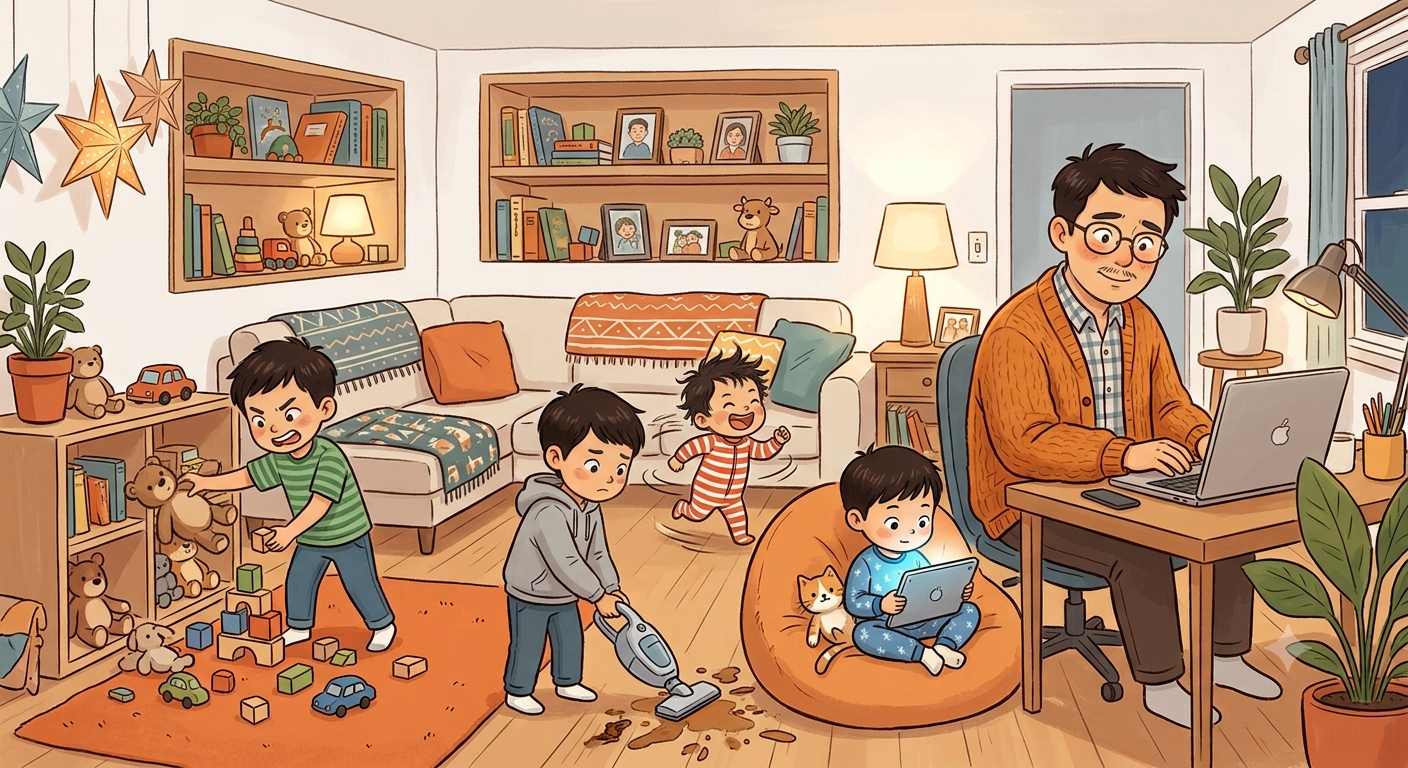
    I have four boys. Ages 9, 7, 5, and 2. And I’ll tell you what trying to clean a house with four boys feels like.

    You pick up toys from the floor. While you’re doing that, two of them are pulling new toys out from the shelf. By the time you’ve finished one corner of the room, the corner you started with looks exactly the same as when you began. It’s like bailing out a boat with a cup while someone else is running the tap on full.

    If you aim for perfection with kids in the house, you’re going to fail. Every time. Boys especially do not register your frustration as a reason to stop what they’re doing. They will continue doing their own thing, completely unbothered, until they sense that something genuinely life-threatening has entered their father’s mind. That’s the only alarm system they respond to — and even that one has a delay.

    Here’s what actually works in our house.

    The Competition System — Make It a Game for Kids at Home

    This one came from my wife, and I’ll give her full credit because I would never have thought of it.

    Boys are simple. Boys like to play. If something feels like a game, they will do it with full energy and zero complaint. If it doesn’t feel like a game, good luck.

    So she made everything a competition.

    “Who can pick up toys faster — you or Dad?”

    “Who can finish eating first?”

    “First one to get their shoes on wins.”

    Suddenly, things that used to take thirty minutes of nagging took three minutes of genuine effort. Four boys sprinting around cleaning up toys because losing to their dad is apparently unacceptable. I’m not complaining.

    I’ll be honest though: this system has a shelf life. My eldest — he’s nine — has already figured it out. He knows we’re using the competition to get him to do things he’d otherwise resist. He told me. Calmly. With full awareness. And then he still competed anyway, because apparently winning matters more than the principle.

    So enjoy this method while it lasts. It works until they get smart enough to see through it, and even then, sometimes it still works anyway.

    The Friday Movie Night System — Family Culture as Motivation

    The competition system works for immediate tasks. But for building consistent habits across the whole week, we use something different.

    We have a standing Friday Movie Night. Every week, without exception — popcorn, the whole family, everyone piled together for a film. The boys look forward to it. It’s become one of those family rhythms that doesn’t need to be enforced, just protected.

    And that’s exactly why it works as a motivation tool.

    “If we can’t finish our tasks today, it’ll be too late and we won’t be able to have Friday Movie Night.”

    No yelling. No threats. No empty consequences that you have to follow through on in exhausting ways. Just a real thing they genuinely want, connected to a real expectation that needs to be met first.

    The key here is that the reward has to be something they actually care about — and something you’re actually willing to cancel if needed. An empty threat doesn’t build family culture. A real one does.

    The Bedtime Screentime Deal — Give and Take

    Evening routines with four boys are their own category of chaos. Getting everyone bathed, brushed, and in bed at a reasonable hour can feel like herding cats who have opinions about everything.

    Our system: if they’re prepared and in bed before 8:30 PM, they each get two 15-minute screen time sessions the following morning.

    The secret weapon is a big square visual countdown timer. It sits where everyone can see it. The boys watch the numbers go down in real time — and something about seeing the time physically disappear makes it real to them in a way that a parent just saying “you have ten minutes” never does. They actually rush. They actually watch the clock. The deadline stops being abstract and becomes something they can see happening.

    Remember — our boys have a long morning since they attend school in the afternoon here in Cambodia. So morning screen time is genuinely valuable to them. It’s not an empty reward. And the 8:30 PM deadline is clear, consistent, and non-negotiable.

    The structure is simple: you give me this (bedtime cooperation), I give you this (morning screen time). Boys understand business, even if they don’t know that’s what it’s called.

    A Word on Screentime (An Honest One)

    I know what you’re thinking. Screentime as a reward? Isn’t that bad?

    Here’s my honest take: only screentime is bad. Unfiltered screentime is bad. But when you narrow and filter what your kids are actually watching, it’s a different conversation entirely.

    My boys will sit down and explain the difference between a whale shark and a whale using actual scientific logic. They’ll tell you facts about insects that I genuinely didn’t know. They ask questions at the dinner table that make my wife and I look at each other like — where did that come from?

    It came from what they watch.

    Some of the content they consume actively encourages them to question us. To push back on things we say. To come back with “actually, Dad, that’s not correct” and then cite their source. I hate this. I also love this.

    I hate it because being fact-checked by a seven-year-old is a specific kind of humbling that nobody prepares you for. I love it because it means something in that content is teaching them to think critically, to be curious, to push past the edges of what they already know.

    That said — filtered screentime only works if you’ve already done the harder work of building a value foundation in your kids first. For us, that means Christian values. We’re a pastor’s household, a missionary family, and we make a point of talking to our boys about humility, truth, and what it means to follow Christ — not just as rules, but as a way of seeing the world.

    The filtering gets harder every year. When I was young, you screened for violence, language, and crude humor. Now there’s a whole additional layer of content that quietly instills worldviews that go against what we’re trying to build in our home. I don’t hate people who hold different views — but I do think there’s a real difference between adults choosing their beliefs and platforms quietly shaping children who are still figuring out who they are.

    So yes — screen time can be educational and genuinely good. And yes — it requires active parenting to keep it that way. You can’t just hand over the tablet and hope for the best.

    Screentime is a tool. Like any tool, it depends entirely on how you use it. Filter it, time it, make it earn its place in the day — and it stops being the enemy and starts being something that works for you.

    The Boredom Method — Let Them Figure It Out

    This last one is the most counterintuitive and honestly the one I use most when I need to actually sit down and get work done.

    Leave them alone. Let them be bored.

    Boys left to their own devices will complain for about five minutes, then they’ll start inventing things. They’ll build something, chase each other, make up a game that has rules nobody else understands. Their brains genuinely fry themselves trying to find something entertaining to do, and eventually they find it — without needing you.

    The trade-off is real: you will have significantly more mess to clean up afterward. Whatever creative explosion happened while you were working will be visible in every room of the house. That’s the cost of the method. For me, it’s usually worth it.

    The Real System for Being Productive With Kids

    Underneath all of these, here’s the actual principle:

    Kids don’t respond to your frustration. They respond to incentives, culture, and fun.

    You can’t force productivity in a house full of kids. You have to engineer it — build the right systems, connect tasks to things they care about, and accept that some days the best you can do is make progress in the gaps between the chaos.

    My wife figured most of this out before I did. I’m just the one writing it down.

  • Morning Routine for Multiple Kids: A System That Actually Works

    Morning Routine for Multiple Kids: A System That Actually Works

    If you’re searching for a morning routine for multiple kids that actually survives real life, you’re in the right place.

    I am, by nature, a prehistoric owl.

    Mornings are not my thing. Never have been. Left to my own devices, I would happily exist on a schedule that starts somewhere around 10am and runs deep into the night. But I have four boys — ages 9, 7, 5, and 2 — and biology doesn’t care what kind of creature I naturally am.

    Every morning around 6:00, sometimes 6:30 if we’re lucky, I’m woken up by the anxious moans of my youngest. Not crying exactly — more like a small engine warming up before it really gets going. My wife and I lie there for a second in that specific kind of dread that only parents of small children understand: please let him sleep in just a little longer. It almost never happens.

    And once he’s up, the rest follow like a strand of potatoes pulled out of the ground one after another — connected, a little messy, impossible to separate cleanly.

    Here’s the actual system that gets us through it, not the Pinterest version.

    The Kitchen Is Base Camp for Our Morning Routine

    We move straight downstairs to the kitchen. This isn’t optional — it’s the anchor of the whole morning. Once we’re down there, I let the boys do their own thing for a few minutes while I get moving: snuggling the dog, playing with blocks, one of them inevitably dozing back off at the table with his face nearly in his arms.

    I don’t try to manage four kids’ moods at 6am. I let them exist for a few minutes while I work.

    Breakfast Has to Be Stupid Simple

    Omelets. Every single morning. Not because I’m a chef — because they’re fast, they’re nutritious, and a drizzle of ketchup makes four young boys think they’re eating something special. If there are bananas on the counter, those disappear before the eggs are even done. I’ve stopped fighting that. Let them eat the banana first if they want to.

    The goal of breakfast isn’t variety. It’s reliability. A system you have to think about every morning isn’t a system — it’s another decision you don’t have the bandwidth for at 6am.

    Fruit comes later, around 9am, as a second wave once the first hunger is handled and the morning has found some kind of rhythm.

    Why Our Mornings Are Long (And Maybe Yours Should Be Too)

    Here’s something specific to our situation that might be useful even if your schedule looks nothing like ours: in Cambodia, school is split into morning and afternoon sessions, and our boys attend in the afternoon. That means we have a genuinely long morning to fill — and instead of treating that as a problem, we built it into the routine on purpose.

    We use the morning hours for homework and extra study — specifically Korean language study. I grew up without strong Korean literacy myself, and I felt that gap later in life in ways I didn’t expect. So now, every morning, before English-language school in the afternoon, our boys sit down and work on reading and writing Korean.

    You may not have a split-schedule school system. But the underlying idea travels: a long, unstructured morning isn’t dead time. It’s space you can choose to fill with something that matters to your family specifically — not just whatever keeps the peace for the next ten minutes.

    When the System Breaks: The 4am Mornings

    Every system has its bad days, and ours has a very specific trigger: a broken nap cycle.

    If our youngest accidentally naps too long during the day — once, he slept clean through until 7pm — my wife and I already know what’s coming. We look at each other with that specific dread parents develop, because we know the next morning is going to be the worst one of the week.

    And it always plays out the same way. He wakes up at 4am. Not 6. Four. With exactly one sentence.

    “I’m hungry.”

    If you’ve raised boys, you know their emotional range can be limited, but there are a few phrases you learn to fear, and “I’m hungry” sits near the top of the list. A hungry toddler does not negotiate. He does not wait patiently. He will cry, he will throw himself on the floor, he will bash and smash anything within reach, and he will not stop until the situation is resolved on his terms.

    That morning, my youngest became, without exaggeration, Angry Hulk.

    Everyone else on the bench could enjoy the show like it’s the latest Avengers release. Me? I was playing Black Widow at 4am, frantically spooning stir-fried egg rice with ketchup — his favorite — directly into an actively furious toddler’s mouth, trying to de-escalate a situation before it woke the entire house.

    It worked. It always works. Food is the great equalizer in our home.

    After going through this exact scenario with all four boys at various ages, I’ve learned something simple but true: food is often what keeps the peace, full stop. Not discipline, not reasoning, not patience — a warm plate of something familiar. And somewhere in the middle of all those 4am rescue missions, I found myself genuinely thankful for my own mother, who clearly did the exact same thing for me every morning of my childhood without me ever noticing the effort behind it.

    The Honest Part

    I love my boys. I also wrestle with them almost every single day — literally, on the floor, every morning practically — and some days that wrestling is fun and some days it’s exhausting in a way that has nothing to do with love and everything to do with simply being tired.

    Nobody talks about that part. The systems exist because the feeling underneath them is real: getting four kids fed, settled, and into a productive morning when you’d rather still be asleep is genuinely hard, every single day, on a loop that doesn’t pause for how you’re feeling that particular morning.

    What Actually Makes This Work

    If I strip away everything else, here’s the core of it:

    One reliable breakfast. Don’t reinvent it daily. Pick something easy and nutritious and let it be boring.

    A single landing zone. Everyone goes to the same place (our kitchen) instead of scattering through the house while you try to track four kids in four rooms.

    Built-in purpose for the long stretch. If your mornings are long for whatever reason, decide what that time is for instead of letting it become aimless screen time by default.

    Permission to be tired. You don’t have to perform enthusiasm at 6am. Showing up consistently matters more than showing up cheerfully.

    That’s it. That’s the whole system. Not glamorous, not Pinterest-worthy, but it gets four very different boys fed, settled, and moving in the same direction every single morning — even when the dad running it would rather still be asleep.