The phone call came while we were still living in Korea.
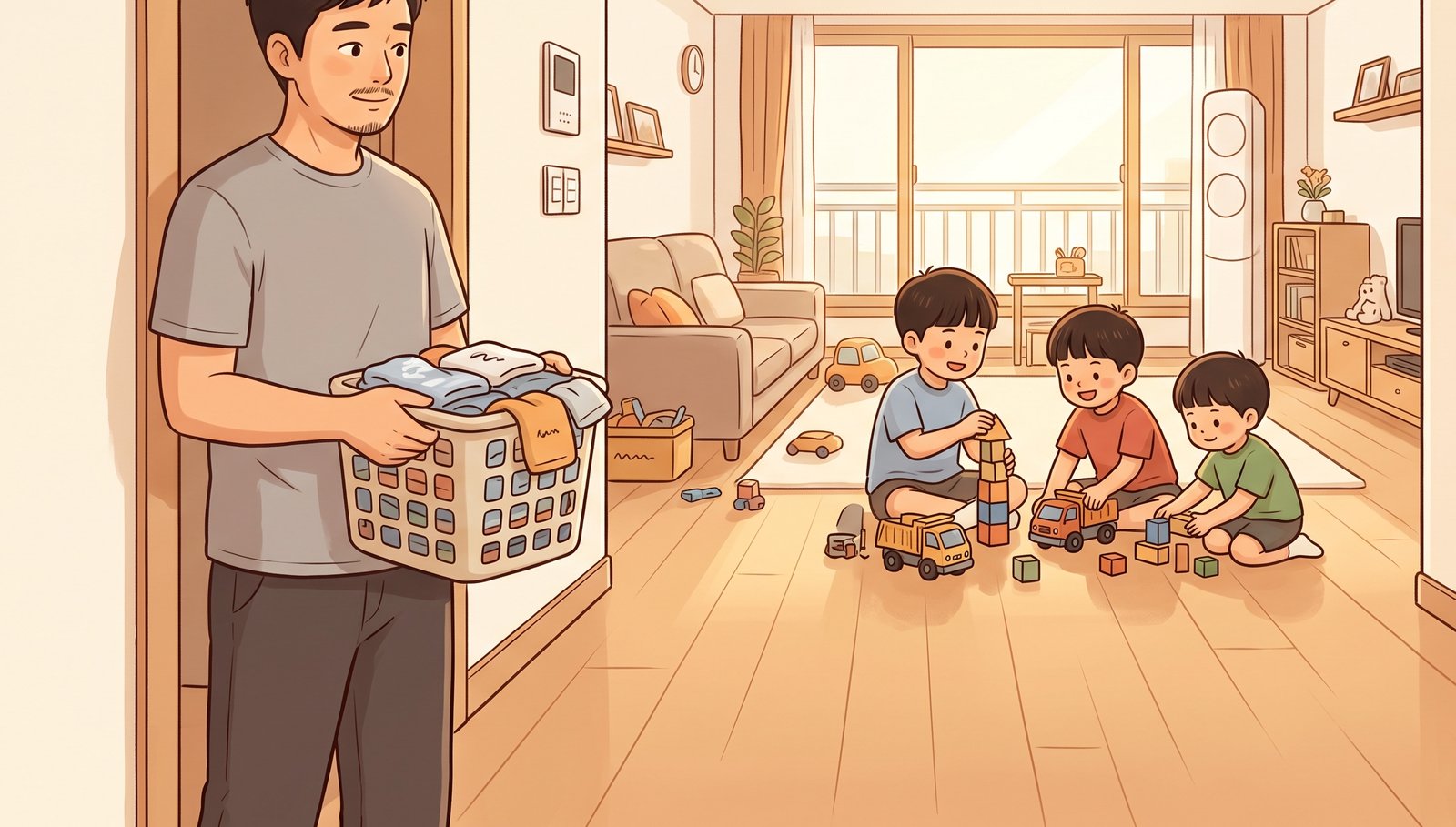
I was standing in our apartment hallway, holding a half-folded pile of small laundry, when I learned that my best friend had died. It was the brutal, agonizing conclusion of a long battle with severe depression and schizophrenia.
In the living room ten feet away, our home was loud. Number 1 and Number 2 were engaged in a high-stakes turf war over a plastic construction crane, and toddler Number 3 was industriously trying to climb onto the coffee table. The television was humming. The washing machine was chiming its cheerful little electronic melody from the utility closet.
I hung up the phone, set the laundry basket on the floor, and looked at my three sons.
In that moment, I realized the peculiar and unforgiving arithmetic of grief and fatherhood.
When tragedy strikes an unencumbered man, he can pull over to the side of the road. He can take a week off work, darken his bedroom, turn his phone face down, and let the sorrow wash over him until the tide recedes. A father of three young boys has no such luxury. The oatmeal on the stove will still burn if you walk away from it. The diapers still need changing. The three-year-old who skinned his knee still needs someone to blow on the scrape and swear it will be fine.
I didn’t know what to feel that afternoon. More accurately, I didn’t have the room to find out.
So I swallowed it. It was mine to carry, and mine alone to handle.
The Luxury of an Immediate Collapse
Modern therapeutic culture loves to talk about processing your emotions in real time. We are told that holding sorrow inside is toxic, that vulnerability is always appropriate, and that true strength means falling apart whenever the wave hits.
That advice is written by people who do not have three children under the age of six demanding lunch.
When you are the roof over a young family, collapsing in the living room is not vulnerability; it is a structural failure. Children do not understand adult mortality, psychiatric agony, or the existential hollow left behind when your closest friend slips out of the world. What a five-year-old understands is terror. When a five-year-old sees his father’s eyes go completely blank with grief, the sky falls in on his small universe.
A father’s primary duty during a crisis is perimeter defense.
You absorb the kinetic energy of the outside world so it doesn’t shatter the glass inside the house. I made a deliberate choice that afternoon: my sons would never experience a collision from my grief. They shouldn’t have to. Their childhood wasn’t the container for my tragedy.
I picked the laundry basket back up. I mediated the crane dispute between Number 1 and Number 2. I made dinner. I put them to bed, prayed over their foreheads, and turned out the light.
And inside my chest, the weight sat down and made itself a permanent home.
Swallowing the Stone: The Mechanics of Delay
There is a difference between denying grief and postponing it.
Denial pretends the loss never happened or that the person didn’t matter. Postponement acknowledges the boulder sitting on your chest, wraps both arms around it, and says: Not now. I have work to do.
For the next two years, that is exactly how I lived. We were in the middle of exhausting church ministry in Korea. We were navigating financial tightropes, preaching schedules, and the relentless physical grinding of early childhood parenting. I wrote before about being a workaholic dad and how easy it is to use activity as armor against your own heart.
In my case, the work was real, but the silence beneath it was heavy.
Whenever the memory of my friend surfaced—his voice, his brilliant mind, the terrifying descent of his illness, the unanswered questions that suicide leaves behind—I locked the door to that room. I didn’t have thirty uninterrupted minutes to fall apart, so I gave it zero.
It was an expensive strategy.
When you swallow an unaddressed loss, you don’t stay completely normal. You lose your emotional bandwidth. You become shorter on patience. You find yourself standing at the kitchen counter staring into an empty coffee mug for ninety seconds, completely untethered from the room, while your kids ask you three times where their shoes are. You don’t explode at them, but you feel like an engine running with low oil.
You are functioning, but the friction is wearing down the parts.
Two Years Later: Finding Room to Grieve
You cannot carry an unexploded shell inside your ribcage forever. Eventually, the casing cracks.
In clinical literature, delayed bereavement is often treated as a pathology—a failure of healthy coping with grief. But for fathers under heavy domestic loads, delay is often the only way the household survives. The danger isn’t the delay; the danger is forgetting to ever unpack the bag.
It took me two full years to finally find the room to mourn.
And I didn’t find that room on my own. My wife made it for me.
She was the only person on earth who had watched me hang up that phone in Korea two years earlier. She had watched me pick up the laundry basket. She knew that behind the calm sermons, the family devotions, and the routine of our days, there was a locked room I never entered.
One evening, after we had transitioned out of full-time pastoral work and were preparing for our eventual move overseas, she sat down across from me. The boys were asleep. The house was finally quiet.
She didn’t give me a speech. She didn’t offer religious platitudes or tell me it was time to “let go.”
She just looked at me and asked a quiet question about him. A simple, ordinary question about a memory we had shared years before he got sick.
And the lock broke.
For the first time in seven hundred days, the father stepped aside and the grieving friend showed up. I sat at our kitchen table and wept with an ugly, shuddering intensity that had been waiting behind my ribs since the afternoon the laundry was half-folded.
My wife didn’t try to fix it. She didn’t hand me a tissue and tell me not to cry. She simply sat there in the dark with me, holding the perimeter, while I finally paid the debt I owed to my brother.
What Grief and Fatherhood Taught Me About Control
When you survive the loss of someone you loved to mental illness, your parenting changes permanently.
It strips away the cheap arrogance that young fathers tend to carry.
Before my friend died, I secretly believed that fatherhood was an engineering problem. I believed that if I provided the right structure, read the right theology, held the right boundaries, and worked hard enough, I could guarantee my sons’ flourishing. I thought good parenting was an equation that yielded predictable results.
Losing my best friend blew that fantasy to pieces.
Mental illness does not care about your pedigree. Depression does not yield to simple pep talks or moral effort. Sometimes the world breaks people who were brilliant, kind, and deeply loved, and there is nothing you can do with your bare hands to stop the bleeding.
That realization terrifies you at first. But once the terror clears, it makes you a much gentler father.
It stops you from treating your sons like small projects to be optimized. When Number 1 struggles with anxiety, or Number 2 melts down over an overwhelming afternoon, I don’t see an annoyance that needs immediate behavioral correction. I see a fragile human soul trying to navigate a world that is heavier than he knows.
It taught me that my job as a father is not to guarantee their happiness—because no man can promise that to his children—but to be an unshakeable presence who will sit on the floor with them when their world goes dark.
The Standard We Protect
My sons are eight, seven, five, and two now. They know their father is a serious man, but they do not know him as a broken one.
They do not know the details of the phone call in Korea. They do not know about the two years of silence, or the night their mother held the kitchen while their father fell apart at the table.
Someday, when they are grown men facing their own crushing phone calls, I will tell them the whole story. I will tell them about my friend, about his brilliant laugh, about the darkness that took him, and about the long road back to daylight.
I will tell them that being a man does not mean you never bleed. It means you choose where and when to bleed so you don’t bleed on the people who depend on you.
Until that day comes, my job remains what it was on that afternoon in the hallway: keep the oatmeal from burning, keep the perimeter secure, and make sure the boys know that the house they live in is safe.