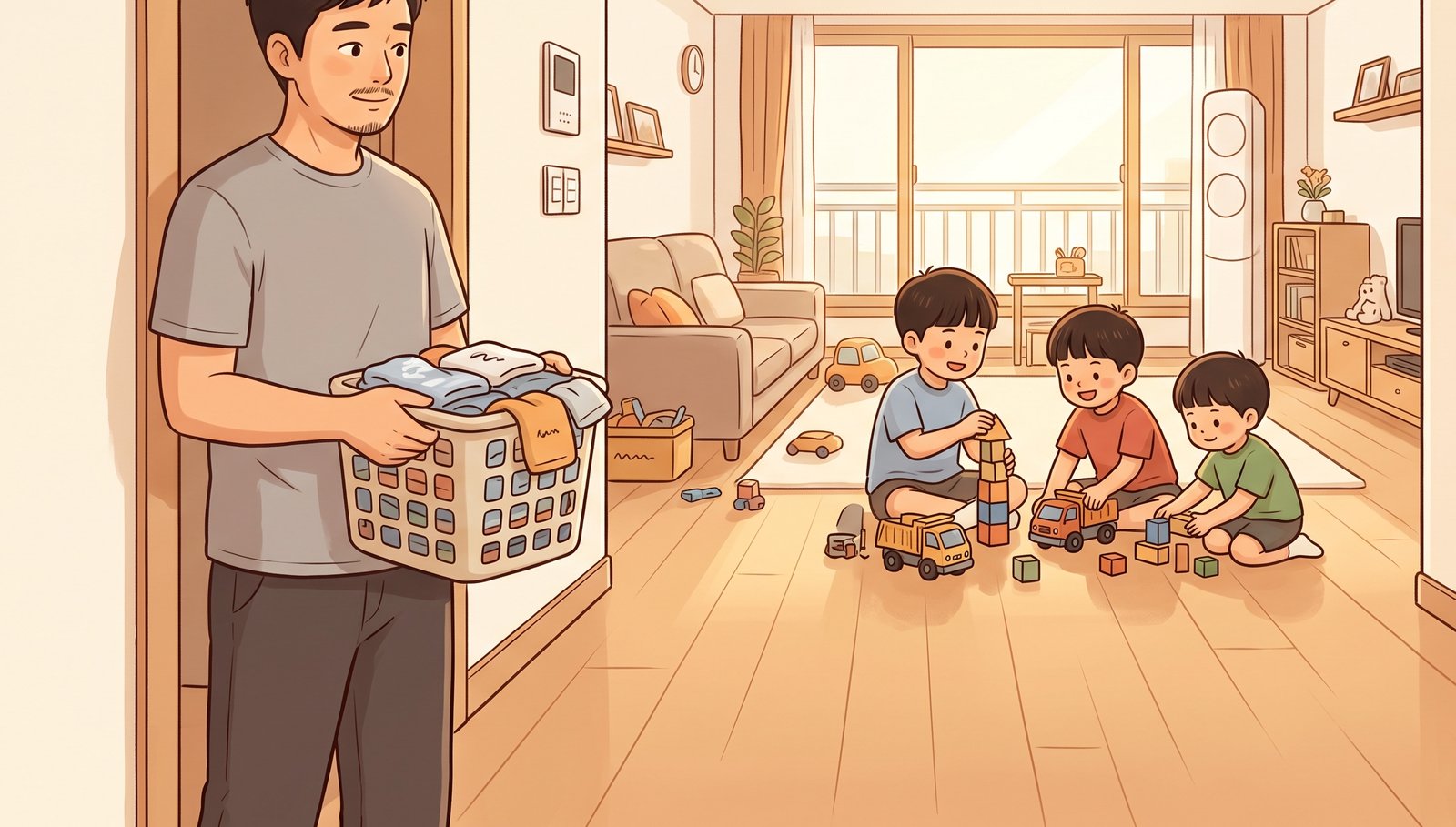
We were leaving for Korea for a few weeks, and my wife’s mother was saying goodbye to the boys the way grandmothers do, one at a time, taking her time about it.
She got to Number 3 and told him she was going to miss him.
He said: “It’s okay. I’ll see you on the phone!”
Then he went to find his shoes.
My boys have two sets of long distance grandparents, and the two are not remotely comparable — one lives twenty minutes away, and the other cannot reach an airport without crossing an international border and losing a day to it. My five-year-old has concluded that this is a distinction without a difference.
He wasn’t being brave about it and he wasn’t brushing her off. He was five, and he was reporting a fact — one he has never had any reason to doubt. For him the phone is not a substitute for a person. The phone is where some of the people are.
I’ve been chewing on that ever since, because our two sets of long distance grandparents are about as different as two sets can be, and my son appears to have concluded that the difference doesn’t matter.
Our Two Sets of Long Distance Grandparents Are Nothing Alike
My wife’s parents have been in Cambodia for about twenty years. They were here long before we were — the ground was already broken when we arrived, which is a large part of why we came to this country at all.
They see the boys weekly. Some weeks more than that. Grandma is not an occasion in this family; she’s part of the week.
My parents are in Ukraine.
My father is still working there, and has been through all of it. When he needs to fly out — for medical appointments, for school board obligations, for the ordinary administrative business of a life that happens to be lived in a war zone — there is no question of driving to an airport, because Ukraine’s civilian airspace has been shut since 2022. The nearest working one is in another country.
So the trip looks like this. Drive to Poland. Leave the car somewhere it will still be there when you come back. Fly out, with a night somewhere in the middle. Then do the whole thing again in reverse, however many weeks later.
Sixteen hours to get out of the country — and here is the part I had wrong for a long time. Almost none of that is the road.
It Isn’t the Distance. It’s the Processing.
Last October my grandfather died.
My parents came, because of course they came. It took them two days to get here.
Not two days of grieving-and-then-travelling. Two days of travelling — the drive, the border, the queue at the border, the paperwork at the border, parking the car in a foreign country, the flight, the overnight, the next flight.
The hours are not a measure of how far away they live. They’re a measure of how many checkpoints, queues and handovers sit between them and a departure gate. A family that lived twice as far from the same border would get there faster.
A death starts a clock. For them the clock runs through other people’s procedures, and none of those procedures care that there’s a funeral at the end of it.
They made it. They were there. And the arithmetic of how they got there is not something most families ever have to do.
That is the other kind of distance my children have. Not weekly. Not a video call away in any sense that a logistics problem would recognize. A border between them and a plane, and two days to a funeral.
My Son Is Not Wrong
Here is the thing I keep running into: the five-year-old has a point.
Whatever I think about the difference between those two sets of grandparents, my son has a real relationship with people he mostly sees on a screen, and it does not feel thin to him. He knows their faces. He knows which one will laugh at a joke that isn’t funny. He shows them things. He has no memory of a world where you could only talk to someone who was in the room, so he isn’t grieving a thing he never had.
I grew up with distance too, and it was not like this. Letters from my grandmother that I couldn’t fully read, a phone call that cost money and had to be kept short, and months between them. Distance meant silence with gaps in it.
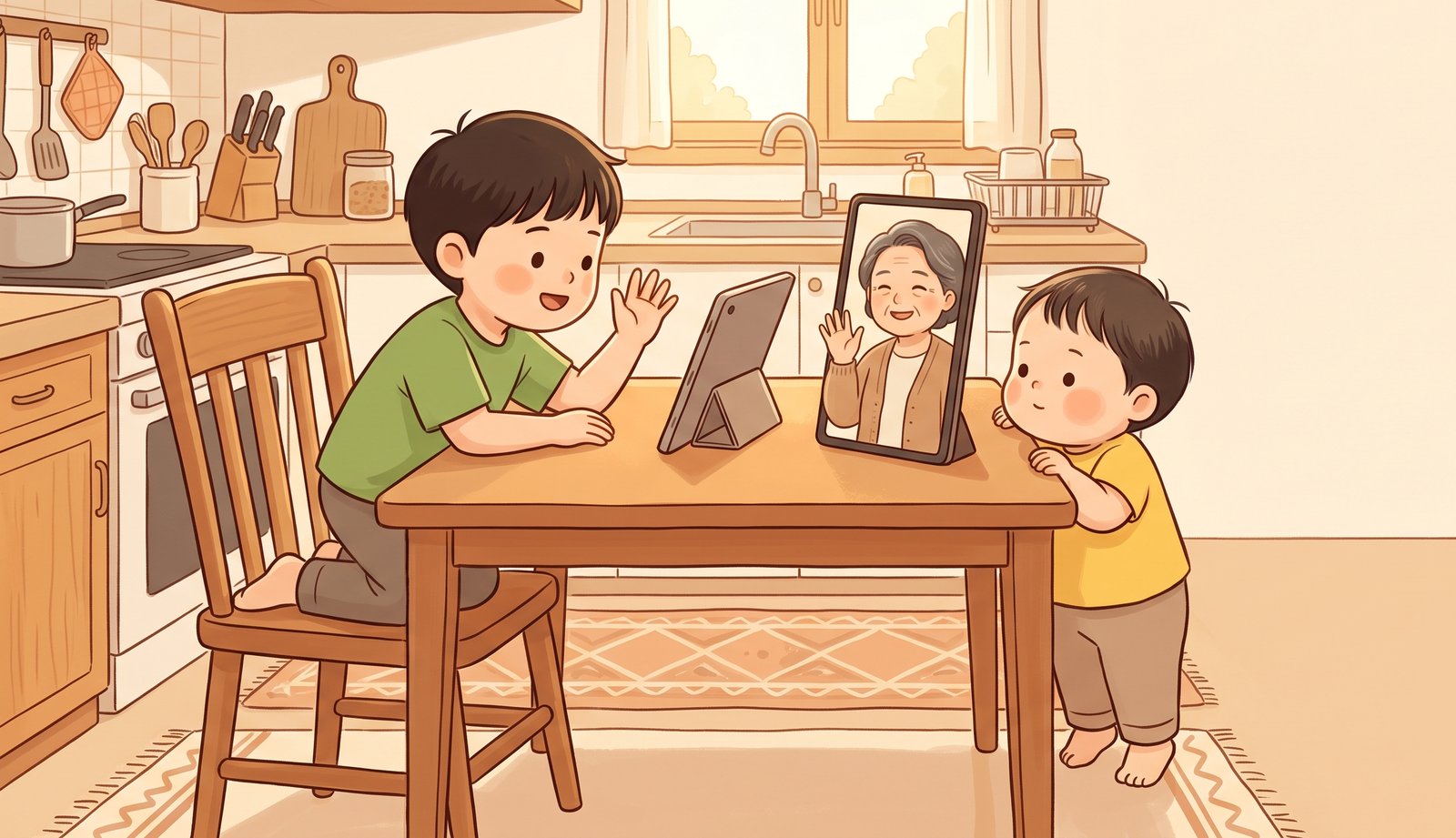
My boys have never experienced that version. For them long distance grandparents means a face that appears on request, in the kitchen, during breakfast.
That is not a lesser relationship. It’s a different one, and I should be careful about mourning on their behalf something they do not experience as a loss.
What the Phone Does Not Carry
And he isn’t entirely right either, which is the other half of this.
The weekly grandmother knows things about my sons that no amount of video calling produces. She knows which one is coming down with something before he says so. She has seen Number 2 in the specific mood that comes forty minutes before it goes badly. She has been in the room for the boring parts, and the boring parts are where most of the knowing happens.
You cannot get that on a call, because a call is always, slightly, an occasion. Everyone is a marginally better version of themselves on a screen. The camera gets the performance. Proximity gets the Tuesday.
There’s a second thing proximity does that I only noticed by watching it happen. A grandparent who is physically present accumulates history with a child in a way that doesn’t require either of them to do anything. They were both just there, repeatedly, and at some point that becomes a relationship nobody had to maintain. A video relationship has to be maintained. Somebody has to decide to make the call, and somebody has to answer, and if a season gets busy on either end the whole thing quietly pauses.
So the two relationships are not interchangeable, and the thing my son can’t see yet is that one of them is being built in a medium that has a ceiling.
The Grandparents Who Stayed at Their Work
I want to be careful here, because there’s a version of this article that makes my parents sound absent, and that is not what’s happening.
They are where they are because the work is there, which is the same sentence that explains why my family lives in Cambodia. My boys are growing up with two sets of grandparents who both chose a country over convenience. That is the family they were born into, and it is not an accident that their own parents did the same thing.
My father spending a day at a border to reach a departure gate is not a man who is far away from his grandchildren. It’s a man who is near something else, and pays the toll every time he leaves.
I don’t expect the boys to understand that for another decade. What I can do is make sure they grow up hearing it stated plainly rather than inferring it from an absence.
What I Actually Do About It
Not much that would look like a system.
We call. Often, and badly — the audio cuts out, the two-year-old walks off mid-sentence, somebody holds the camera at the ceiling for a full minute. I have stopped trying to make these calls go well. A call that goes badly still happened, and the goal is frequency, not quality.
We talk about them when they aren’t on the phone, which turns out to matter more than the calls. A grandparent who only exists during a video call is an event. A grandparent whose name comes up at dinner is a person.
We also let the calls be useless. A grandparent does not need a topic. Some of the best ones have been a boy silently showing a Lego build to a screen for four minutes while the adult makes approving noises, which is exactly what it would look like in a living room.
And we do not dramatize the distance to the children. I know what each of those crossings costs. The boys do not need to carry that at five and seven and nine. They’ll understand the shape of it when they’re older, and in the meantime the useful thing is that their grandparents are ordinary to them.
The Line I Keep Coming Back To
“It’s okay. I’ll see you on the phone.”
That was said to the grandmother who lives twenty minutes away, which is the part I didn’t notice at the time. He wasn’t reaching for the phone because the distance was large. He reached for it because a few weeks in Korea and a border crossing in Eastern Europe are, as far as he can tell, the same category of problem — and both have the same solution.
He will find out that they aren’t. Probably around the time he works out what his grandfather’s two-day journey to that funeral was actually made of.
But I’m not in a hurry to teach him. There’s a window where a child believes the people who love him are all permanently within reach, and that belief is doing real work. He’ll get the arithmetic later.
For now, Grandma is on the phone, and that’s enough, and he goes to find his shoes.