Every parent who’s ever bought building blocks for kids knows the drill: no matter how many boxes you own, it’s never enough. I learned exactly how true that is on the day my two-year-old climbed a kitchen chair to bring down his brother’s proudest creation.
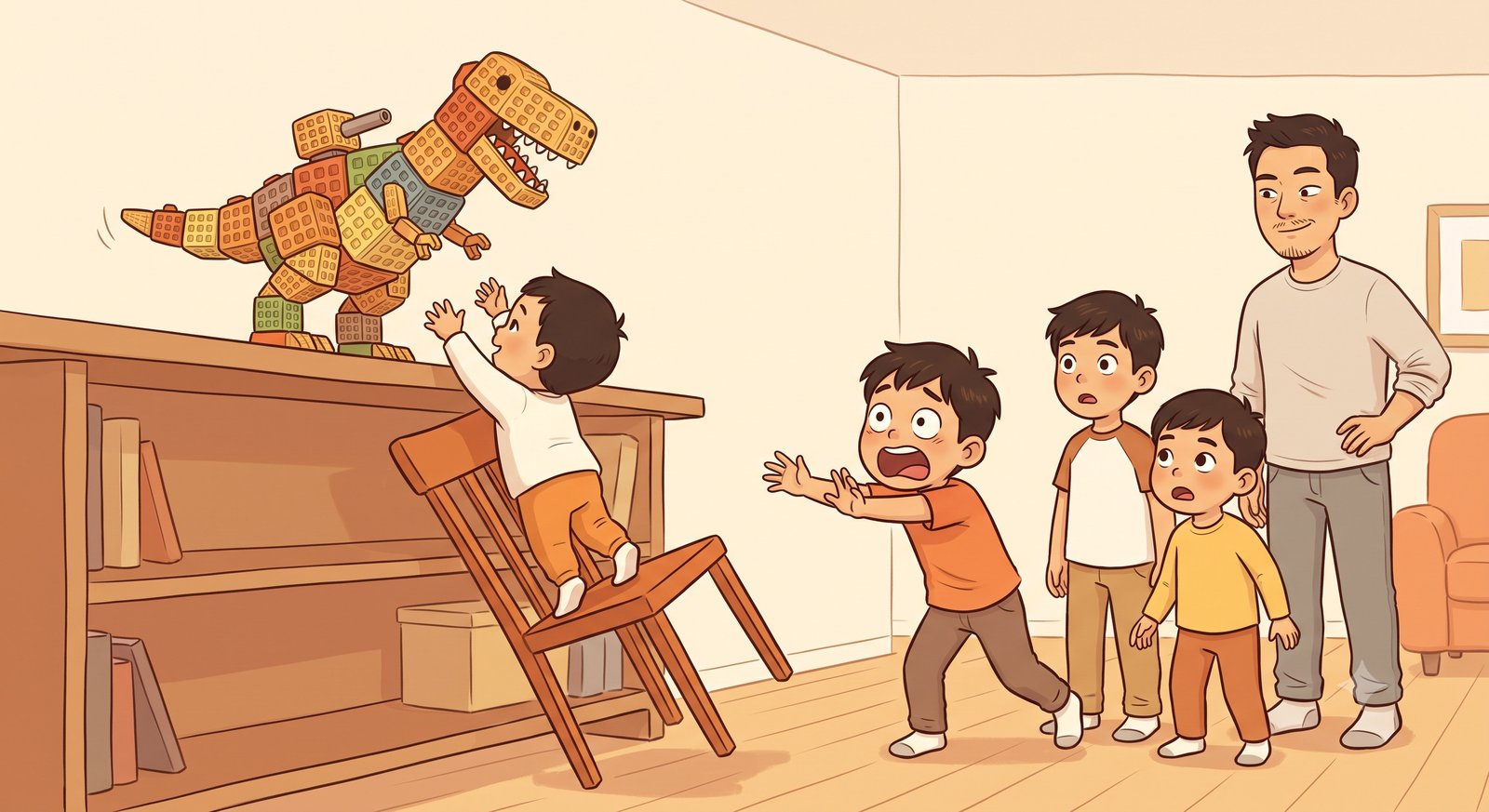
Number 2 spent close to two hours on it. When he finished, it genuinely looked like something out of a cartoon — a tyrannosaurus built entirely from waffle blocks, except this one had blaster cannons mounted on both sides and one more on its back. Three cannons. A Mecha T-Rex, fully armed, and it was easily the most impressive thing any of my boys had built up to that point. He shelved it on the top shelf in the living room, the way you’d display a trophy, and we all went back to whatever we were doing.
A few minutes later, Number 4 started dragging a kitchen chair — all the way from the kitchen to the living room — and climbed it like a ladder until he was standing at the top shelf, both hands wrapped around the Mecha T-Rex.
He made eye contact with Number 2 across the room. I still don’t know if he was surprised he’d been caught, or if some part of him had climbed up there specifically to watch it shatter. Either way — he dropped it.
Number 2 screamed. Not a small scream. A full “NO” that carried through the house, and he was still screaming it as he ran across the room toward the wreckage. Number 4 was already gone — gone like the wind — sprinting for the couch and wedging himself behind it, convinced, apparently, that nobody would think to look there. He looked genuinely terrified when we found him. It was, I’ll admit, very funny.
That’s the highlight reel. It’s also just an ordinary Tuesday in our house, because this happens constantly, in one form or another, and it’s the whole reason we can never seem to have enough building blocks no matter how many boxes we buy.
Why Building Blocks for Kids Are Never Enough
We have a lot of blocks. Boxes and boxes of waffle blocks. Lots and lots of wooden blocks. Two full boxes of MagFormers — the magnetic kind, not cheap, bought with the confidence that surely, finally, this would be enough building blocks for kids who build like ours do.
It is never enough. If you’ve ever wondered why the same open-ended building blocks show up on every kid’s wish list generation after generation, this is why — they’re infinitely reusable, which means the “shortage” is never really about the blocks themselves.
I used to think this was a supply problem. Buy more blocks, solve the shortage. I’ve since learned it isn’t a supply problem at all. It’s a demand problem, and the demand is bottomless, because of one simple rule none of us wrote down but all four of my boys somehow agreed on: every finished build has to sit on a shelf like a trophy.
The Gundam Connection
I understand this rule better than I’d like to admit, because I grew up building the exact same way.
When I was a kid, I built plastic models — Gundam kits, the robot models every boy I knew was obsessed with at some point. You’d spend hours snapping pieces together, and when it was done, it didn’t get boxed back up. It went on the shelf. It sat there as proof: I made this. It stayed until the shelf was full, and then you needed a new shelf.
I actually tried starting Number 1 on his first Gundam kit not long ago. It didn’t go well — the pieces are smaller and more complex than I remembered, and he wasn’t quite ready for them yet. We shelved that attempt too, in a manner of speaking. I’m hoping to try again next year, once his hands and his patience have both caught up.
In the meantime, his generation builds the same instinct out of different material. Finish something, and it doesn’t get broken down for the next build. It goes on display. Which means every new project needs its own fresh pile of blocks, because the last pile is now a museum exhibit and museum exhibits are not for touching.
Four boys, four museums, one shrinking supply of blocks. That’s the actual math behind why we’re always short.
The Professionals
Here’s where it gets interesting, though — because the shortage isn’t really the story. What the blocks revealed was something about how creativity moves between siblings.
Number 2 is our dinosaur professional. The Mecha T-Rex was his masterpiece so far, but it didn’t come from nowhere — he’s been building dinosaurs out of these blocks for a while now, and each one has been more ambitious than the last. This one just happened to level up into a dinosaur-robot hybrid, cannons and all.
Number 3 picked a different lane entirely: robots. Not because anyone assigned it to him — because dinosaurs were already taken, and he needed his own trophy, his own thing to be known for.
Number 1, the oldest, never picked one specialty. He builds everything else — trains, houses, whatever the day calls for. He’s the generalist, and somehow that fits him exactly the way dinosaurs fit Number 2 and robots fit Number 3. Maybe that’s also why the Gundam kit didn’t click yet — a generalist needs the freedom to build whatever’s in his head that day, not follow somebody else’s instruction booklet.
One brother’s masterpiece never just sits there being admired. It becomes a blueprint, a challenge, an invitation the others couldn’t turn down. Somebody makes something new, and suddenly everybody wants to be part of what’s next. (We’ve written before about how this kind of creative play unfolds in our house — blocks are just the version with the highest body count.)
The Demolitioner
And then there’s Number 4.
Number 4 does not build. Number 4 destroys. He is, without question, the most efficient force of chaos in this house — the toddler who will drag a kitchen chair across two rooms and climb a shelf just to get his hands on somebody else’s two hours of work.
His brothers are not thrilled about this. I understand why. The Mecha T-Rex is gone. Hours of concentration, gone in the second it took to fall.
But here’s what I’ve noticed, watching this happen over and over: the demolition isn’t just a loss. It’s a reset. Once the Mecha T-Rex was gone, Number 2 didn’t have a model sitting on the shelf to copy anymore. If he wants another one, he has to build it from memory — and a dinosaur rebuilt from memory instead of copied from a standing model is never quite the same dinosaur. It’s a different one. Usually a better one, because he’s had practice now and he’s not just recreating. He’s improving.
The old one is gone. There’s nothing left to mimic. So it has to be something new.
Why Nothing New Feels New Anymore
Watching these four cycle through building and losing and rebuilding got me thinking about something bigger than blocks.
We live in a world completely obsessed with new. New ideas, new content, new products, new everything — and the moment something genuinely creative or intuitive shows up, everyone wants to be part of it. That’s not a modern flaw. I think it’s wired into us. It’s in the human genome the same way it’s apparently in my sons’ genome: somebody makes a Mecha T-Rex, and now everyone needs to be a professional at something too.
But intuition and real creativity aren’t things that show up on command. They don’t arrive every day. And the more of life you’ve experienced, the harder genuine newness is to come by — because you’ve already seen so many versions of new that very little actually surprises you anymore.
I’m a millennial dad. I got to live through both worlds — the analog one and the digital one. I remember when new meant a plastic model kit and a free afternoon. My boys were born entirely inside the digital world; for them, sometimes it’s the old analog stuff that actually feels new. The physical block in your hand, the toy with no screen and no app, the thing you have to build with nothing but your own hands and whatever’s already inspired you.
So now I bring them my old stuff on purpose — old games, old toys, the analog things that shaped me — and drop them into their fast, digital lives. And it works. They slow down. They get curious. Something that’s decades old to me is brand new to them, and for a little while, everyone at the table has found something genuinely new again.
What the Shortage Actually Taught Me
We are never going to have enough building blocks for kids in this house, and at this point I’ve stopped trying to fix that. The shortage isn’t the problem. The shortage is the whole system working exactly as it should.
One boy creates something and it becomes a trophy. The trophy inspires the others to become professionals in their own right. And when Number 4 tears it all down — which he will, without fail, without warning, chair-dragging and all — nobody gets to coast on the old blueprint. Everybody starts over. Everybody has to be creative again, for real this time, instead of just rebuilding what already worked.
I used to think starting over was the demolition’s cost. The longer I watch these four, the more I think it’s the demolition’s gift.
Because once you’ve lived a little, you learn that starting something new was rarely ever optional in the first place. Somebody — a toddler, a season of life, circumstance — is going to knock the shelf down eventually. The only real question is what you build next, once the blueprint is gone and it’s just you and the blocks again.
Sometimes the thing that feels like it broke you is the thing your kids genuinely needed to see happen. Not because it didn’t hurt. Because watching you start over anyway is its own kind of lesson — one no instruction booklet can teach them.