
Category: Productivity & Systems

  • Money Lessons for Kids: Why My 4 Boys Don’t Get Allowance (Yet)

    Money Lessons for Kids: Why My 4 Boys Don’t Get Allowance (Yet)

    Money lessons for kids come up early for every dad of four boys — ages nine down to two, growing up here in Battambang, Cambodia — because eventually you get asked the money question: do the kids get an allowance? The honest answer is no, not yet. Not because we can’t afford it, but because we haven’t needed to. Their living expenses are covered. What they need right now isn’t cash sitting in a drawer — it’s understanding what money actually is and does, before we hand any of it over.

    Money Lessons for Kids Before the Cash

    Instead of allowance, we give them missions. A mission is simple: walk into the shop, buy the snacks or the bottled water, hand over the bill, count the change. That’s it. There’s no rigid system behind it, honestly — just teaching them to be smart with what’s in front of them, one trip to the shop at a time. They’re the ones doing the math, the ones learning that money runs out if you’re not paying attention to it.

    Why We’re Waiting Until Sixth Grade

    We’re planning to start real allowance once the oldest hits sixth grade. I picked that age specifically because that’s usually when money stops being optional and starts being expected. Before sixth grade, allowance is a nice-to-have. After it, there are more social events, more friends, more hangouts — the kind of things you can’t really opt out of without your kid feeling left out. That’s the point where money stops being a lesson and starts being a real need. When we do start, I’m thinking $10 a week, maybe $20 a month. That sounds generous until you do the math on where we live. This is Battambang — a small pack of Oreos, six pieces, runs about 1,000 riel, roughly 25 cents. Twenty dollars is eighty packs of Oreos. I already feel like I’m being too generous, and that’s before I mention that if we lived in Phnom Penh instead, the number would have to at least double to $50 a month, because everything there costs more.

    Privilege, Not Payment

    Even without a set allowance, their privileges are tied to chores and behavior. But it’s not a strict pay-for-work system either — some of it is unconditional, because they’re my sons. Until they move out or grow up, supporting them is my job, not something they have to re-earn every day.

    Where the Money Actually Goes

    There isn’t much to spend on here besides snacks, drinks, and the occasional trip to a kids’ cafe. Kids cafes are still fairly new around here — they used to only exist in Phnom Penh, but a few have made their way to Battambang recently. At least a few times a month, the boys get the choice of going to one instead of playing at home again. Once we’re there, all four of them disappear into the ball pool, the slides, the little play houses. They play hide and seek in there, they run their own little detective games, making up situations out of nothing. It’s one of the few places here that gives them something different to do, and one of the few things their saved-up money actually gets spent on. When they get money as a gift — from friends or grandparents — we put it straight into savings instead of letting it disappear on snacks within the week. That way, when we travel to Korea, they land with real money waiting for them, enough to actually buy something they want: a toy, or a game for the Nintendo.

    The Grandparent Problem

    Korea trips come with a complication: grandparents who want to buy gifts. When it was just two boys, Number Two wanted whatever Number One got — a predictable pattern. Now, with four boys, the pattern has broken down completely. Number Two wants what he wants. Number Three gets what he wants. Number Four wants everything. He’ll ask for the same dinosaur as Number One, the same robot as Number Two, the same Police Hero toy as Number Three — option (d), all of the above. That doesn’t happen. Ever. And when he tries his best kitten eyes on the grandparents, my wife and I step in before they cave.

    Who’s in Charge

    Right now, I manage all of it — savings, investments, everything. The goal is for each of them to have at least $10,000 saved by the time they’re adults, a real starting point instead of nothing. Until they’re old enough to take that over themselves, it’s on me.

    What My Mother Taught Me About Money

    I’ll be honest — there’s a part of the older generation of Korean missionaries and pastors I question, at least on this one point. There’s a financial philosophy running through a lot of the Korean Christian church that treats holding onto money — money not immediately spent on missions or ministry — as something close to wrong. That was the atmosphere I grew up around, especially in the more conservative, traditional churches. I don’t think it’s really about sin, though. I think it’s more about a lack of financial understanding than actual doctrine. The Bible is full of financial wisdom, more than people give it credit for — if you actually read into it, there’s enough in there to manage money well and still be faithful.

    My mother is the one who helped me see that. She knew the churches around us wouldn’t approve of saving in any real sense, but she explained the biblical case for it in a way that let me think a step further than what I was hearing on Sundays. Once I started getting allowance as a kid, I saved almost all of it toward my first camera, a Canon 450D. It took two years of snack money, and I made sure not to touch a cent of it. Even with all that effort, I still came up short, and that’s where my dad stepped in and chipped in the rest. I bought the camera, and I’ve been shooting ever since. I still love cameras enough that if I had a few thousand dollars sitting around, I’d buy two — one for ministry, one just for myself.

    What Faith Has to Do With It

    That same mix of faith and practicality is what I’m trying to pass down now. We come from a family of pastors and missionaries, and growing up, there wasn’t much of a financial philosophy beyond “God will provide.” I still believe that. But I also believe God gave us the knowledge and wisdom to be smart, to invest, to prepare — and that using it is part of being responsible and faithful, not separate from it. Faith in provision doesn’t only look like ravens bringing food to Elijah. Sometimes it looks like being a tentmaker. Or a carpenter.

    Number Four Already Knows Enough

    Number Four doesn’t understand money yet, not really. But he understands exactly what it’s for. He’s taken to grabbing Grandpa’s wallet and announcing, “Let’s go to the mart” — like it’s going to become a daily routine now. It’s not funny anymore, mostly because he means it. When I say no, he doesn’t argue with me. He just goes and finds Grandpa instead.

    Money Lessons Are Just Another Piece of the System

    This isn’t really about money. It’s the same project as everything else in this house: raising boys who grow into responsible, respectable men. The Chore System teaches them that work has value. The Discipline System teaches them that boundaries hold even when it’s inconvenient. Money is just the next lesson in that same line — that what you have doesn’t appear out of nowhere, and that patience now buys something better later. Whether it’s a camera, a bag of Legos, or eighty packs of Oreos, the lesson is the same either way.

  • Screen Time Rules That Actually Work: Our Gatekeeper System

    Screen Time Rules That Actually Work: Our Gatekeeper System

    Every parent I know is fighting the same war: the screen. And most screen time rules for kids fail for the same reason — the whining, the negotiating, and the meltdowns wear the parents down first. And most of the advice out there swings between two useless extremes — ban everything and raise your kids in 1854, or give up and let the tablet babysit.

    We did neither. We have four boys, ages nine to two, and screens in our house cause almost zero fights. Not because our kids are special — believe me — but because of a system we call the Gatekeeper Rule.

    Here’s the whole philosophy in one line: screen time is a blessing and a curse at the same time. Controlled, it’s a blessing. But the moment Mom and Dad go weak, it turns into a curse — because kids will abuse any privilege that isn’t guarded. Watching content isn’t the problem. I enjoy watching content myself. The problem is screens without rules.

    So we built rules. Real ones, with teeth.

    Screen Time Rule One: No Weekday Screens. None.

    Monday through Friday, there are no screens for the kids. No TV, no tablets, nothing. Zero.

    I know how extreme that sounds. But here’s what it does: it removes the single biggest source of daily negotiation from our house. There’s no “can I watch something after homework?” because the answer is structurally, permanently no — not because Dad is in a mood, but because it’s simply not a weekday thing. Kids stop asking for things that are never on the table. That alone eliminated most of our screen fights.

    (Friday night is the exception — that’s family movie night, which we control and watch together, and even the movie ends before 8:30 bedtime. The system bends for family time, never for solo screen time.)

    Fun Day: Structured Freedom

    Saturday is Fun Day — the day the boys get their screens. But even Fun Day has architecture:

    TV content happens in the morning. Gaming happens in the afternoon, after lunch. Never the reverse, never both at once. Splitting the windows means no single screen marathon, and the built-in break at lunch resets everyone’s brains before the Switch comes out.

    And here’s the part that makes the whole thing run — the Gatekeeper Rule itself:

    Every screen window is unlocked by a chore, and each brother holds a different gate.

    – Morning: Number 3 does the breakfast dishes. No dishes — nobody watches TV.

    – Lunch: Number 2 does the lunch dishes. No dishes — no gaming for anyone.

    – Evening: Number 1 does the dinner dishes. No dishes — next Saturday is at risk.

    Notice what this structure does. It’s not “do your chore, get your reward.” It’s “do your chore, or everyone loses the privilege.” Each boy is the gatekeeper for his brothers’ fun. They’re a team — if one fails, the consequences come together. The peer pressure runs itself: I’ve watched Number 2 remind Number 3 about the dishes with an urgency I could never generate as a parent. They police each other, because they’re all invested in the gate opening.

    And when a gatekeeper is genuinely sick on his day? Then it’s the parent’s duty to take over his gate — no penalty, no drama. We get sick sometimes, and sometimes we have to ask for a sick day; it’s the same for kids. Even that teaches them how the system society runs on actually works, on a minor scale: real teams cover for a teammate who’s down. What doesn’t fly is a mysterious illness that arrives at dish time and departs by TV time — Dad has seen that particular virus before.

    The Freeloader Clause

    Sharp-eyed readers will notice Number 4, our two-year-old, holds no gate. His brothers have noticed too. Yes — he’s a freeloader. He gets to watch without any chore responsibilities, and the older three have made peace with it.

    Here’s how we explain it to them: everyone in this house has the responsibility to do what they’re able to learn. For the older boys, that’s dishes, cleaning the room, picking up toys. For Number 4, it’s getting off the diapers, learning to use the toilet, learning to brush his own teeth. It’s the same rule — just different wordings for different ages.

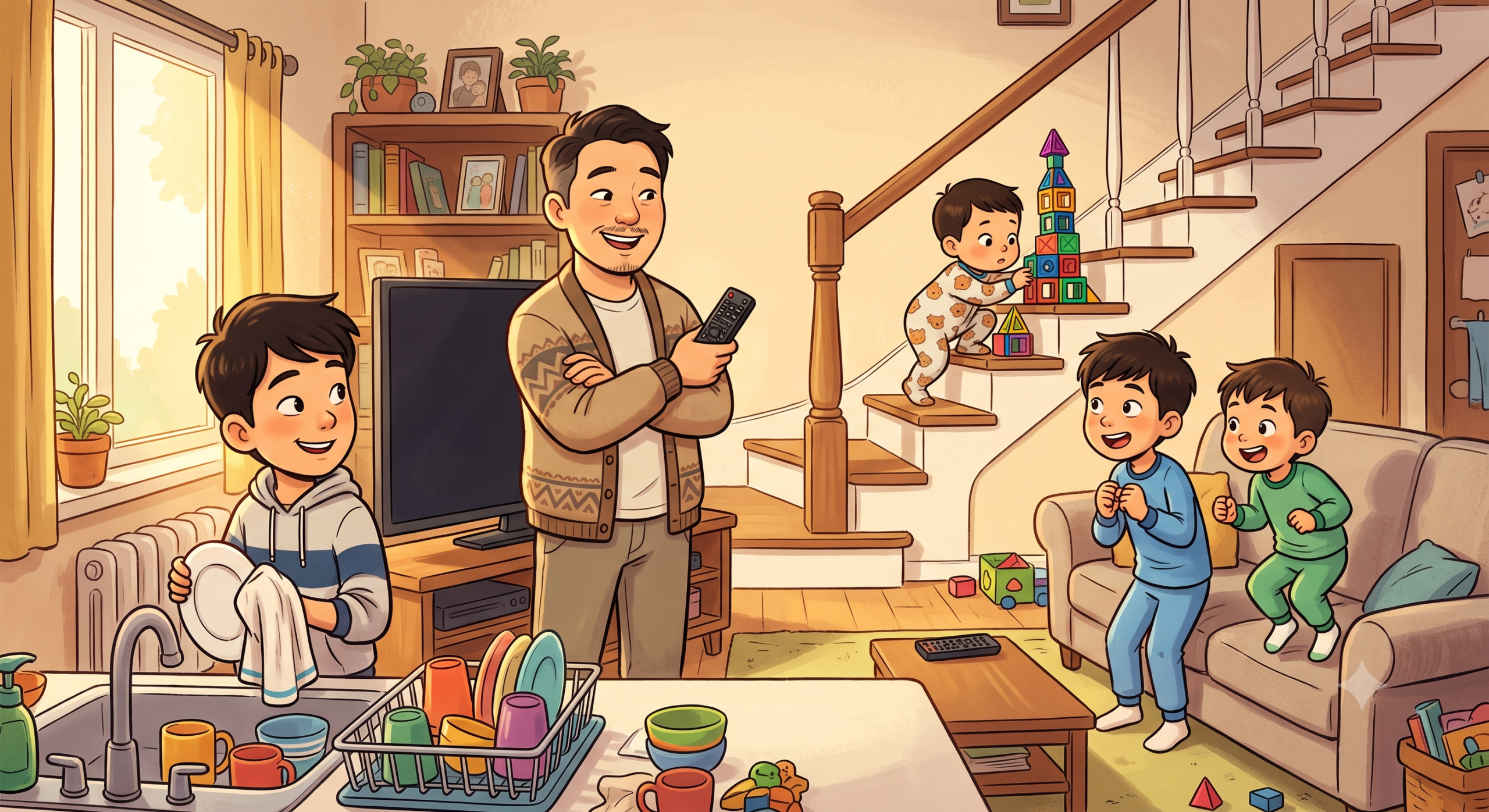
    He’s in what we call his internship phase anyway: watching his brothers do the dishes and pick up toys, sometimes following along, sometimes fighting for his playtime instead — he’s two, that’s the job description. And honestly, his screen appetite is small. The mission videos his brothers love bore him; he’s a dinosaur-content man. Most of the time he skips the screen entirely in favor of his magnetic blocks, which he attaches to every metal surface in the house, including the entire staircase railing. More cleanup work for me. The internship continues.

    What About Sunday?

    Sunday runs on a different engine entirely, and I’ll be upfront about why: I’m a pastor and a missionary, and church isn’t an option in our family — it’s who we are. Service starts at 9am, and between worship, sermon, fellowship, and lunch, we’re usually home around 1pm. The boys genuinely enjoy it; they’ve got local friends there, and Grandma and Grandpa too.

    Screen-wise, Sunday afternoon is the loosest part of our whole week — deliberately so. Sometimes there’s screen time, and when there is, it’s afternoon-only and usually educational or faith-based content, nothing far off topic. Sometimes there’s no screen time at all, because we’re at the park as a family or over at the grandparents’ neighborhood instead.

    That flexibility is on purpose. Saturday is the structured screen day with gates and rules; Sunday is family-first, and screens only fill whatever space the day leaves over. Two different days, two different jobs.

    The Ban That Made It Real

    Rules only work if kids believe the consequences. Ours do, because of the month-long ban.

    A while back, the rules got broken badly enough that their favorite content — the Roblox and Minecraft mission videos — went away for an entire month. Not a weekend. A month. And I kept my word for all thirty days of it.

    That ban is now load-bearing family history. The kids know that whatever Dad says will actually happen. So they do their best to finish their jobs — not because they fear me, but because they’ve learned that my words and reality match. If you take one thing from this article, take that: one fully-enforced consequence is worth a hundred threatened ones.

    The Filter: A 90s Standard of Appropriate

    People always ask what we actually let them watch. Our filter is simple: nothing that conflicts with our family’s values and faith, nothing occult, nothing horror. (That last one is non-negotiable in our house — our Number 2 still has hard nights because of horror clips someone showed the kids at school. That’s a bedtime story for another article.)

    Beyond that? My standard is what I call the 90s standard of appropriate: if it would’ve been considered fine for kids in the 90s, it’s fine for mine.

    Yes, that includes Tom and Jerry. I’m aware that by modern sensibilities, Tom and Jerry is a shockingly violent program about a cat being repeatedly flattened by household objects. I grew up on it. I turned out fine. Some of the shows I loved would probably get flagged by every modern content committee for one reason or another — and yet my generation somehow survived cartoon anvils.

    What the boys actually watch on a Fun Day morning: Tom and Jerry, the Roblox and Minecraft mission videos, Bear Grylls’ survival series, and — their current obsession — Korean documentary channels about insects and wildlife. Real footage, real lab tests, real facts. It’s Magic School Bus without the magic, and the boys throw facts at us that we genuinely didn’t know. We also steer them toward Numberblocks, Alphablocks, and a Korean children’s channel that teaches the language. The house rule of thumb: we don’t want a diet of pure cartoons and gaming content. Educational content isn’t the vegetable they’re forced to eat — we’ve made it the thing they actually request.

    The Co-Watching Rule: Harry Potter and the Questions That Never Stopped

    Here’s the last layer, and honestly my favorite one: if it’s above their age grade, they don’t watch it alone. They watch it with me.

    Number 1 wanted to watch the Harry Potter movies. And to a nine-year-old, the first film is genuinely dark — a boy loses his parents, grows up an orphan with relatives who despise him, and then there are trolls, a three-headed dog, a dark lord with no nose. Intriguing, fun, and a little scary. He wanted the company.

    Now, there are two kinds of movie watchers in this world: watchers and askers. My son is an asker. He asks every question, during the movie, the moment it forms — because he needs to know. He takes after his mom, and I’ll confess that back when we were dating, the mid-movie interrogation was the one part of movie dates I didn’t love. God has a sense of humor: He gave me a son with the same feature.

    But this time, the questions were the whole point. It was his movie choice, and it was my job to walk him through the whys, the hows, and the what-ifs. Why is Voldemort evil? Why are people mean? Why would anyone attack Harry and his friends?

    And that opened the conversation I actually wanted to have: this world isn’t just rainbows and butterflies. There is evil in it — evil that will sometimes come at you for no reason — and pretending otherwise doesn’t protect kids, it just leaves them unprepared. A lot of content today teaches that nobody’s really a bad guy, just a good guy who made accidental bad choices. I think different. Evil exists. And so does good: people with kindness, humility, and love, who will stand up and fight for what’s right. Those are the people you keep close — the way Harry kept Ron and Hermione close.

    My son got all of that from a movie night with his dad. That’s what co-watching buys you: the screen stops being a babysitter and becomes a classroom where Dad is in the room to explain the hard parts. Some content isn’t “too old” for your kid — it’s too old for your kid alone.

    Our Screen Time Rules for Kids, in One Paragraph

    Our screen time rules for kids are simple: no screens on weekdays, ever — so there’s nothing to negotiate. Friday movie night together. Saturday is Fun Day: TV in the morning, gaming after lunch, and every window is unlocked by a brother’s chore, so the boys enforce the system on each other — and a parent covers the gate of a genuinely sick gatekeeper, the way any real team covers a teammate. Sunday is family-first — church, grandparents, sometimes a park — with screens only filling the leftover space, if any. The toddler freeloads, as is his birthright, until his internship ends. Content passes a values filter and a 90s standard of appropriate. Anything above their grade gets watched with Dad. And every consequence that gets spoken gets executed — ask the boys about the month with no mission videos.

    Screens didn’t get less fun at our house. They got predictable. And it turns out that’s what kids actually wanted all along: not unlimited screens, but a clear, unmovable answer to when, what, and how — so they can stop lobbying and just enjoy the Saturday they earned.

    The gate opens every week. They just have to open it themselves.

  • The Chore System That Finally Got Our Kids to Help Without a Fight

    The Chore System That Finally Got Our Kids to Help Without a Fight

    Finding a chore chart for kids that works feels impossible — until you stop trying to reason with a parliament and start running a benevolent dictatorship.

    If you’ve ever asked a child to pick up their toys and received a fully prepared courtroom defense in return, welcome. You’re among friends here.

    For years, our house ran on what I call manual gear. That’s the control concept where you believe — genuinely, adorably believe — that you can simply tell your kids what to do and they’ll do it. Chores, favors, basic human cooperation. You give the command, they execute. That’s the theory.

    The reality? Kids have minds of their own. They don’t rebel with pitchforks. They rebel with debate. They’d rather negotiate the terms of picking up one Lego than actually pick up the Lego. And with four boys in the house, I wasn’t running a household. I was running a parliament where nobody had been elected and everybody had opinions.

    So we changed the system. And I’m going to tell you exactly how — including the part where I had to use what I can only describe as “good manipulation.”

    Our House Is Not a Democracy

    Let me say the thing out loud that most parenting blogs won’t: our house is not a democracy. It’s a dictatorship.

    Before you close the tab — hear me out. A benevolent one. I show the example first, and the boys follow. Rules are rules. Chores are not a choice. When I say the toys get cleared before bed, the toys get cleared before bed. There’s no vote. There’s no committee. There is Dad.

    And for Numbers 1, 2, and 3, this works beautifully. Number 1 is our Captain America — nine years old, rule-follower, soft heart. You give him a system and he practically salutes. Number 2 is Thor: full power, no filter, immediate regret. He’ll protest loudly, then comply, then feel bad about the protest. Number 3 is Spider-Man, our five-year-old peacemaker who’s rarely the problem and often the solution. When Numbers 1 and 2 argue about whose turn it is to water the dog, Number 3 will sometimes just do it himself — not because he was told to, but because fighting about it seemed like more effort than the chore.

    But Number 4? Number 4 is two years old, pure chaos, and here’s the thing about him: he doesn’t want to live under the dictatorship.

    He wants to be the dictator.

    The Robot Dinosaur Coup

    Every regime faces a coup eventually. Ours came in the form of a robot dinosaur.

    Number 4 seized Number 2’s favorite robot dinosaur and declared it his own. Not borrowed. Not shared. His. Full annexation. And he was not giving it back — not for anything.

    I tried the standard dictatorship move first. A firm NO. A direct command: return the dinosaur to your brother. This works on the older three every time.

    It bounced off Number 4 like rain off a window.

    So I switched systems. If dictatorship was stalling, it was time for a little socialism. What’s yours is ours. What’s ours is his. Everything is for sharing — which sounds lovely until you realize sharing cuts both ways.

    I crouched down and asked him, “Whose toy is this?”

    “Mine.”

    “No. It’s Number 2’s.” I said it right in front of Number 2, on purpose. The owner needed to hear Dad acknowledge the ownership just as much as the thief needed the correction.

    “Did you ask Number 2 for the toy?”

    “…No.”

    There it was. So I laid out the new terms: “You took Number 2’s toy without asking, right?”

    “Yes.”

    “Then you need to give what’s yours to Number 2. That’s only fair. If you keep being stubborn, I will give your toys to Number 2 — because you took his.”

    And for the first time in the entire standoff, Number 4 stalled. You could see the tiny gears turning. His toys? Going to Number 2? The math was suddenly not in his favor.

    In the end, he asked — actually asked — if he could play with the dinosaur. Number 2 lent it to him, kept it in Number 4’s hands until the little guy got bored, and got it back without a single scream. The dictatorship held. It just needed a policy update for one very specific citizen.

    The Chore Blueprint: Evening Tasks, First Floor Only

    Here’s what our actual system looks like, because the philosophy is fun but the blueprint is what you came for.

    Everything happens in the evening, on the first floor. We deliberately have no morning chores. Mornings are for a relaxed start — nobody should begin their day being nagged about toys. Instead, before bed, the boys handle their zone:

    – Clear all toys off the floor

    – Shelve their books

    – Give the puppy fresh water

    – Do their own dishes at least once a week

    That’s it. It’s not an elaborate chart with fifty stickers. It’s a small, repeatable set of tasks that protects the one thing every parent wants: a peaceful morning.

    And I want to be clear about the word “required.” These aren’t suggestions. I demonstrate everything myself — the dictator works too — and the boys are expected to follow at least to the bare minimum.

    The Gatekeeper Rule: No Chores, No Screen Time

    Every system needs an enforcement mechanism, and ours is simple: no chores, no screen time.

    Screen time in our house is already rare and scheduled. Friday night is movie night. Saturday is Fun Day — Switch 2 and their favorite (heavily filtered) content. Sunday follows the same weekend rhythm. That’s it. No weekday screens at all.

    Which means those weekend privileges are precious. And precious things make excellent leverage.

    We’ve pulled the trigger on this, too. We have a strict rule about verbal fighting — debating is fine, screaming at each other is not. Words can be as violent as fists. One week, the older boys got into a full shouting match and got caught. That Saturday, their favorite YouTube gaming content — the Roblox and Minecraft mission videos they love — was off the table.

    They once lost that show for an entire month. Believe me, they learned their lesson. Well — up until the lesson wore off, which is a topic for another article. But the point stands: the consequences are real, the boys know it, and the system enforces itself far better than my voice ever did.

    Number 4’s Internship

    A quick word on age boundaries, because I know someone’s asking, “You make your two-year-old do dishes?”

    No. Numbers 1, 2, and 3 are active participants in the system. Number 4 is in what we call his internship phase. His chores are: growing up, learning to use the potty, and watching his older brothers work. That’s the whole job description.

    What he actually does is undo. Number 1 stacks the books neatly — Number 4 unstacks them. Number 3 puts the toys on the shelf — Number 4 pulls three back off. The older boys find this deeply frustrating and somehow still love him anyway. He has also learned that the kitten eyes work on his brothers too, which he deploys strategically when his internship activities create conflict.

    He’s learning the system by osmosis, the same way interns everywhere learn — by hovering nearby and occasionally causing problems.

    The Mosquito Rule: Proof the System Works

    Here in Cambodia, we have one rule with a 100% compliance rate, and it’s not one I enforce at all.

    Our main entrance has two doors — a steel security door and a mosquito net door. The boys close them both, every single time, along with every window in the house. No reminders. No threats. Some of them check the windows subconsciously now, the way you pat your pocket for your keys.

    Why? Because one night, a window was left open, and the boys spent the entire night getting eaten alive. We had to run a full mosquito extermination operation the next day. It was miserable, it was itchy, and it was educational.

    That’s the secret hiding inside our whole chore system: kids follow rules perfectly when the consequence is immediate and personal. Mosquito bites teach themselves. Chores don’t — the consequence of a messy house is delayed and abstract to a seven-year-old. So the system’s job is to make consequences feel closer: skip your chores tonight, lose the Switch on Saturday.

    You can’t make every rule a mosquito rule. But you can build your system so the sting arrives close enough to the choice that even Thor thinks twice.

    The dictatorship endures. The dinosaur is back on Number 2’s shelf. And the mornings — the blessed, chore-free mornings — are peaceful.

    Mostly.

  • How to Focus With Toddlers Around (When They Have Other Plans)

    How to Focus With Toddlers Around (When They Have Other Plans)

    If you’re searching for how to focus with toddlers around, I want to start by telling you about Kronosaurus.

    Kronosaurus is an aquatic dinosaur — think Mosasaurus from Jurassic World, but apparently cooler. I know this because my two-year-old has made it his entire personality. He is obsessed. He talks about it constantly. And apparently, when Dad is sitting at a desk staring at a screen, the only logical conclusion a two-year-old can reach is that Dad is watching Kronosaurus without him.

    He walks up to my desk. He looks at the screen. He says, with complete sincerity:

    “Kronosaurus?”

    And the negotiation begins.

    How to Focus With Toddlers Around — Teaching a Toddler What Work Is

    I’ve been working on this longer than you might think. Ever since Number 4 started understanding even a little bit of what was happening around him, I’ve been deliberately giving him the message: Dad is busy. Dad is working. This is not screen time.

    Does he fully understand? No. He’s two. But he’s getting there.

    The concept I’m trying to install in his head is actually a complex one when you break it down: Dad is looking at a screen, but it’s not for fun. It’s work. Work is different from play. Dad gets to do it, and you don’t — not right now — and that’s not unfair, it’s just how it works.

    Try explaining that to someone who learned the word “yes” before he learned the word “work.”

    So for the most part, my strategy with Number 4 is simple: I zone in. I put on my focused face. I make it clear through body language and routine that when Dad is at the desk, Dad is in a different mode. And more often than not, he accepts this. He wanders off. He finds something else. The system works.

    Until it doesn’t.

    But here’s something that surprised me about Number 4 compared to his brothers — when the system is working and he’s accepted that Dad is busy, he’s actually a remarkably good solo player.

    He takes the Kronosaurus — which technically belongs to Number 1, but Number 4 has declared full sovereignty over it and nobody is contesting this — and he builds entire story worlds with it. He collaborates with insects and other dinosaurs from across the room. He narrates things under his breath. He is creative and self-sufficient in a way I didn’t fully expect.

    The key insight: he doesn’t want screen time as much as he wants company. Just knowing Dad is in the room is often enough. He’s not trying to take over your work session. He just doesn’t want to be alone.

    Once I understood that, the whole dynamic shifted. I’m not fighting for isolation. I’m just holding a boundary on the screen — and as long as he has his Kronosaurus and a room with toys, he can work with that.

    The Tantrum — Ah-Ni-Ya

    There was a day when nothing went through.

    He snapped.

    He had been watching his brothers get screen time, watching Dad get screen time, and apparently reached the conclusion that he was the only person in the entire household being denied this basic right. The injustice was too much. He broke.

    He screamed at the top of his lungs. He threw his favorite toy. He stood in the middle of the room and shouted “Ah-Ni-Ya” — over and over — which means “No” in Korean, and which he deployed with the energy of a seasoned protest leader.

    My reaction?

    The mask. No expression. Completely serious face.

    Inside I was laughing so hard I could barely breathe. Because here’s the thing — I’ve already been through this exact scene three times. I’ve watched Number 1, Number 2, and Number 3 all run this same play. I know exactly what it is, I know exactly how it ends, and I know that the worst thing I can do is let him see that I find him adorable right now.

    So I waited.

    The System — Let the Tantrum Burn Out

    Here’s what I’ve learned about toddler tantrums after four boys:

    They are not a problem to solve. They are an energy source to wait out.

    If you’re at home and a toddler is mid-meltdown, do not negotiate. Do not escalate. Do not try to reason with someone who just used their entire vocabulary to say “No” seventeen times in a row.

    Make eye contact. Stay calm. Wait.

    Some kids burn through it in thirty seconds. Some take longer. But eventually — always — they rev down. The engine runs out of fuel. The screaming softens. The crying slows. And somewhere in there, they look at you and something shifts.

    That’s your window.

    Once Number 4 started winding down, I got on his level and asked him:

    “Are you okay?”

    “Were you angry because you didn’t have screen time?”

    “Were you sad because Dad said no?”

    “But Number 4 — Dad told you why screen time isn’t allowed right now.”

    “We can have screen time later. Is that okay?”

    To every single question, he answered: “Yes.”

    Did he understand half of what I asked? Probably not. But he knows that “yes” is the answer that moves things forward. And what changed during that whole exchange is that he was heard. He knew Dad saw him, understood what he wanted, and gave him a timeline.

    He could work with a timeline. He just needed one.

    The Nuclear Option — Kitten Eyes

    I need to warn you about something.

    His brothers taught him this.

    When all else fails — when the tantrum didn’t work, when the negotiations failed, when Dad has held the line — Number 4 deploys the kitten eyes.

    You know what I mean. The slow blink. The slightly pouty lower lip. The small, devastatingly cute sound effect that accompanies the look. The whole production.

    His brothers figured out years ago that Mom and Dad have a specific soft spot — and that this soft spot becomes completely indefensible when activated by the youngest member of the household. So they passed the knowledge down. They taught him. He learned.

    It works approximately 50% of the time.

    Here’s the sound that goes with it: a high-pitched, soft hm~~~ — not a word, not a cry, just a sound effect. The closest I can describe it is a very gentle, very cute “please” that exists entirely outside the realm of human language. It’s something between a whimper and a melody. It should not be as effective as it is.

    I try. I genuinely try to hold the line. But when those eyes lock onto yours and that sound kicks in — I’m not going to sit here and tell you I’m made of stone. I’m not. Nobody is.

    After four boys, my overall success rate against manipulation tactics is probably around 78%. That number went up dramatically with Number 4 because I was trained by Numbers 1, 2, and 3. I’ve seen every play. I know every move.

    Except this one. The kitten eyes with the sound effect. That one I still haven’t fully figured out how to counter. I’m not sure it’s possible.

    The good news is that this is his last resort. He only brings it out when everything else has failed. Which means if you can survive the tantrum and the negotiation, you’ve got maybe a coin flip’s chance of making it through the kitten eyes.

    Maybe.

    How the Older Boys Learned — And Why Number 4 Is Different

    The older three didn’t learn “Dad is working” the way Number 4 is learning it.

    When Number 1 was two years old, I was in seminary. Living in a dormitory. I came home on weekends. He didn’t fully understand where Dad went during the week — but he understood one thing clearly: when Dad is home, Dad can wrestle with me, throw me on the mattress like Superman, and play. When Dad is away, none of that is available.

    So he made a simple calculation. He wanted Dad home. And home meant accepting that sometimes Dad works — because that was still better than Dad being gone entirely.

    Numbers 2 and 3 learned the same lesson naturally, by watching Number 1. They inherited the understanding.

    Number 4 was born into a house where Dad is already home most of the time. He’s never had to want Dad home — Dad just is home. So the trade-off that trained his brothers doesn’t apply to him. He’s learning it from scratch, without that context.

    That’s why he’s still in progress. And why I’m still losing 22% of the battles.

    When You Absolutely Cannot Be Interrupted

    There are moments when the regular system isn’t enough. High-stakes work — a video call, urgent sermon prep, something with a real deadline — requires a different protocol.

    Here’s exactly what I do, in order:

    Option 1 — Call in the wife. Same principle as always: explain everything, give a timeline, TMI is never TMI. She takes over. I disappear into the work.

    Option 2 — Deploy Number 1. If all four boys are home, I call Number 1 and tell him to apprehend Number 4. He does it. Willingly. Because Number 1 is Captain America and he takes his responsibilities seriously. This works surprisingly well and has the added benefit of giving Number 1 a sense of authority he genuinely enjoys.

    Option 3 — Give up. Give Number 4 what he wants and try again later. I don’t recommend this one. The side effects are real: he learns that Dad is vulnerable, and these kids will absolutely use that information against you every chance they get. But sometimes the work can wait and the two-year-old cannot. You make the call.

    The system, in order of preference: wife, Number 1, retreat.

    What Actually Works — The Real System

    After all of this — the Chronosaurus requests, the Ah-Ni-Ya protests, the kitten eyes — here’s what actually helps me focus with toddlers around:

    Establish the routine early. The earlier you start giving a toddler the concept of “Dad works now,” the faster they absorb it. Number 4 is two and he already understands the desk means something different from the couch. That didn’t happen by accident. It happened by consistency.

    Don’t break under the tantrum. The moment you give in during a meltdown, you’ve taught them that the meltdown works. One capitulation costs you ten future battles. Hold the line, wait it out, then talk to them calmly after.

    Give them a timeline, not a refusal. “No” is a wall. “Later” is a door. Number 4 can live with later. He cannot live with never. The distinction matters more than you’d think for a two-year-old.

    Accept the 50% loss rate on kitten eyes. You’re human. They’re adorable. Some battles you lose and that’s okay. The key is that the routine and the consistency are doing the real work — the occasional kitten eye surrender doesn’t undo the system.

    And when none of that works?

    You put on the mask. You wait. You remind yourself that you’ve done this three times already.

    And you do not — under any circumstances — let him see you smile.

  • Why “Just Block Your Calendar” Doesn’t Work When You Have Kids (And What Does)

    Why “Just Block Your Calendar” Doesn’t Work When You Have Kids (And What Does)

    If you’re looking for time management tips for parents, I want to start with the most honest thing I can say:

    Time management with kids is inherently inconsistent. The goal isn’t a perfect system. The goal is a flexible one that survives contact with real life.

    And real life, when you have four boys, includes things no productivity guru has ever put in a YouTube video.

    When Everything Just Stops

    The first thing that breaks any time management system with multiple kids is illness.

    Not just a runny nose. I mean the kind of sick that takes over the whole house.

    When one of our boys gets sick, we go into full quarantine mode immediately. The sick boy goes to Mom. Nobody makes contact. We isolate fast because in a house with four kids, a cold doesn’t just pass through — it sets up camp and rotates through every single person in the house for months if you let it spread unchecked.

    I learned this the hard way during our first year in Cambodia.

    We were at a conference in Sihanoukville — a beautiful coastal city in the south. Then Number 2’s fever spiked to 39 degrees Celsius out of nowhere. We headed back immediately. He was taken to the ER at Khema Hospital. His blood infection levels came back alarming. He was admitted on the spot.

    The diagnosis: Scarlatina. Scarlet Fever.

    And then, one by one, we all got it.

    What followed was an entire month of our family completely isolated from the outside world. No school. No church. No human contact. The boys took turns going back to the ER to manage the fever spikes. Once they were all stabilized, I was the last one standing — on Tylenol, Advil, and prescribed amoxicillin, feeling physically terrible but technically functional.

    Here’s the thing nobody tells you about being a sick dad: you don’t get to be sick the same way everyone else does. The kids get the ER visits. Mom gets the caretaking role. Dad gets the laptop and the responsibility to keep things moving.

    So I worked from quarantine. Deliveries came to the door. The boys got unlimited screen time as the greatest Scarlet Fever consolation prize in history. And I got five hospital visits and a month of forced stillness that, honestly, gave me more uninterrupted work time than a typical month ever does.

    Consistency is a luxury. Adaptability is the actual skill.

    The Sleep Cycle Problem

    The second thing that quietly destroys a parent’s time management is the nap that shouldn’t have happened.

    You know the one.

    A boy depletes his batteries too early in the day — runs too hard, crashes too soon — and goes down for a nap at 4pm. You breathe a sigh of relief. Then 9pm arrives and he’s wide awake, announcing he’s not sleepy, asking for dinner, having fully transformed from a small lamb into a tiny nocturnal creature with opinions about bedtime.

    The domino effect of one wrong nap can shift the entire household schedule by hours. And your 8:30pm work window — the one you were counting on — is now a negotiation.

    I used to panic when this happened. Now I evaluate.

    If it’s Number 4 who’s suddenly wide awake at 9pm — that’s actually an opportunity. The loudest, most energetic one is contained and accounted for, which means the rest of the house is quieter than usual. Open the laptop.

    If it’s Number 2 — same logic, same opportunity. Except Number 2 sometimes doubles his noise output in the absence of Number 4, as if he’s compensating for the missing chaos. In those cases I close the laptop, attend to the kids, and accept that tonight’s work is postponed.

    This is why I try to work ahead of deadlines wherever possible. I know things will change — not maybe, not sometimes, but inevitably. The wrong nap will happen. The schedule will shift. The window will close before it opened. Working ahead means that when it does, I’m managing a delay, not a crisis.

    And if something is genuinely urgent? I’ll get to that in a moment — but there’s a third window that handles exactly that situation.

    This is why I don’t build a rigid schedule. I build windows.

    My Actual Work Windows

    People assume productivity requires large, protected blocks of uninterrupted time. For a dad of four, that’s a fantasy.

    Every time management tip for parents I’ve ever read assumes you control your environment. You don’t.

    What I actually have are three windows — and I use whichever one the day makes available:

    The school window. Our boys attend school in the afternoon here in Cambodia, which means there’s a stretch of morning time that occasionally opens up for focused work. I say occasionally because four boys at home in the morning is not silence. But it’s something.

    The 8:30pm window. This is my primary work time. Once the boys are in their places and the house settles, I open the laptop. Some nights it’s two hours of solid work. Some nights Number 4 has opinions about sleeping and the window closes before it opened. Tonight I’m writing this article at 10:39pm while the boys are finally winding down. It’s just one of those nights.

    The 4am window. This is the one I mentioned earlier as the emergency fallback — but it’s also a planned tool when the work demands it. For tasks that require absolute concentration — the kind where I need my whole brain without interruption — I set an alarm for 4am. The house is completely still. Nobody is asking for anything. It’s the most productive two hours of my entire day. I don’t use it every day. But when the work demands it, I use it without hesitation. Not my favorite window. But the most reliable one.

    Everything I work on lives in the cloud. Google Drive, documents, notes — all of it accessible from my tablet wherever I am, whatever time it is. The Scarlet Fever quarantine taught me that clearly: when your physical location becomes unpredictable, your work has to live somewhere that isn’t tied to a desk.

    The Baton Pass — Handing Off to Mom

    There are moments when I need to hand the family completely to my wife and disappear into a task. Not often. But it happens.

    Here’s exactly how I do it without creating tension:

    I tell her what I need to accomplish. Specifically — not “I have some work to do” but “I need to finish writing this report, it’ll take about ninety minutes, and I need to not be interrupted during that time.”

    I tell her the approximate time it will take. This matters more than most dads realize. Open-ended requests feel like abandonment. A time boundary feels like a negotiation.

    I give her all the information she needs about what I’m doing — even when my brain tells me it’s too much detail. It’s never too much detail for Mom. She’s taking on four boys solo. She deserves to know exactly why.

    A happy wife is a happy life. That’s not a cliché in our house. It’s operational policy.

    ## When Ministry Breaks the Schedule Entirely

    Here’s the layer that most parenting productivity advice never accounts for: I’m a missionary.

    Which means there are stretches where consistency isn’t just difficult — it’s structurally impossible.

    When I travel to another city alone for a conference or a missions meeting, I’m gone for a day or two. Mom holds the house with four insubordinate minions and no backup. I carry the weight of that knowledge the entire time I’m away.

    When a missions team comes to us, I’m with them around the clock — guiding them through Cambodia, sharing the culture and history of the Khmer people, taking them to historical sites, through the weight of the Khmer Rouge history, to Siem Reap to see the ancient ruins of the Khmer Kingdom and Angkor Wat. For that stretch, the family runs without me.

    I’m in church ministry, dormitory ministry, and working toward education ministry at a local international school. Each of those pulls on the schedule differently. None of them run on a nine-to-five.

    The dormitory ministry is worth explaining because most people outside of missions work have never encountered it. In Cambodia, quality education is concentrated in the cities. Students from rural areas — middle school age, high school age — have to relocate to the city just to continue their schooling. Many of them have nowhere to go. So we run a dormitory that houses them, feeds them, and teaches them community and life skills alongside their studies. They attend church. They contribute a small amount for accountability. The rest comes through donations from churches and individuals who believe in the work.

    It’s one of the most meaningful things we do. It’s also one of the most unpredictable in terms of time demands.

    This is the reality of a missionary dad’s time management. The blocks on my calendar don’t always mean what I put there. People need things at unpredictable hours. The work of ministry doesn’t respect the bedtime routine.

    So I’ve stopped trying to manage time the way productivity books describe it. I manage energy instead. I protect the windows I have. I communicate clearly with my wife when I need to borrow hers. I keep everything in the cloud so the work can follow me wherever the day goes.

    But I want to be honest about the times it doesn’t work.

    Preparing a sermon takes me at least ten hours. Not because I’m slow — because it matters. I research, I write, I revise, I build the presentation. AI tools have helped with some of it — finding quotes, building slides — but you can’t hand a sermon to an algorithm. The thinking, the conviction, the delivery — that has to come from somewhere real.

    There have been Sundays where the windows never opened the way I needed them to. Where the boys were unpredictable, the week was chaotic, and I found myself on a Saturday night knowing the sermon wasn’t ready.

    Our church has four pastors — two local, two missionaries. We coordinate sermon schedules, programs, training sessions. When I’ve had to call and ask to swap the order, to ask for leniency — it’s humbling. It doesn’t happen often. But it happens.

    And that’s okay. Missing a deadline tends to become a bigger problem later on, which is why I fight hard to prevent it. But when it’s inevitable, I face the truth, be honest with the people who need to know, and do better next time.

    Failure is the mother of all success. You just have to be willing to try again.

    And when Scarlet Fever hits the whole family at once?

    You order delivery, hand the kids the tablet, open the laptop, and keep going.

    That’s the system.

    It’s not the time management tip for parents you’ll find in a productivity book. But it’s the one that actually survives four boys, a missionary schedule, and Scarlet Fever.

  • How to Get Anything Done With Kids Constantly Interrupting You

    How to Get Anything Done With Kids Constantly Interrupting You

    If you’re searching for how to be productive with kids at home, here’s what nobody tells you upfront: the goal isn’t to eliminate the interruptions. It’s to work around them strategically enough that you actually finish something by the end of the day.

    I have four boys. Ages 9, 7, 5, and 2. And I’ll tell you what trying to clean a house with four boys feels like.

    You pick up toys from the floor. While you’re doing that, two of them are pulling new toys out from the shelf. By the time you’ve finished one corner of the room, the corner you started with looks exactly the same as when you began. It’s like bailing out a boat with a cup while someone else is running the tap on full.

    If you aim for perfection with kids in the house, you’re going to fail. Every time. Boys especially do not register your frustration as a reason to stop what they’re doing. They will continue doing their own thing, completely unbothered, until they sense that something genuinely life-threatening has entered their father’s mind. That’s the only alarm system they respond to — and even that one has a delay.

    Here’s what actually works in our house.

    The Competition System — Make It a Game for Kids at Home

    This one came from my wife, and I’ll give her full credit because I would never have thought of it.

    Boys are simple. Boys like to play. If something feels like a game, they will do it with full energy and zero complaint. If it doesn’t feel like a game, good luck.

    So she made everything a competition.

    “Who can pick up toys faster — you or Dad?”

    “Who can finish eating first?”

    “First one to get their shoes on wins.”

    Suddenly, things that used to take thirty minutes of nagging took three minutes of genuine effort. Four boys sprinting around cleaning up toys because losing to their dad is apparently unacceptable. I’m not complaining.

    I’ll be honest though: this system has a shelf life. My eldest — he’s nine — has already figured it out. He knows we’re using the competition to get him to do things he’d otherwise resist. He told me. Calmly. With full awareness. And then he still competed anyway, because apparently winning matters more than the principle.

    So enjoy this method while it lasts. It works until they get smart enough to see through it, and even then, sometimes it still works anyway.

    The Friday Movie Night System — Family Culture as Motivation

    The competition system works for immediate tasks. But for building consistent habits across the whole week, we use something different.

    We have a standing Friday Movie Night. Every week, without exception — popcorn, the whole family, everyone piled together for a film. The boys look forward to it. It’s become one of those family rhythms that doesn’t need to be enforced, just protected.

    And that’s exactly why it works as a motivation tool.

    “If we can’t finish our tasks today, it’ll be too late and we won’t be able to have Friday Movie Night.”

    No yelling. No threats. No empty consequences that you have to follow through on in exhausting ways. Just a real thing they genuinely want, connected to a real expectation that needs to be met first.

    The key here is that the reward has to be something they actually care about — and something you’re actually willing to cancel if needed. An empty threat doesn’t build family culture. A real one does.

    The Bedtime Screentime Deal — Give and Take

    Evening routines with four boys are their own category of chaos. Getting everyone bathed, brushed, and in bed at a reasonable hour can feel like herding cats who have opinions about everything.

    Our system: if they’re prepared and in bed before 8:30 PM, they each get two 15-minute screen time sessions the following morning.

    The secret weapon is a big square visual countdown timer. It sits where everyone can see it. The boys watch the numbers go down in real time — and something about seeing the time physically disappear makes it real to them in a way that a parent just saying “you have ten minutes” never does. They actually rush. They actually watch the clock. The deadline stops being abstract and becomes something they can see happening.

    Remember — our boys have a long morning since they attend school in the afternoon here in Cambodia. So morning screen time is genuinely valuable to them. It’s not an empty reward. And the 8:30 PM deadline is clear, consistent, and non-negotiable.

    The structure is simple: you give me this (bedtime cooperation), I give you this (morning screen time). Boys understand business, even if they don’t know that’s what it’s called.

    A Word on Screentime (An Honest One)

    I know what you’re thinking. Screentime as a reward? Isn’t that bad?

    Here’s my honest take: only screentime is bad. Unfiltered screentime is bad. But when you narrow and filter what your kids are actually watching, it’s a different conversation entirely.

    My boys will sit down and explain the difference between a whale shark and a whale using actual scientific logic. They’ll tell you facts about insects that I genuinely didn’t know. They ask questions at the dinner table that make my wife and I look at each other like — where did that come from?

    It came from what they watch.

    Some of the content they consume actively encourages them to question us. To push back on things we say. To come back with “actually, Dad, that’s not correct” and then cite their source. I hate this. I also love this.

    I hate it because being fact-checked by a seven-year-old is a specific kind of humbling that nobody prepares you for. I love it because it means something in that content is teaching them to think critically, to be curious, to push past the edges of what they already know.

    That said — filtered screentime only works if you’ve already done the harder work of building a value foundation in your kids first. For us, that means Christian values. We’re a pastor’s household, a missionary family, and we make a point of talking to our boys about humility, truth, and what it means to follow Christ — not just as rules, but as a way of seeing the world.

    The filtering gets harder every year. When I was young, you screened for violence, language, and crude humor. Now there’s a whole additional layer of content that quietly instills worldviews that go against what we’re trying to build in our home. I don’t hate people who hold different views — but I do think there’s a real difference between adults choosing their beliefs and platforms quietly shaping children who are still figuring out who they are.

    So yes — screen time can be educational and genuinely good. And yes — it requires active parenting to keep it that way. You can’t just hand over the tablet and hope for the best.

    Screentime is a tool. Like any tool, it depends entirely on how you use it. Filter it, time it, make it earn its place in the day — and it stops being the enemy and starts being something that works for you.

    The Boredom Method — Let Them Figure It Out

    This last one is the most counterintuitive and honestly the one I use most when I need to actually sit down and get work done.

    Leave them alone. Let them be bored.

    Boys left to their own devices will complain for about five minutes, then they’ll start inventing things. They’ll build something, chase each other, make up a game that has rules nobody else understands. Their brains genuinely fry themselves trying to find something entertaining to do, and eventually they find it — without needing you.

    The trade-off is real: you will have significantly more mess to clean up afterward. Whatever creative explosion happened while you were working will be visible in every room of the house. That’s the cost of the method. For me, it’s usually worth it.

    The Real System for Being Productive With Kids

    Underneath all of these, here’s the actual principle:

    Kids don’t respond to your frustration. They respond to incentives, culture, and fun.

    You can’t force productivity in a house full of kids. You have to engineer it — build the right systems, connect tasks to things they care about, and accept that some days the best you can do is make progress in the gaps between the chaos.

    My wife figured most of this out before I did. I’m just the one writing it down.