Every parent I know is fighting the same war: the screen. And most screen time rules for kids fail for the same reason — the whining, the negotiating, and the meltdowns wear the parents down first. And most of the advice out there swings between two useless extremes — ban everything and raise your kids in 1854, or give up and let the tablet babysit.
We did neither. We have four boys, ages eight to two, and screens in our house cause almost zero fights. Not because our kids are special — believe me — but because of a system we call the Gatekeeper Rule.
Here’s the whole philosophy in one line: screen time is a blessing and a curse at the same time. Controlled, it’s a blessing. But the moment Mom and Dad go weak, it turns into a curse — because kids will abuse any privilege that isn’t guarded. Watching content isn’t the problem. I enjoy watching content myself. The problem is screens without rules.
So we built rules. Real ones, with teeth.
Screen Time Rule One: No Weekday Screens. None.
Monday through Friday, there are no screens for the kids. No TV, no tablets, nothing. Zero.
I know how extreme that sounds. But here’s what it does: it removes the single biggest source of daily negotiation from our house. There’s no “can I watch something after homework?” because the answer is structurally, permanently no — not because Dad is in a mood, but because it’s simply not a weekday thing. Kids stop asking for things that are never on the table. That alone eliminated most of our screen fights.
(Friday night is the exception — that’s family movie night, which we control and watch together, and even the movie ends before 8:30 bedtime. The system bends for family time, never for solo screen time.)
Fun Day: Structured Freedom
Saturday is Fun Day — the day the boys get their screens. But even Fun Day has architecture:
TV content happens in the morning. Gaming happens in the afternoon, after lunch. Never the reverse, never both at once. Splitting the windows means no single screen marathon, and the built-in break at lunch resets everyone’s brains before the Switch comes out.
And here’s the part that makes the whole thing run — the Gatekeeper Rule itself:
Every screen window is unlocked by a chore, and each brother holds a different gate.
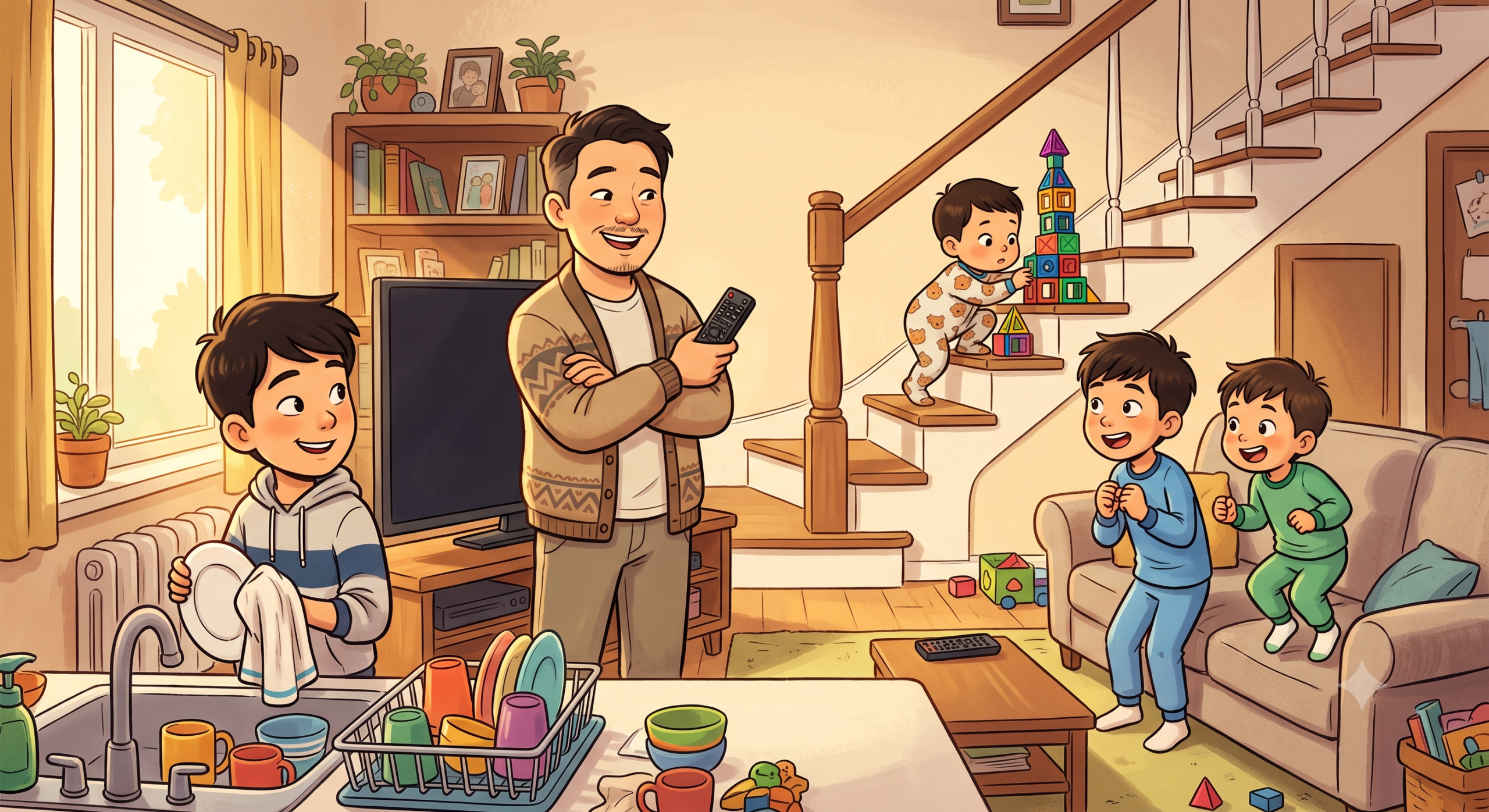
– Morning: Number 3 does the breakfast dishes. No dishes — nobody watches TV.
– Lunch: Number 2 does the lunch dishes. No dishes — no gaming for anyone.
– Evening: Number 1 does the dinner dishes. No dishes — next Saturday is at risk.
Notice what this structure does. It’s not “do your chore, get your reward.” It’s “do your chore, or everyone loses the privilege.” Each boy is the gatekeeper for his brothers’ fun. They’re a team — if one fails, the consequences come together. The peer pressure runs itself: I’ve watched Number 2 remind Number 3 about the dishes with an urgency I could never generate as a parent. They police each other, because they’re all invested in the gate opening.
And when a gatekeeper is genuinely sick on his day? Then it’s the parent’s duty to take over his gate — no penalty, no drama. We get sick sometimes, and sometimes we have to ask for a sick day; it’s the same for kids. Even that teaches them how the system society runs on actually works, on a minor scale: real teams cover for a teammate who’s down. What doesn’t fly is a mysterious illness that arrives at dish time and departs by TV time — Dad has seen that particular virus before.
The Freeloader Clause
Sharp-eyed readers will notice Number 4, our two-year-old, holds no gate. His brothers have noticed too. Yes — he’s a freeloader. He gets to watch without any chore responsibilities, and the older three have made peace with it.
Here’s how we explain it to them: everyone in this house has the responsibility to do what they’re able to learn. For the older boys, that’s dishes, cleaning the room, picking up toys. For Number 4, it’s getting off the diapers, learning to use the toilet, learning to brush his own teeth. It’s the same rule — just different wordings for different ages.
He’s in what we call his internship phase anyway: watching his brothers do the dishes and pick up toys, sometimes following along, sometimes fighting for his playtime instead — he’s two, that’s the job description. And honestly, his screen appetite is small. The mission videos his brothers love bore him; he’s a dinosaur-content man. Most of the time he skips the screen entirely in favor of his magnetic blocks, which he attaches to every metal surface in the house, including the entire staircase railing. More cleanup work for me. The internship continues.
What About Sunday?
Sunday runs on a different engine entirely, and I’ll be upfront about why: I’m a pastor and a missionary, and church isn’t an option in our family — it’s who we are. Service starts at 9am, and between worship, sermon, fellowship, and lunch, we’re usually home around 1pm. The boys genuinely enjoy it; they’ve got local friends there, and Grandma and Grandpa too.
Screen-wise, Sunday afternoon is the loosest part of our whole week — deliberately so. Sometimes there’s screen time, and when there is, it’s afternoon-only and usually educational or faith-based content, nothing far off topic. Sometimes there’s no screen time at all, because we’re at the park as a family or over at the grandparents’ neighborhood instead.
That flexibility is on purpose. Saturday is the structured screen day with gates and rules; Sunday is family-first, and screens only fill whatever space the day leaves over. Two different days, two different jobs.
The Ban That Made It Real
Rules only work if kids believe the consequences. Ours do, because of the month-long ban.
A while back, the rules got broken badly enough that their favorite content — the Roblox and Minecraft mission videos — went away for an entire month. Not a weekend. A month. And I kept my word for all thirty days of it.
That ban is now load-bearing family history. The kids know that whatever Dad says will actually happen. So they do their best to finish their jobs — not because they fear me, but because they’ve learned that my words and reality match. If you take one thing from this article, take that: one fully-enforced consequence is worth a hundred threatened ones.
The Filter: A 90s Standard of Appropriate
People always ask what we actually let them watch. Our filter is simple: nothing that conflicts with our family’s values and faith, nothing occult, nothing horror. (That last one is non-negotiable in our house — our Number 2 still has hard nights because of horror clips someone showed the kids at school. That’s a bedtime story for another article.)
Beyond that? My standard is what I call the 90s standard of appropriate: if it would’ve been considered fine for kids in the 90s, it’s fine for mine.
Yes, that includes Tom and Jerry. I’m aware that by modern sensibilities, Tom and Jerry is a shockingly violent program about a cat being repeatedly flattened by household objects. I grew up on it. I turned out fine. Some of the shows I loved would probably get flagged by every modern content committee for one reason or another — and yet my generation somehow survived cartoon anvils.
What the boys actually watch on a Fun Day morning: Tom and Jerry, the Roblox and Minecraft mission videos, Bear Grylls’ survival series, and — their current obsession — Korean documentary channels about insects and wildlife. Real footage, real lab tests, real facts. It’s Magic School Bus without the magic, and the boys throw facts at us that we genuinely didn’t know. We also steer them toward Numberblocks, Alphablocks, and a Korean children’s channel that teaches the language. The house rule of thumb: we don’t want a diet of pure cartoons and gaming content. Educational content isn’t the vegetable they’re forced to eat — we’ve made it the thing they actually request.
The Co-Watching Rule: Harry Potter and the Questions That Never Stopped
Here’s the last layer, and honestly my favorite one: if it’s above their age grade, they don’t watch it alone. They watch it with me.
Number 1 wanted to watch the Harry Potter movies. And to an eight-year-old, the first film is genuinely dark — a boy loses his parents, grows up an orphan with relatives who despise him, and then there are trolls, a three-headed dog, a dark lord with no nose. Intriguing, fun, and a little scary. He wanted the company.
Now, there are two kinds of movie watchers in this world: watchers and askers. My son is an asker. He asks every question, during the movie, the moment it forms — because he needs to know. He takes after his mom, and I’ll confess that back when we were dating, the mid-movie interrogation was the one part of movie dates I didn’t love. God has a sense of humor: He gave me a son with the same feature.
But this time, the questions were the whole point. It was his movie choice, and it was my job to walk him through the whys, the hows, and the what-ifs. Why is Voldemort evil? Why are people mean? Why would anyone attack Harry and his friends?
And that opened the conversation I actually wanted to have: this world isn’t just rainbows and butterflies. There is evil in it — evil that will sometimes come at you for no reason — and pretending otherwise doesn’t protect kids, it just leaves them unprepared. A lot of content today teaches that nobody’s really a bad guy, just a good guy who made accidental bad choices. I think different. Evil exists. And so does good: people with kindness, humility, and love, who will stand up and fight for what’s right. Those are the people you keep close — the way Harry kept Ron and Hermione close.
My son got all of that from a movie night with his dad. That’s what co-watching buys you: the screen stops being a babysitter and becomes a classroom where Dad is in the room to explain the hard parts. Some content isn’t “too old” for your kid — it’s too old for your kid alone.
Our Screen Time Rules for Kids, in One Paragraph
Our screen time rules for kids are simple: no screens on weekdays, ever — so there’s nothing to negotiate. Friday movie night together. Saturday is Fun Day: TV in the morning, gaming after lunch, and every window is unlocked by a brother’s chore, so the boys enforce the system on each other — and a parent covers the gate of a genuinely sick gatekeeper, the way any real team covers a teammate. Sunday is family-first — church, grandparents, sometimes a park — with screens only filling the leftover space, if any. The toddler freeloads, as is his birthright, until his internship ends. Content passes a values filter and a 90s standard of appropriate. Anything above their grade gets watched with Dad. And every consequence that gets spoken gets executed — ask the boys about the month with no mission videos.
Screens didn’t get less fun at our house. They got predictable. And it turns out that’s what kids actually wanted all along: not unlimited screens, but a clear, unmovable answer to when, what, and how — so they can stop lobbying and just enjoy the Saturday they earned.
The gate opens every week. They just have to open it themselves.