My first fried rice was when I was 11 years old. It wasn’t great. I’ve been cooking almost every day since then — before I was a teenager, long before I got married, and now every single day for a family of six in Cambodia. Nobody taught me this as a discipline. It just became one, meal by meal, the same way most of what actually works in a house with four boys becomes a system: not because I sat down and designed it, but because I kept doing the thing that worked and quietly dropped the things that didn’t.
Somewhere in those twenty-some years, I stopped thinking about cooking as a skill I was building and started thinking about it as a system: a small rotation of meals that are fast, that my kids will actually eat without a fight, and that don’t require me to be a better cook than I actually am.
Today’s theme is eggs, because eggs are the backbone of that system. Cheap, fast, endlessly flexible, and — if you do them right — something four boys under ten will eat without a single complaint. These are the five egg recipes for kids that actually survive contact with a picky table, not the ones that just look good in a photo.
The System Behind Our Egg Recipes for Kids
Here’s the part I have to keep re-learning: better, in my standards, is not the same as edible, in my kids’ standards. I’ll get ambitious some nights — want to cook something more interesting, more impressive, more “me” — and it just sits on the plate while a bowl of egg fried rice would’ve disappeared in four minutes flat. Cooking shouldn’t be stressful. If my kids eat it without complaining and it’s a healthy meal, it works. That’s the whole system. It’s not glamorous. It’s just repeatable.
Our boys live on the first three of these five egg recipes for kids as their default menu. I mix in pasta or pasta soup here and there, but eggs are the routine — the thing I can make with my eyes half open before anyone in the house is properly awake. Here’s all five, exactly how I make them.
Egg Fried Rice
This is our kids’ favorite, no contest. The rule that matters most: use day-old, cold leftover rice — never freshly cooked rice. The colder and older it is, the better it fries. Freshly cooked rice is too wet and clumps instead of frying loose.
Season the rice, then crack in eggs — one egg per person eating. Three kids at the table means three eggs. Mix the eggs straight into the rice before it ever touches the pan; it’ll look like a strange egg porridge at this stage, and that’s correct.
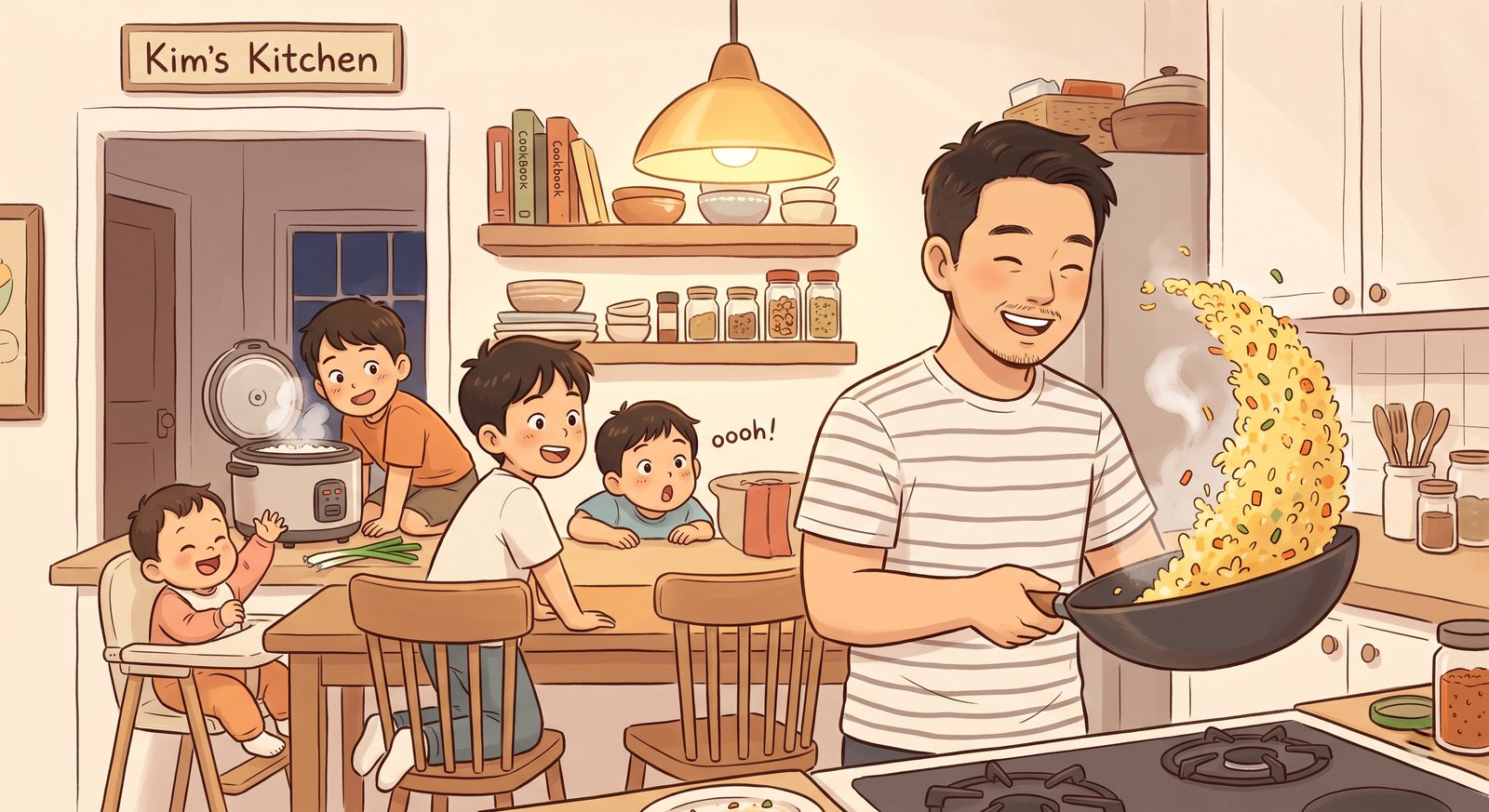
Get a wok if you have one — it makes a real difference here. High heat, and be generous with the oil, or the eggs will burn onto the pan. Toss in minced garlic (seasoned) and let it start changing color, then dump the whole egg-rice mixture in and start tossing immediately.
From here you’re committed: you will not have time to season while this is happening, or the rice will clump. You need to be actively tossing for about five minutes straight, until there’s no sticky texture left on the rice. Once it’s dry-tossed like that, turn the heat off, throw in a handful of chopped thin green onions, and toss for one more minute — the residual heat in the pan takes the raw, sharp scent out of the greens without cooking them into mush.
That’s it. Serve it. If you want, mince some onion in too — mince it small enough that the kids can’t actually see it in the rice. They’ll just see yellow and think it’s eggs. If you don’t see it, you don’t know it’s there.
Day-old rice isn’t a quirky preference — it’s the actual reason restaurant fried rice fries loose instead of clumping into a sticky mess, since the rice dries out and firms up in the fridge overnight.
Egg Soup
This one’s simpler on ingredients, harder on timing. Stir-fry garlic and onion in a pot until they start changing color, then add water and season the broth. A splash of soy sauce gives it depth, and a bit of tuna liquid (참치액, cham-chi-aek) if you have it — it makes a real difference. Let it come to a boil.
Here’s the part that took me a while to get right: once it’s boiling, turn the heat off. Have your eggs already whisked and ready to go. Once the bubbling settles, stir the soup in one direction to create a whirlpool, and slowly pour the whisked egg in along the side of that whirlpool as it spins. That motion is what gives you those soft, wispy egg ribbons instead of solid clumps.
And then — don’t stir again. Not once the egg is in. If you stir after pouring, the egg clumps together instead of staying in those delicate strands. Let it sit. That’s the whole trick, and it’s the difference between a good egg soup and a mediocre one.
Omelets
This is our standard daily breakfast, and it’s the simplest of the five. I mince whatever vegetables I’m using and keep them in a separate bowl first. Pour whisked eggs into a hot, oiled pan and give it a quick stir to start it cooking evenly. Once there’s a layer set, sprinkle a handful of the minced vegetables over it, then fold it over on itself little by little, working it into an oval, until it closes up.
That’s it — no fixed recipe for what goes inside, just whatever’s on hand that morning.
Stir-Fried Eggs and Tomatoes
This one has its lines — not every kid is on board with it the way they are with the fried rice. It’s a Chinese dish originally, customized a bit to how I like it. It’s also our “older kids” recipe; it took our older boys getting a bit more adventurous with flavor before this one landed for them.
Slice regular tomatoes and fry them first, pressing them down with the spatula as they cook to release all the juice — you don’t want any liquid left trapped in the tomato pockets. Once most of the moisture has cooked off, add whisked, seasoned eggs, all still on low-medium heat. I add oyster sauce here for flavor, and let the eggs roll around in the tomato juice as they set. The tomato’s sourness cooks off, and what’s left is a sweet flavor from the oyster sauce coating the eggs. End result: something like scrambled eggs folded through mashed tomato, glazed in tomato juice and oyster sauce.
Egg Soy-Sauce Rice Mix (The One-Minute Cheat Code)
This is the cheat code, and it’s a Korean thing my whole generation grew up on. In a bowl of hot rice, crack in one raw egg, add two to three tablespoons of soy sauce, and a drizzle of sesame oil. Mix it together. Done.
This one exists for parents who didn’t have time to actually cook for themselves — but it’s still a favorite among Korean millennials who grew up eating it, myself included. It sounds too simple to be good. Try it anyway. For real.
Cooking Shouldn’t Be Stressful
I’ll be honest about the trade-off in all of this: leftover rice as a running household routine wasn’t necessarily the smartest system to build a habit around, and the dishes still pile up after all this frying and tossing — we don’t have a dishwasher here, so that part I still question every time. But the actual cooking part isn’t the stressful part anymore, and that’s the whole point of having a system instead of reinventing dinner every night.
I still catch myself wanting to cook something more impressive some nights. But my kids will eat egg fried rice without a single complaint, every time, and that’s worth more to me most evenings than being a better cook than I actually am. Twenty years ago that first fried rice was a mess because I was trying to prove something to myself. Now it’s just Tuesday dinner, and that’s exactly the point — a system stops being impressive and starts being useful the moment you stop needing it to say something about you.
The kids are the easy audience, honestly. My wife is a different story — picky in her own way, sometimes as picky as the boys — and getting her to try anything new has been its own ten-year project. There’s a tomato soup and a batch of homemade baguettes involved in that story. That’s next.