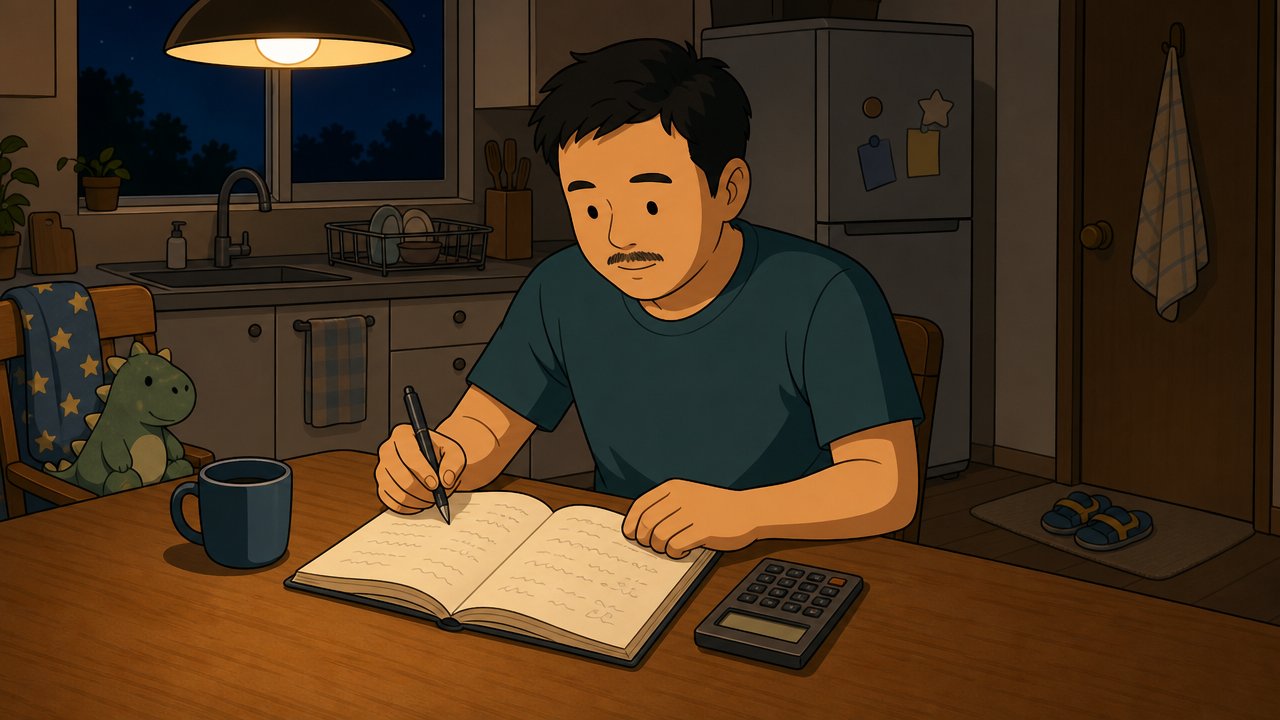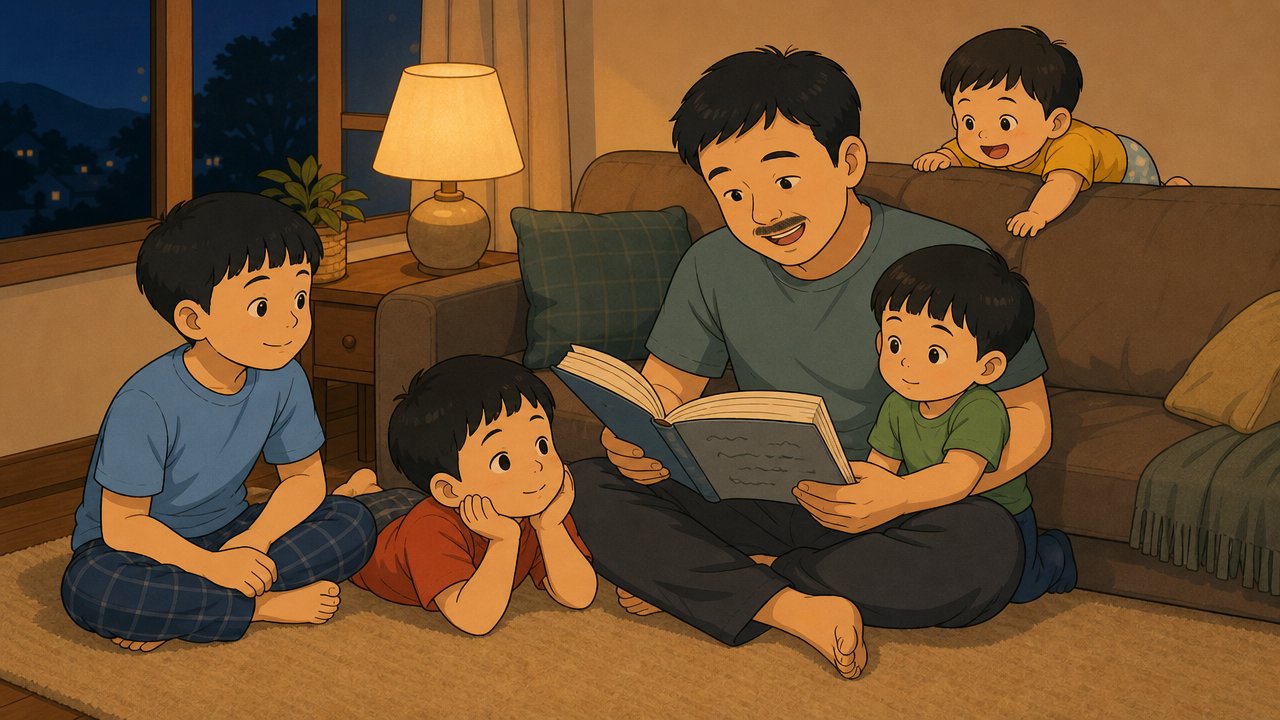
We were at dinner, plates half-cleared, the boys still picking at rice, when my wife asked the question every parent eventually asks: “What do you want to be when you grow up?” Neither of us knew it yet, but that ordinary question was about to turn into a real conversation about teaching kids to serve others — not the planned kind, the kind that just shows up while you’re clearing plates.
It’s usually a throwaway question. You expect “astronaut” or “YouTuber” or whatever cartoon he watched that morning. Number 1 didn’t answer it like a throwaway question.
“I want to help people. Like you and mom.”
That part came out fast, like he’d already decided it a while ago. Then came the part he’d clearly been sitting with, turning over on his own, maybe for weeks. He loves marine life — he can tell you the difference between a manta ray and a stingray without blinking. He loves robotics, the kind of love where he asks for parts instead of toys. He loves insects, watches documentaries about them the way his brothers watch cartoons, the narrator’s voice basically background music in our house at this point. But somewhere along the way he’d also decided he wanted to be a missionary, and in his head, those things didn’t belong in the same sentence. Missionaries preach. Missionaries plant churches. Where does a kid who wants to study octopuses and build robots fit into that?
He said it like a real dilemma, not a passing thought — the kind of thing he’d been carrying quietly and finally decided to hand to us at the dinner table, hoping we could solve it. “But I don’t know if I can be a missionary and do those things too,” he said. He wasn’t looking for permission to change his mind. He wanted to know if he actually had to choose.
Where the Question Actually Came From
To understand why this mattered so much to him, you have to back up a few months, to something that had nothing to do with career questions at all.
Late last year, a border conflict between Thailand and Cambodia displaced a huge number of families near us. At the peak of it, there were roughly 60,000 displaced people within about 50 kilometers of Battambang — entire villages that emptied out overnight because the fighting made it too dangerous to stay. Some of those border villages are still occupied even now, months later, still unreachable to the families who used to live in them. The Cambodian government is working through it. In the meantime, people just needed help, and we were close enough to give some.
Our church and ministry network ended up helping at four different camps — bringing food, hygiene supplies, care packages, whatever we could raise money for and physically deliver. It wasn’t a one-time drop-off. It was weeks of going back, checking on the same families, learning names.
I missed a chunk of that season. Right in the middle of it, I flew to Korea for ear surgery I’d been putting off, and recovery kept me out of commission for weeks — no lifting, no long car rides on rough roads, no camp visits. While I was gone, my wife kept going without me. On one of those visits, she and Number 1 found out that fifty or sixty kids his own age at that particular camp had nothing for school. No notebooks. No pencils. No uniforms. Nothing. Kids who’d been going to school just like him a few months earlier, now with no way to.
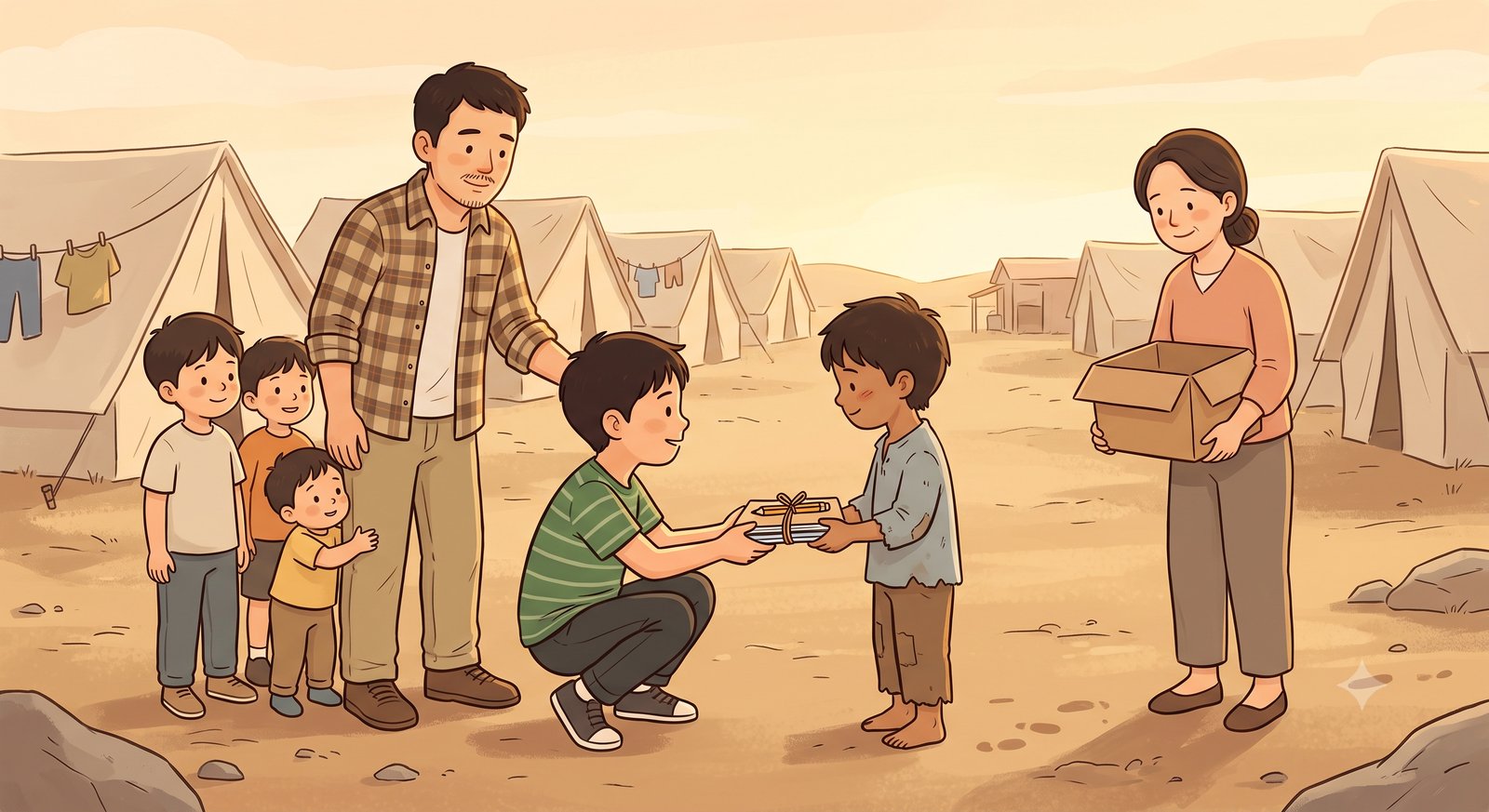
So we raised what we could from our own network, and my wife made a supply run — pencils, notebooks, sharpeners, erasers, uniforms, enough for every kid at that camp who needed one. She and Number 1 went together to hand them out.
He didn’t just tag along and watch from behind her legs. He was the one crouching down, putting a bag directly into another kid’s hands, the two of them close enough in age that there wasn’t much distance between “the boy giving” and “the boy receiving” except circumstance.
I wasn’t there for it. I heard about it secondhand, after I’d flown back and was still moving slowly, my hearing not fully returned yet. But I recognized the look on his face when he told me about it — not the performance of being proud of himself, something quieter than that. He kept circling back to it in conversation over the following weeks, the way you do with something you haven’t fully processed yet. A detail here, a detail there. What one kid said to him. How heavy the boxes were. He wasn’t announcing that it mattered to him. He just couldn’t stop thinking about it, and it kept leaking out sideways. Looking back, that afternoon probably did more for teaching kids to serve others than any conversation we could have planned at home.
Teaching Kids to Serve Others Starts Before They Understand the Word “Missionary”
That’s really what was sitting underneath his dinner-table dilemma, even if he couldn’t have explained it that way himself.
He didn’t need a theology lesson before any of this made sense to him. He’d already felt what it was like to hand something real to someone his own age who had nothing, and to watch that kid’s face change because of it. Teaching kids to serve others isn’t something you accomplish with a conversation and then hope it sticks later — it’s putting them inside the actual moment first and letting the feeling do the teaching. The words come after. The words are just how we help them make sense of what they already felt in their hands. It’s not so different from how we’ve handled money and giving with him in general — the lesson lands because he’s lived it, not because we lectured him into it.
So when he told us at dinner that he wanted to help people like his mom and dad, he wasn’t reaching for an abstraction he’d absorbed from a sermon. He was reaching for that specific afternoon at that specific camp, a memory with weight and texture to it, not a value we’d successfully installed.
You Don’t Have to Choose
So we told him the truth as we understand it, as best as I could put it to an eight-year-old without losing him halfway through.
A missionary isn’t just someone who plants churches or preaches from behind a pulpit. The church matters enormously — it’s the headquarters. It’s where people are discipled, taught, trained. It’s where we come to understand that we’re children of God, saved by faith, not by our own effort. It’s where we return again and again to be recharged, to have real fellowship with the Lord and with each other. None of that is optional or secondary. But the church was never meant to be the only place missions happens, and it was never meant to be the finish line either.
You are not required to become a pastor to live a missional life. You are required to actually live it — professing Jesus through what you do, what you say, even what you privately think, wherever you happen to be standing. If you can become genuinely skilled at something, anything, that serves and benefits other people, you can live out your faith through that skill. It doesn’t need a pulpit underneath it. And when the moment comes — and it will come, usually when you least expect it — you say something true about why you live the way you do.
Relief work. Education. Medicine. Media. Marine biology. Robotics. None of these are distractions from missions or a lesser calling you settle for if the “real” ministry doesn’t work out. They’re tools for it, the same as preaching is a tool for it. The specific tools shift with the era — a missionary a hundred years ago didn’t have social media in his toolkit, and today it might be one of the most effective ones we have. The strategy has to keep shifting with the world it’s trying to reach. What doesn’t shift, what can’t shift, is the calling sitting underneath all of it.
So no, I told him, he doesn’t have to choose. He can love God, love Jesus, and be willing to talk about that love in whatever he ends up doing with his life — including, if that’s really where his curiosity takes him, spending his days studying coral reefs or teaching a robot to walk or naming every insect in a rainforest canopy. That isn’t a compromise version of being a missionary. That, done honestly, is the whole point of it. That’s the real shape of teaching kids to serve others — showing them the calling fits inside any profession, not just a pulpit.
What I Actually Learned Sitting There
I’ve spent years thinking hard about what it actually means to raise my boys to live out their faith instead of just performing the motions of it in front of us. I didn’t expect the clearest version of that lesson to arrive by watching my own son wrestle, in his eight-year-old way, with almost the exact question I’ve spent my adult life trying to answer for myself.
He handed a kid his own age a bag of pencils and felt something he didn’t have language for yet. Weeks later, sitting across from us at dinner, he was still trying to figure out where that feeling was supposed to live — whether it belonged behind a pulpit, inside a marine biology lab, or somewhere he hadn’t even heard of yet. The honest answer, the one I actually believe, is that it belongs wherever he ends up, as long as he’s willing to carry it there with him.
Growing up the way he is — moving between cultures, raised as a third culture kid in a country that isn’t the one on either of his parents’ passports — he’s already learning to hold more than one identity at once without treating them as a contradiction. Missionary and marine biologist is just the next version of that same skill.
I don’t know yet if he’ll grow up to study the ocean, build robots, chase insects through a jungle, stand in front of a congregation, or somehow end up doing all of it at once — kids that age contain multitudes, and most of it will change six more times before he’s twenty. I don’t actually need to know which one it is. What I know, what I actually watched happen with my own eyes months apart, is that he’s already done the hardest part of this. He’s felt, firsthand, what it costs and what it gives you to hand something real to someone who needed it. Everything else — the career, the title, the “what do you want to be” answer he eventually settles into — is just deciding what container he ends up carrying that feeling in.