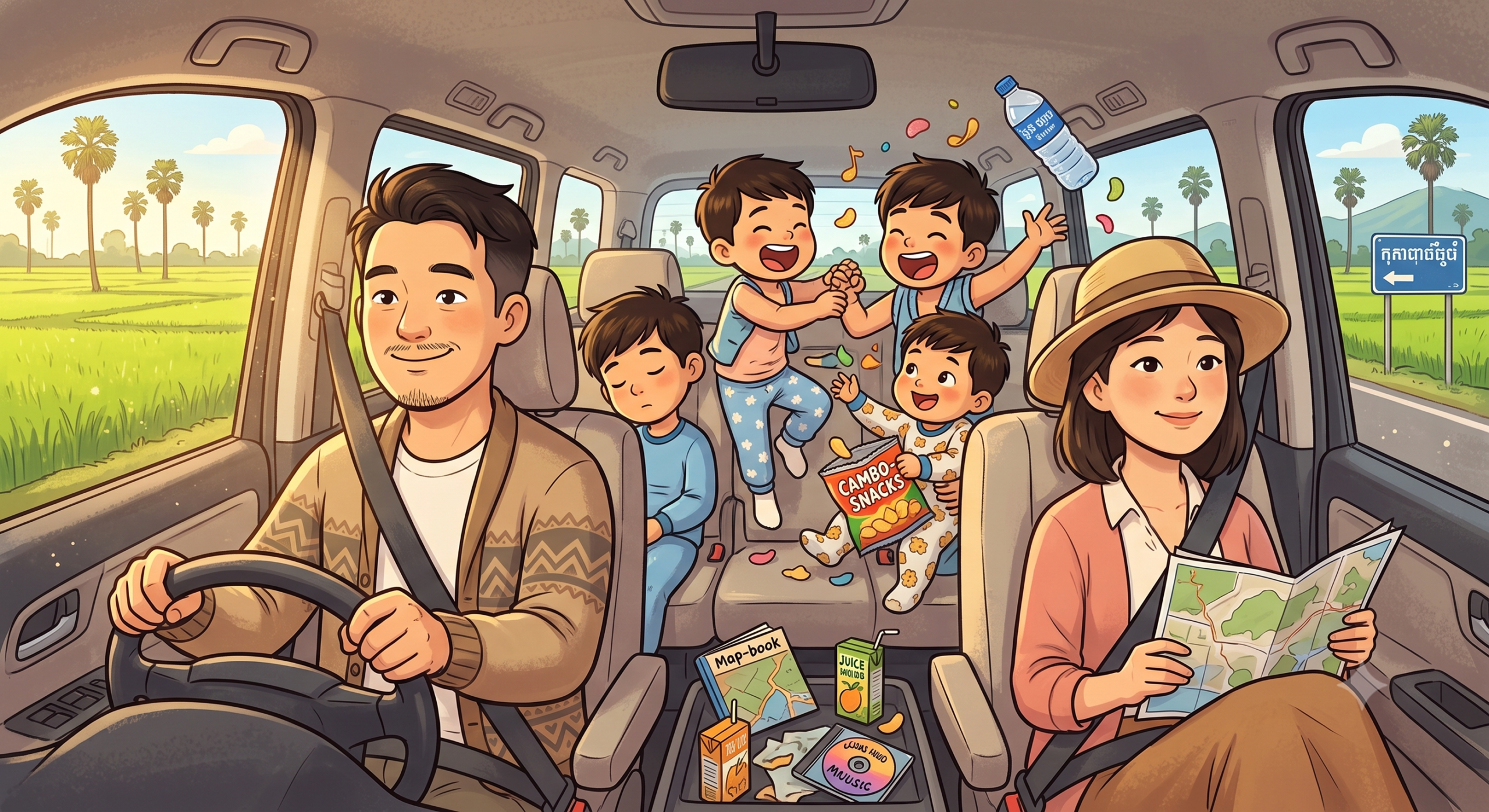
A road trip with kids is a different sport entirely — and every quarter or so, our family of six plays it: four to five hours across Cambodia, Battambang to Phnom Penh, sometimes Siem Reap. Four boys, ages eight to two, one driver, one heroic mom, and a 2012 Toyota Sienna that has broken down on me five or six times and counting.
If you’re planning a road trip with kids and searching for the perfect packing list, I’ll be honest upfront: we don’t have rules for traveling with kids. We have *priorities.* And the difference between those two words is the entire article.
The Van (a Love Letter With Complaints)
Our Sienna is amazing. All six of us fit with room for the mountain of luggage that four boys generate — though I’ll note the mountain shrinks as they grow; the diaper-era luggage was far worse.
It’s also a 2012 model living in Cambodia, which means breakdowns are part of the travel budget. Engine lights. The entire dashboard going dark, no power, in the middle of a trip — full shutdown, pull the battery out, put it back in, jump-start, pray, continue. It’s a hassle. But if it takes us from A to B, it’s good enough. That sentence is basically our family’s whole travel philosophy.
The Pre-Departure Protocol
Before any trip, the launch checklist:
The house: lights out, air conditioners off, everything set for our return.
The puppy: dropped with a close friend who runs a vet clinic — the best puppy-sitting arrangement known to man.
Supplies: lots of water, lots of snacks, and bags for the garbage those snacks become.
And one empty plastic bottle.
Parents of boys — and I mean specifically boys — you already know what the bottle is for. When you’re in a rush, or on a stretch of road with no stops anywhere, the bottle gets opened and the kid goes in it. Is it hygienic? No. Is it a solution? Absolutely. Pack the bottle.
The Number 4 Variable
Here’s the single biggest factor in our travel time: whether the two-year-old sleeps.
Our departure timing is built around him — we leave around noon and aim to arrive before evening traffic. When we’re lucky, Number 4 falls asleep in the car, and we do not stop. We go all out. Best case, Phnom Penh in four hours flat.
When we’re not lucky, we stop at every station, and the trip stretches to nearly six hours. And gas station stops with Number 4 are their own event: given the chance, he will grab everything he wants in the store, and he wants everything. So our standing preference is simple — when given the option to stop, don’t.
Six hours of that, as the only driver, is exhausting. And I’m not driving in peace — I’m driving in chaos. Nobody sits still. Nobody stays quiet. There is screaming, shouting, and a running interview being conducted at the back of my head. This is why we don’t have rules on the road. Rules break. Priorities hold: kids’ needs first, everything else improvised.
The Seating Chart (a Work of Fiction)
Technically, we have assigned seats. Mom rides shotgun. Number 4 sits directly behind my driver’s seat, Number 1 beside him, and Numbers 2 and 3 take the back row.
That’s the plan. The plan never survives. Our kids know how to unbuckle themselves, and Cambodia has no car seat laws — so the back of the van regularly becomes a playground, boys migrating forward and back like weather systems. I’m not recommending this; it’s just our honest reality, and it assigns me my job on every trip: it is Dad’s duty to drive as safely as humanly possible, because the margin for error back there is zero. If you live somewhere with seat belt laws, count that as a blessing and use them.
The Road Rule Suspension
Now for the confession: inside the travel van, our house rules don’t apply. The famous no-weekday-screens rule? Suspended. The boys get their iPads on the road.
I know. It sounds terrible. But hear the structure before you judge: screens cover roughly *half* the travel time, not the whole ride. We start with nothing — no screens, no mention of screens — and just drive. Chatting, looking out the window, the boys singing bizarre songs I’ve never heard, imported from school friends and YouTube. Around hour two or three, someone finally asks: “Can we watch something?” And that’s when screens come out.
The first half teaches them to just suck it up and enjoy the view — a life skill, honestly. The second half buys the driver silence for the home stretch. Both halves matter. And through it all we try to keep chatting, though I’ll admit the driver’s contributions aren’t always sharp — half my answers are “mhmm” delivered at highway speed.
My favorite recurring bit: Numbers 2 and 3 are still learning hours versus minutes, but minutes they understand. So when they ask how long is left, I say “a hundred and twenty more minutes” instead of two hours, purely for the reaction. “WHAT?” Never gets old. For me.
The Korea Comparison (Rest Stops Done Right)
We’ve also done the long haul in Korea — Busan to Seoul to Chuncheon, about seven hours, in a narrower car the boys did not appreciate. But Korean highway travel has a cheat code: the hyugeso, Korea’s legendary highway resting areas. These aren’t gas stations with a toilet — they’re small towns. Restaurants, markets, cafes, lounges, souvenir shops, sometimes a McDonald’s, sometimes an actual park. Places where you can release four boys to run and feel completely safe doing it.
When we’re on Korean roads I search out the stations families rate highest, and it pays off — one stop was running a promotion for families with multiple kids and handed us two free pork cutlets. Nearly twenty dollars of food, and pork cutlet happens to be our boys’ love language. A rest stop that rewards you for having four kids: Cambodia, I know you’re trying, but please take notes.
The Trip That Went Wrong
You wanted realistic, so here’s the puke story.
Coming home from Phnom Penh, Number 1 wasn’t feeling right — something from breakfast, we still don’t know what. He said he felt sick, so we moved him to the front seat. Then came the first burst. We stopped right on the highway, I ran around and opened his door — and as the door opened, the second wave came out like somebody had turned on a hose. Not pretty. But outside the car, which in the moment counts as a victory.
The recovery move: we drove to the nearest gas station that sold ice, bagged it, and laid the ice pack on his chest until the sickness settled. Once he was okay, we rolled on. No panic, no turning back — clean the boy, cool the boy, continue the journey. Add “gas station ice” to your emergency playbook; it’s cheap and it works.
The Flight: Nine Hours With a 50-Day-Old
Our longest journey was the move itself — Busan to Cambodia. Domestic flight to Incheon from Busan, an international to Phnom Penh, about nine hours door to door with the transfer.
The hardest part wasn’t the three boys. Numbers 1, 2, and 3 were old enough to ask for what they needed, and honestly I was confident about them. The hardest part was that Number 4 was fifty days old. Holding an infant on a plane, you’re just up — every sense on alert, the entire flight. At that age all he could do was burp, poop, and cry, with no way to tell us which was coming. Compared to that, traveling with him now is easy mode.
Our non-negotiable flight rule is that there are no rules. All the viral flight hacks you see online? Half of them have been banned by airlines for safety reasons anyway. Our approach: satisfy the kids. Unlimited seatback screens, whatever they want to watch as long as it’s appropriate. It’s not an everyday thing — when will they next get to watch TV in an airplane seat? — and it genuinely lowers their stress, because a first flight is uncomfortable for a kid: cabin pressure shifting, ears going numb, strange everything. The screens carried them through beautifully.
The arrival did not. We landed near midnight. My wife had the infant in her arms the whole way — zero hands free — which meant the luggage for two adults, three toddlers, and one infant was all on me, while Numbers 1 through 3 hit the sleepy wall and begged to be carried through passport control. Managing three collapsing boys and a luggage train at midnight in a new country is not an experience I’m looking to repeat.
Which brings me to the single best travel purchase we’ve ever made: ride-on children’s luggage — the little suitcases with wheels that kids sit on and scoot. Getting our hands on those a few years later was a genuine eureka moment. The kid sits on it, holds the handle, and follows you. One more free hand, one less bag to carry, one less child to carry. They’re a bit expensive, and worth every dollar. I thank God, and I thank the man who invented them, in that order.
The System Behind All of It
So here’s our travel system, compressed: the van is old but willing, the bottle is packed, departure is at noon, stops are avoided, screens unlock at halftime, the ice trick handles emergencies, planes have no rules, and the luggage carries the children instead of the other way around.
But underneath every one of those tactics is the same single priority, and it’s the actual answer to “how do you travel with four kids”: the trip runs on the condition of the children. Not the itinerary, not the schedule, not the plan. When the kids are okay, we drive four hours straight. When they’re not, it takes six, and that’s the trip we were always going to have.
Everything else — the arrival, the unpacking, the boys cannonballing into a pool while my wife watches and I fire up the Korean barbecue — is the reward for holding that one priority the whole way there.
A hundred and twenty more minutes. You’ve got this.