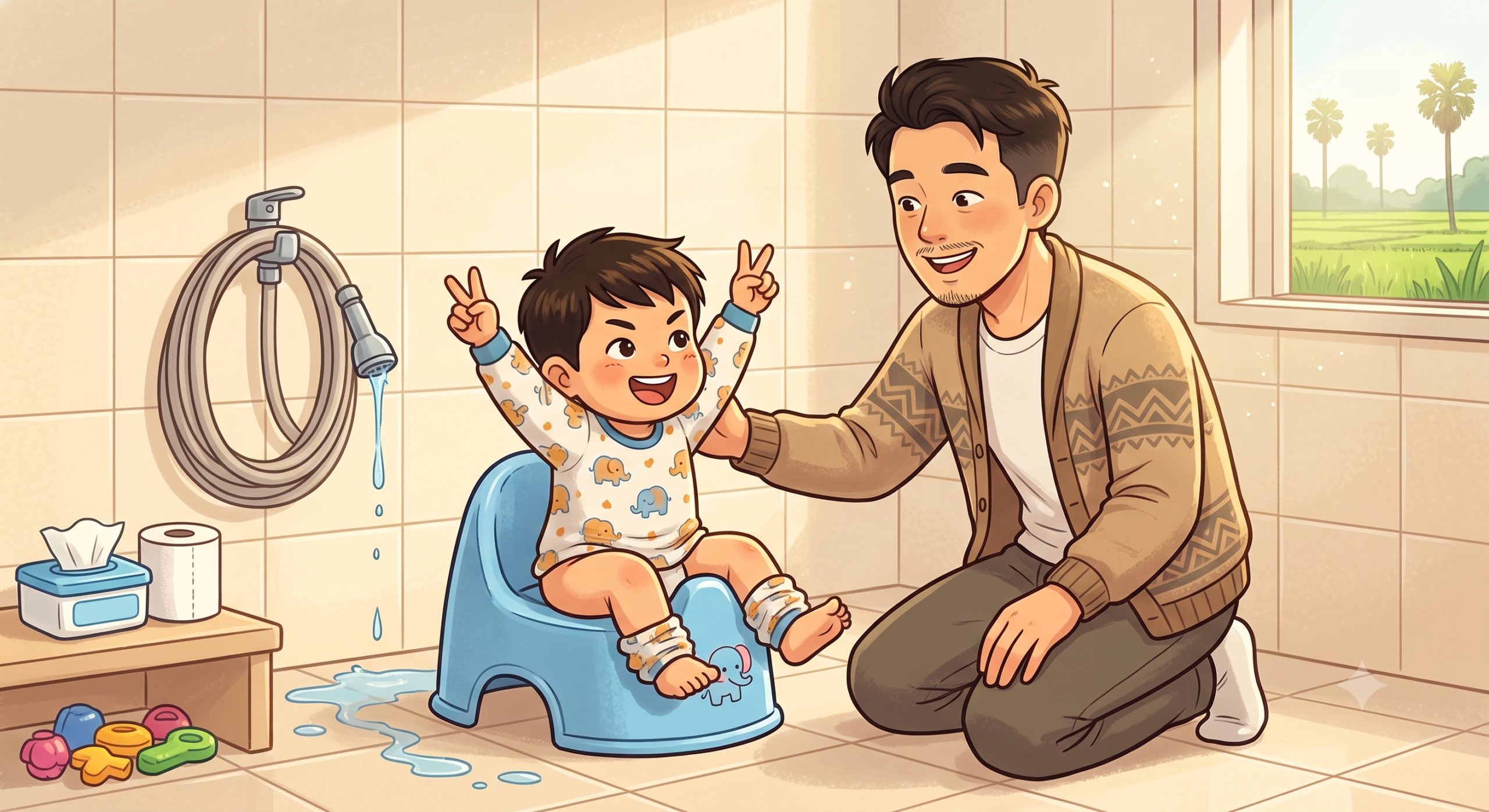
Potty training a 2 year old is one of those milestones that looks small from the outside and enormous from the inside. It’s the step where your child literally becomes independent from you — at least for one very important daily function. And I’ll say the part every parent thinks but rarely writes: the money. A kid off diapers is a monthly bill that simply vanishes. Independence for him, a raise for you.
We’re in the middle of round four right now. Number 4 is two and a half, and he’s our last one — which means this is both a progress report from the trenches and a look back at what changed between training our first boy and our fourth.
Spoiler: everything changed. Mostly us.
Where He Is: The Scoreboard
Daytime: conquered. He knows how to go, he knows how to pee, he knows how to poo. What he doesn’t know is how to clean up after the poo — that’s a course for a later semester, and every parent of a newly-trained kid knows exactly the era I’m describing.
Naps: conquered. Not a single incident. He’s making it through.
Nights: in progress. He still makes mistakes — little leaks — but here’s the detail that tells me he’s actually learning: he wakes up the moment it happens. That’s the difference between a kid who isn’t ready and a kid who’s almost there. His body is reporting the news; it’s just reporting it a minute late.
Potty Training a 2 Year Old at Night: Our System
Nighttime is where we actually run a system, and it has three parts:
1. Water diplomacy. We persuade him not to drink too much water at night, because water at bedtime is the direct cause of every mistake. (Regular readers know this battle from our bedtime article — Number 4’s midnight water heists are family legend.)
2. Bracketing. He goes to the toilet right before bed, and again whenever he wakes — no exceptions, no negotiations.
3. The moan signal. This one we discovered by accident. He moans in the middle of the night, and at some point we realized: that’s not random sleep noise, that’s the announcement. So now, every time he moans, we pick him up, sit him on his little potty seat — and he pees. Victorious, half-asleep, every time. Your kid is probably broadcasting a signal too; it took us four children to learn to listen for it.
Fourth Kid vs. First Kid: The Stress Chart
Here’s the honest comparison, because “potty training your fourth” versus “potty training your first” is a difference measured in blood pressure.
With Number 1, everything was a first time. The baby was a first time. Nurturing was a first time. Potty training was a first time. Every accident felt like data about our failure as parents. We were worried, unconfident, reading everything.
By the fourth, you’re an experienced veteran, and you’ve arrived at what I call the what-the-heck stage of life: he makes an accident? Okay. We’ll give it a go again. More laundry. That’s it. That’s the whole crisis. The stress level between one and four isn’t just lower — it’s off the charts different.
And there’s a strategy lesson hiding in our history. With Number 1, we started late — past three years old — and precisely *because* he was older, he had more control of his body and made almost no mistakes at all. Numbers 2 and 3, same pattern. With Number 4, honestly? We might be rushing him a little. We pulled his schedule earlier than his brothers’ for no particular reason — he was the only one left, so we decided to give it a go. So take this from a four-time veteran: later is easier. A kid trained at three-plus basically trains himself. A kid trained at two and a half trains the washing machine.
“Daddy, I Peed” — From 3,000 Kilometers Away
The moment of this whole journey happened while I wasn’t even in the country. I was in Korea recovering from ear surgery when my wife video-called me and turned the camera: Number 4, sitting proudly on his potty, announcing to my face — *”Daddy, I peed.”*
And something happened in me that surprised me. I’m sure I reacted the same way with Numbers 1, 2, and 3. But with the fourth, it lands differently — there’s finally room to absorb the awe. With your first, milestones arrive buried under worry and checklists. By the fourth, the worry is gone and what’s left is just the pure thing itself: wow. He has grown.
If you’re on your first kid reading this: that feeling is waiting for you too, once experience clears out the anxiety renting space in your chest.
He Is Also, However, a Boy
Balance demands I tell you about yesterday.
Number 4, for no reason — and I want to stress that, no reason — decided to flip his potty seat over. It was full. It was next to the bed. Physics did the rest.
By some mercy, the contents missed the bed entirely and hit the wall instead. And here’s where I thank Cambodian architecture: walls here are tiled. We wiped it down, the smell was gone completely, and we all slept refreshed in a room that had been a crime scene an hour earlier. Potty training a 2 year old is a roller coaster in the most literal sense — chill, then thrilling, then terror level, then antagonized, then chill again. Buy the ticket anyway.
The Internship Pays Off
Long-time readers know Number 4 is in what we call his internship phase — his only chores are growing up and learning by watching. And I can now report: observation-learning is real. He mimics his brothers using the toilet, picking up toys, cleaning up — and above all he simply loves their company (and bothering them, which at two is the same thing).
But the internship has a specific supervisor, and it’s not who you’d guess. Numbers 1 and 2 don’t care — they’re busy with their own worlds. It’s Number 3, our five-year-old friendly neighborhood Spider-Man, who goes the extra mile: actively dragging Number 4 around, leading him — do this, do that — and Number 4 follows and does exactly as he says. The peacemaker turned out to be a natural coach. If you have multiple kids, watch for which sibling steps into that role; it’s probably not the oldest, and it’s worth everything.
The Cambodia Wrinkle: The Hose
One local detail Western readers won’t expect: every toilet in Cambodia — homes, shops, gas stations — has a water hose mounted beside it. It works like a bidet; you wash, then wipe dry. Our kids grew up with this and it’s completely normal to them.
Enter Number 4: curious, adventurous, and now in possession of unsupervised bathroom access and a pressurized water source. After he pees — sometimes instead of anything else — he shoots water all over the room. Which is why our final rule stands: he still needs surveillance on every voluntary bathroom trip, because sometimes he’s not there to pee. He’s there to enjoy.
What Round Four Taught Me
Potty training a 2 year old, fourth edition, comes down to this: the kid learns the toilet, but the training was always for the parents. Round one trained us to survive the anxiety. Round four is almost peaceful — a system at night, grace for the accidents, a brother doing half the coaching, and enough calm left over to actually feel the wonder when a small voice announces “Daddy, I peed” from the other side of a phone screen.
He’ll get the nights soon. He’ll even learn to clean up after himself, eventually, probably before he learns to stop weaponizing the hose. And then the diaper line in our budget closes forever, four boys deep — and the internship graduates its last student.
More laundry until then. That’s it. That’s the whole crisis.