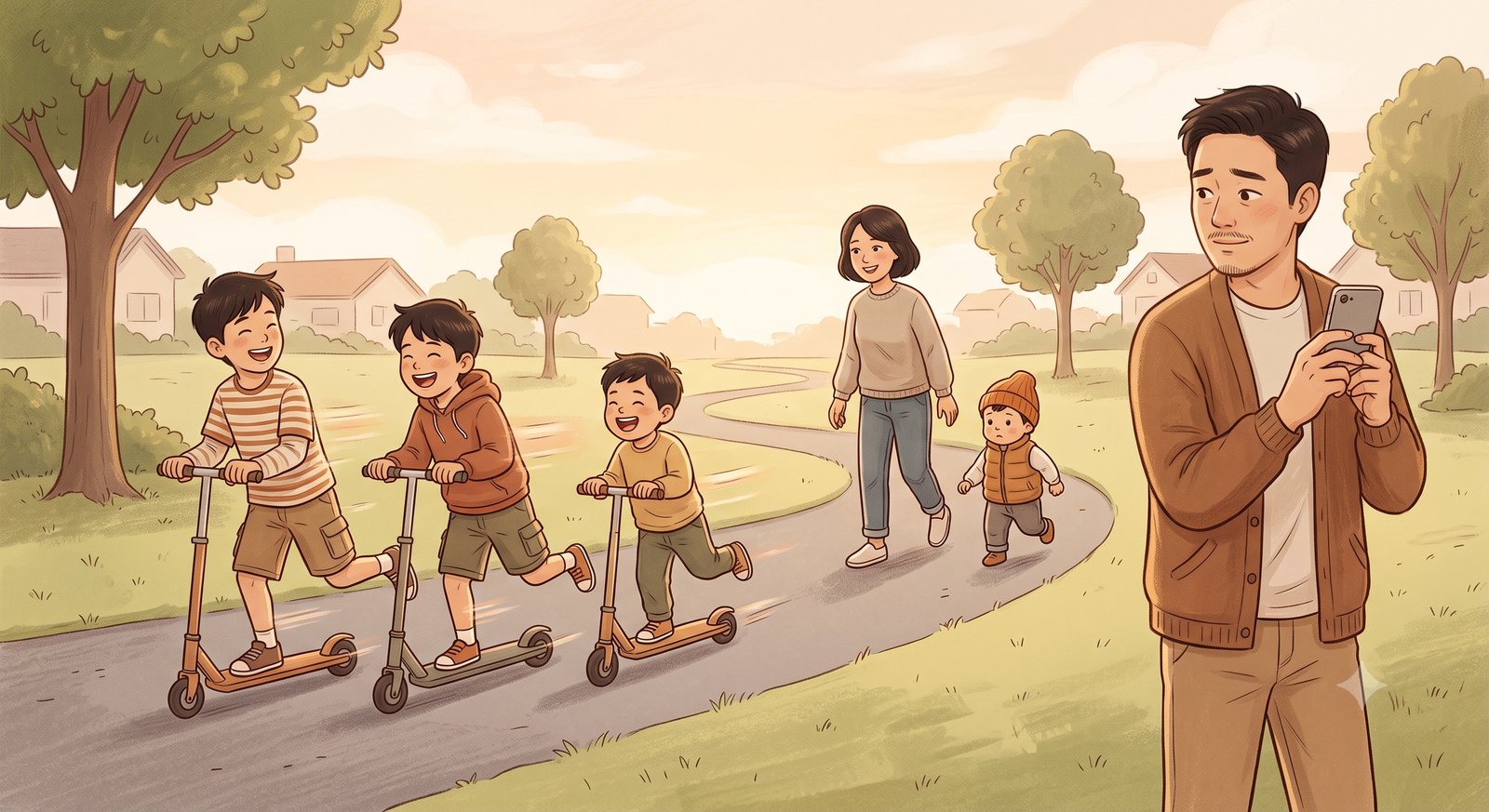
Every morning lately, our family goes out to exercise in the open area near our house. The boys ride their kickboards ahead of us. My wife walks. Number 4 — two years old, short legs, full commitment — trails along behind, refusing to be left out of whatever his brothers are doing. It’s an ordinary fifteen minutes. It is also, most mornings, the best fifteen minutes of my day.
And every morning, I stand there wanting to capture it, and all I have in my hand is my phone. Capturing family memories used to be second nature to me — now it’s the thing I miss most.
My phone camera is good. It is not a camera. It doesn’t take in the scene the way I’m experiencing it — the light, the noise of four boys, the specific way my wife laughs at something Number 2 just said. It flattens the whole thing into a clip I’ll scroll past in a month. And that gap between what I’m feeling and what the phone gives back to me is when I realized: I really want a proper camera in my hand again.
Capturing Family Memories Runs in My Family
This isn’t a new feeling. It’s inherited.
Before we moved from Korea to Uzbekistan, when I was a boy, my dad had a Nikon F-501. He carried it everywhere. I remember one day at an amusement park with my parents and my two brothers — all three of us running through a fountain area where water shot up randomly from holes in the ground, no pattern, just chaos and shrieking and getting completely soaked. We only had one spare set of clothes between us: our taekwondo uniforms. So that’s what we changed into. And my dad, camera in hand as always, photographed the three of us running through the fountain in our dobok, and then sitting together afterward, still dripping.
That photo is still hanging in my parents’ living room in Korea today. Every time I visit, it’s there.
My dad didn’t just own a camera. Camera and camcorder both, always within reach — every birthday, every ordinary Saturday, every trip, documented without anyone having to ask him to. I can go back to that house right now and open an album and watch our whole childhood play back. That’s not a small thing. That’s a father who decided, quietly and consistently, that this family was worth recording.
I didn’t choose to inherit that instinct. It just came with growing up in his house.
The Restless Years
I’ve owned more cameras than I’d like to admit as an adult. A Sony a7III first, after I got married — beautiful image quality, but the color science felt flat to someone who’d grown up loving what Canon does with color. So I sold it for a Fuji X-T4, which I loved — small in the hand, endless film-simulation profiles to play with. Then the pull of full-frame got me again with a Sony a7C, then a Panasonic S5II for the video specs, until the lenses got heavy enough to hurt my shoulder on hikes. Then a Nikon Zf, which might be the one I regret losing the most — the dials, the black-and-white monochrome shots, the whole feel of it in my hands.
I’m not proud of the churn. But underneath the restlessness was always the same thing my dad had: I wanted to carry something that could actually hold what I was seeing. Capturing family memories was never really about the gear — I wanted to take pictures with my sons, of our family, of whatever was happening in front of me. I loved it enough that I once took a picture of my own foot, just because the light was doing something interesting. (It’s the same instinct, I think, that shows up in how a hobby passes from one generation to the next in this house — you don’t teach it so much as you just keep doing it in front of them.)
The Camera I Sold on Purpose
My wife wanted a camera too. She’d started thinking about vlogging — documenting our ministry, our kids, our life here — and she needed real tools for it, not just my hand-me-down enthusiasm.
So I sold the Zf. In its place, I got her two cameras: a DJI Pocket 3 and a Sony ZV-E10 II.
There was a real conversation behind that decision, not just a budget spreadsheet. I knew she’d spent years living with my camera obsession — watching me buy, sell, upgrade, agonize over color science like it was a moral question. She’d earned the right to have what she wanted without a fight. So when the moment came, I didn’t hesitate. It felt like the right thing to do, and it still is. She uses those two cameras almost every day now. She’s happy. That part worked exactly like I hoped.
What I didn’t expect was how losing the Zf would actually feel, months later. It was the right call. I’d make it again. And I’ve also learned, with more honesty than I expected to need, that I love cameras more than I thought I did. Both of those things are true at the same time, and I’ve stopped trying to resolve them into one clean feeling.
The ZV-E10 II is a genuinely great camera. It also sits on a tripod in our room, because it was never really mine. I only pick it up when my wife asks me to — birthdays, anniversaries, the moments that need documenting. The best camera is supposed to be the one you actually carry with you. Right now, the one I carry is my phone.
The Part I Didn’t See Coming
Here’s what I didn’t plan for, and what’s made the whole thing feel less like a loss and more like a relay.
Number 1 recently discovered vlogging. On a trip with his mom, he picked up her DJI Action 6 and started talking to it — unprompted, completely on his own. “This is a zoo,” he’d announce, then explain something about whatever animal was in front of him. “This is the swimming pool,” and then a full breakdown of how fun it was. He’s awkward doing it — you can see him working out that he’s talking to a lens, not a person, and it doesn’t quite sit naturally yet. But underneath the awkwardness, you can see he’s actually enjoying it. That part isn’t performance.
Before all that, when I still had the Zf, he asked if he could hold it. I let him. He strapped it around his neck the way he’d seen me do a hundred times, put it on auto, and took a photo of Number 3 — his little brother, mid-moment, nothing posed. It came out genuinely decent. Not luck-decent. Actually good.
That’s the photo that did it, I think. Something clicked for him right there, holding a real camera and getting a real result. The curiosity that followed — the vlogging, the narrating, the wanting to hold the camera again — didn’t come from me teaching him anything. It came from one photo he took himself, of his brother, on a camera that wasn’t even his.
What I Actually Learned From All This
My dad carried a Nikon F-501 through a fountain full of shrieking kids in taekwondo uniforms because he wanted to hold onto that afternoon. I’ve cycled through six cameras chasing the same feeling. And now my son is narrating zoo animals into a lens, badly and joyfully, because one time he got to hold a camera that actually worked.
None of that required me to have the right gear. It didn’t even require me to have any gear at all — for months now, I haven’t. Capturing family memories, it turns out, was never actually about which camera was in my hands. It required a family that kept showing up to be recorded, and one photo that let my oldest feel what it’s like to actually catch a moment instead of just living through it.
I’m still hoping to get my hands on a Fuji again by the end of the year. I won’t pretend I’ve made peace with not having one. But I’ve stopped thinking the camera is the thing that matters. My dad’s F-501 is sitting in a drawer in Korea right now, not doing anything. The photo it took is still on the wall. That’s the part that lasted.
Whatever ends up in my hands next — or in Number 1’s, someday, if I have anything to say about it — I think that’s the only part I actually need to get right.