If you’re looking up how to handle a toddler tantrum in public, you already know the theory. Every parenting book says the same thing about tantrums: ignore them. Don’t give the tantrum your attention. Don’t hand your kid the upper hand. Stick to your no. It sounds simple on paper. In practice, most of us fail at it — not because the advice is wrong, but because we cave. We feel guilty. We feel sorry for them. Or honestly, we’re embarrassed, standing in a grocery store or a kids’ cafe with a kid going full volume, and it feels easier to just give in than to be the parent everyone’s staring at.
I’ve had tantrums happen to me in a store, at church, in a kids’ cafe — all the classic locations, all because a kid wanted something and wasn’t getting it. What I noticed, years into this, is that I was actually pretty good at saying no and meaning it. And because I stuck to it long enough, my boys learned something important: tantrums don’t work in this house. Not “don’t work most of the time.” Don’t work, period.
What “Ignore” Actually Means
When I say ignore, I mean it literally. Not a stern look, not a quiet negotiation in the cereal aisle — actually ignore it. No attention, no reaction, no acknowledgment that the tantrum is happening at all. The tantrum gets nothing from me. That’s the whole mechanism, and it’s really the same mechanism behind the discipline system that works for the rest of our house too. Kids escalate because escalation has worked before. The second it stops working, most of them stop trying it — eventually, and not always gracefully, but they stop.
How to Handle a Toddler Tantrum in Public: The Chocolate Bar Standoff
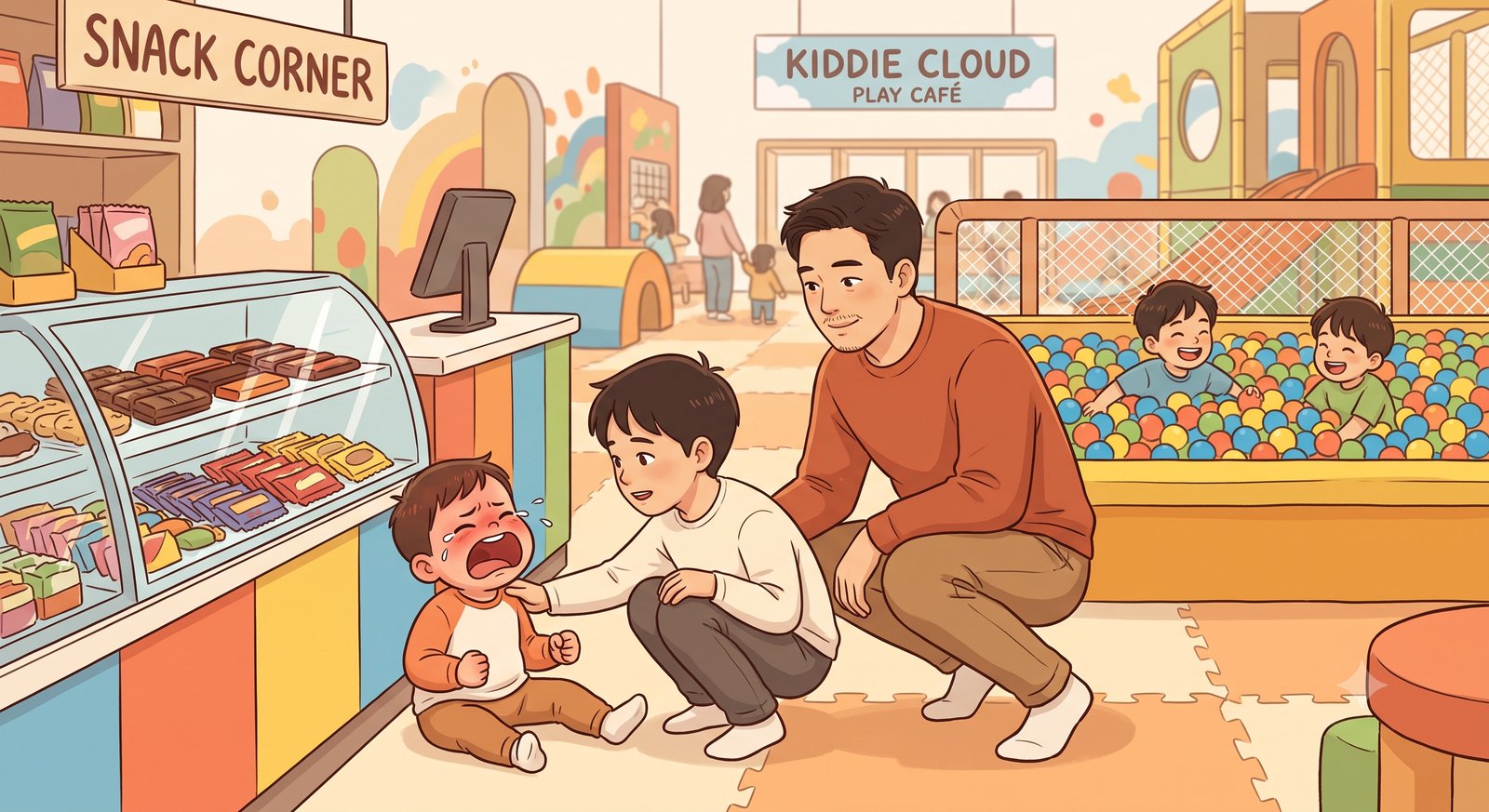
I remember one particular kids’ cafe, back when we still lived in Korea, the first time we ever took Number Three there. He was two, still a little unsteady on his feet, and completely thrilled to be turned loose in a ball pit for the first time in his short life. For a solid twenty minutes he did exactly what a two-year-old is supposed to do in a place like that — chased his brothers, face-planted into foam cubes, shrieked about something only he understood. Then, on his way past the snack counter, a chocolate bar in its shiny wrapper caught the light just right, and that was the end of the ball pit for him.
He beelined straight for my hand, grabbed it with both of his, and started hauling me toward the counter like he was landing a fish. I already knew this move. I’d seen it twice before — the grip, the pull, the little grunt of effort like I was the one being slow. So before he could even get the words out, I crouched down and told him: I’ll get it for you, buddy — before we leave.
That was the actual offer. A real yes, just not an immediate one. What made it into his two-year-old ears was one word: no. The “before we leave” part evaporated somewhere between my mouth and his understanding, and that was his cue to fall apart.
And he did, completely. Sat down right there on the floor, threw his head back, and let it out — the full production, tears, noise, the works. A couple of young part-timers behind the counter went a little wide-eyed, clearly unsure whether they were supposed to intervene, call a manager, or pretend to restock napkins. I gave them a small nod — it’s fine, he’s fine, this is just what two looks like sometimes — and knelt back down to try the explanation again, slower this time. I’ll buy it before we leave. Not right now. Same words. Same wall.
That’s when Number One wandered over, probably drawn by the noise, took one look at the situation, and crouched down to his little brother’s eye level like he’d done this a hundred times. He didn’t repeat my sentence. He translated it. “Dad’s gonna buy it when we’re done playing,” he said, in the easy, matter-of-fact tone only an older brother can pull off. Same information, word for word almost. But something about hearing “Dad’s gonna buy it” instead of whatever his two-year-old brain had filed my sentence under made it click. The crying stopped almost mid-breath. He wiped his face, took his brother’s hand, and trotted back off toward the ball pit like nothing had happened.
I’ve thought about that moment more than a two-minute chocolate bar standoff probably deserves. A tantrum is a symptom, not the actual problem — it’s a request that hit an error somewhere along the way and couldn’t get through. My son had the right instinct underneath all that noise: ask, then wait for the answer. He just had a corrupted subroutine running on top of it, and “tantrum” is what that particular bug is called. The second the exact same message got reformatted — same information, cleaner code, delivered by a different messenger — it ran without a hitch. If you want something, the job is to find the version of the request that actually runs. Breaking the system harder never gets you further down the line. It just crashes the whole program, chocolate bar and all.
Three Boys In, and the Tantrums Are Gone
At this point, I can’t remember the last real tantrum from my oldest three. Number four is still what I’d call in his internship phase — he’s two, and he’s learning the rules the same way his brothers did: by watching how they act in front of me and my wife, and by watching what happens next. He’s already throwing fewer tantrums than he used to. He’s figuring out which side of us he wants to be on. That’s not something I taught him directly — that’s patience compounding over time. The more of it you invest early, the less of it you need later.
Why It’s Not a Democracy
Here’s the part that’s harder to hear than “ignore the tantrum”: being strict with yourself means accepting that some people won’t like it. There’s a whole school of thought that says being a good parent means being agreeable — that saying yes, or at least negotiating, is the loving move. I don’t believe that. A tantrum is a demand, and a demand isn’t a discussion.
Our house doesn’t run like a democracy where every vote counts equally. It runs more like a household with a clear chain of command, because someone has to set the rules, and it isn’t going to be the two-year-old. My wife and I write the rules. Our boys live inside them until they’re old enough to write their own. But those rules only hold up because they come from love, not convenience. If we were making rules just to make our own lives easier, I think we’d have a full-blown mutiny on our hands. Kids can tell the difference between a rule that protects them and a rule that’s just about parental comfort, even if they can’t say it that way.
Whose Fault It Is Later
If we don’t teach our boys now how to handle hearing no, how to wait their turn, how to be told “not right now” and actually accept it — that’s not on them in ten years. That’s on us. I’ve watched other kids grow up without anyone ever holding a boundary with them, and it doesn’t end well once they’re adults dealing with a world that isn’t interested in their tantrums either. I’d rather my boys make their mistakes here, small, at home, where the cost is low and I’m still around to walk them through it — than let them find out the hard way later, when the cost is a lot higher and I’m not in the room.
I know which kind of dad that makes me. Some people would call it too strict. I’d rather be that than raise boys nobody wants to be around.
They Know Where the Line Is
None of this means my kids are scared of me in any way that worries me. We play. We’re genuinely close — my boys still come running when it’s time for our monster hunt game around the house. But they also know, instantly, when my tone changes. They know when they’ve actually crossed a line, not just annoyed me. When that happens, there’s a real consequence — not a production, just something that costs them right away, so the lesson actually lands. That mix is the whole point: real warmth, and real boundaries, at the same time. One without the other doesn’t raise the kind of men I’m trying to raise.
The Deal-Making Loophole
Here’s what’s interesting — my boys haven’t stopped wanting things. They’ve just stopped throwing tantrums to get them. What they do now instead is negotiate. If one of them wants ice cream, or a snack I don’t usually buy, he knows walking up and just asking gets him a no. So instead, he’ll come to me with an offer: “Dad, I’ll do the dishes tonight. I’ll walk Tori and clean up after her tomorrow morning. Can I get ice cream?”
That’s a deal I can work with. My love for them doesn’t have a price tag — that’s never up for negotiation. But privileges do, and I think that’s a good lesson for them to carry: almost everything worth having costs something, and if you’re willing to pay a fair price, most reasonable people are willing to make the deal. They’re getting surprisingly good at figuring out what counts as a fair price. Usually, I say yes.
What This Actually Comes Down To
If you came here looking for a script for how to handle a toddler tantrum in public, this is it: the tantrum was never really the problem. The problem was always whether I could hold a line when it was inconvenient, embarrassing, or exhausting to hold it. Ignoring a tantrum is easy advice to read and hard advice to actually live out in a crowded kids’ cafe with everyone watching. My son needed someone to hand him a version of “wait” that his own code could actually run. But before any of that could happen, I had to be the one who didn’t crash first. The discipline that mattered most in our house was never really about the kids. It was about whether I was willing to be strict with myself first.