Category: Discipline & Behavior

  • Why My Kids Stopped Throwing Tantrums (It Wasn’t About Discipline — It Was About Me)

    Why My Kids Stopped Throwing Tantrums (It Wasn’t About Discipline — It Was About Me)

    If you’re looking up how to handle a toddler tantrum in public, you already know the theory. Every parenting book says the same thing about tantrums: ignore them. Don’t give the tantrum your attention. Don’t hand your kid the upper hand. Stick to your no. It sounds simple on paper. In practice, most of us fail at it — not because the advice is wrong, but because we cave. We feel guilty. We feel sorry for them. Or honestly, we’re embarrassed, standing in a grocery store or a kids’ cafe with a kid going full volume, and it feels easier to just give in than to be the parent everyone’s staring at.

    I’ve had tantrums happen to me in a store, at church, in a kids’ cafe — all the classic locations, all because a kid wanted something and wasn’t getting it. What I noticed, years into this, is that I was actually pretty good at saying no and meaning it. And because I stuck to it long enough, my boys learned something important: tantrums don’t work in this house. Not “don’t work most of the time.” Don’t work, period.

    What “Ignore” Actually Means

    When I say ignore, I mean it literally. Not a stern look, not a quiet negotiation in the cereal aisle — actually ignore it. No attention, no reaction, no acknowledgment that the tantrum is happening at all. The tantrum gets nothing from me. That’s the whole mechanism, and it’s really the same mechanism behind the discipline system that works for the rest of our house too. Kids escalate because escalation has worked before. The second it stops working, most of them stop trying it — eventually, and not always gracefully, but they stop.

    How to Handle a Toddler Tantrum in Public: The Chocolate Bar Standoff

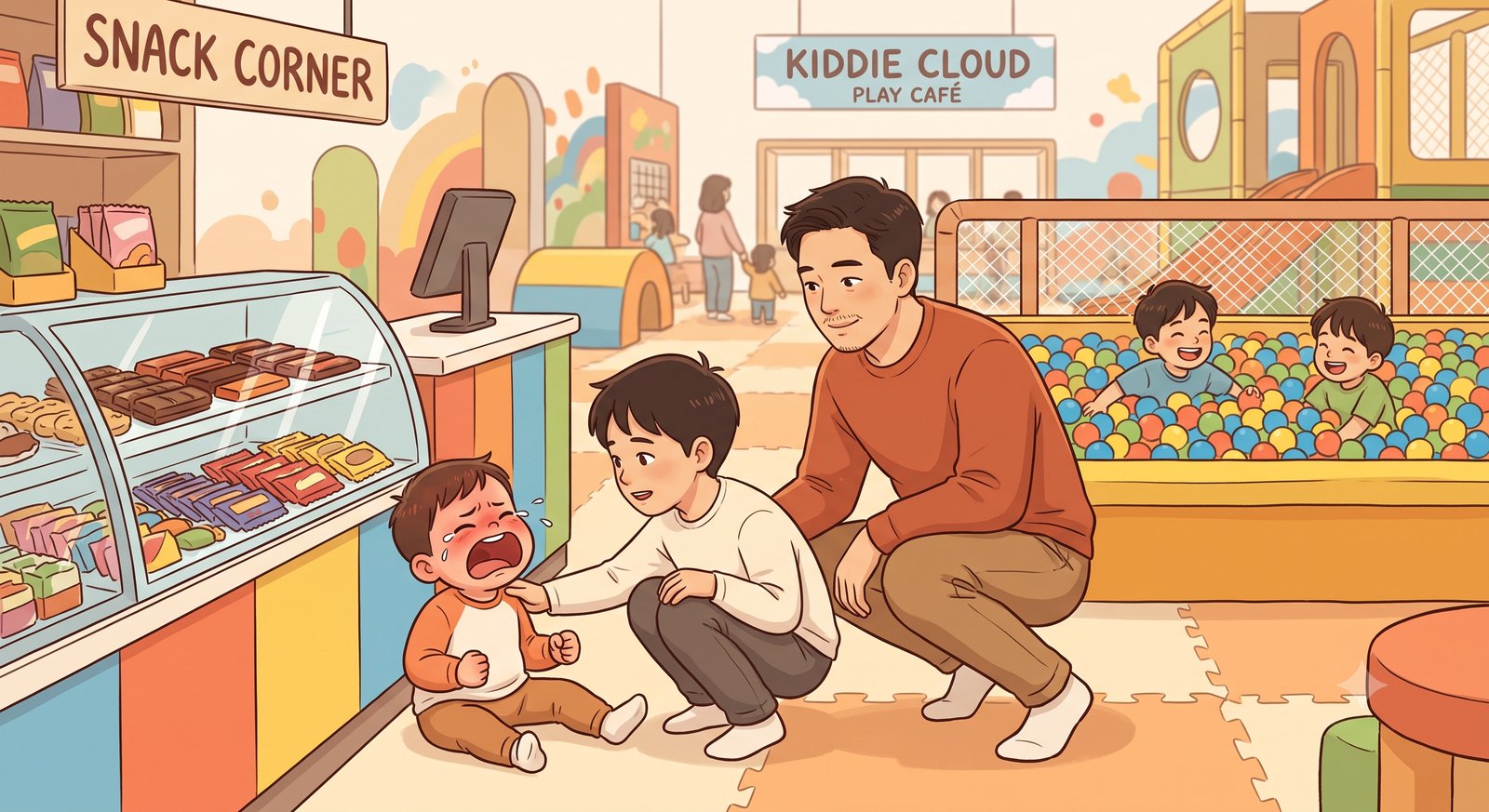
    I remember one particular kids’ cafe, back when we still lived in Korea, the first time we ever took Number Three there. He was two, still a little unsteady on his feet, and completely thrilled to be turned loose in a ball pit for the first time in his short life. For a solid twenty minutes he did exactly what a two-year-old is supposed to do in a place like that — chased his brothers, face-planted into foam cubes, shrieked about something only he understood. Then, on his way past the snack counter, a chocolate bar in its shiny wrapper caught the light just right, and that was the end of the ball pit for him.

    He beelined straight for my hand, grabbed it with both of his, and started hauling me toward the counter like he was landing a fish. I already knew this move. I’d seen it twice before — the grip, the pull, the little grunt of effort like I was the one being slow. So before he could even get the words out, I crouched down and told him: I’ll get it for you, buddy — before we leave.

    That was the actual offer. A real yes, just not an immediate one. What made it into his two-year-old ears was one word: no. The “before we leave” part evaporated somewhere between my mouth and his understanding, and that was his cue to fall apart.

    And he did, completely. Sat down right there on the floor, threw his head back, and let it out — the full production, tears, noise, the works. A couple of young part-timers behind the counter went a little wide-eyed, clearly unsure whether they were supposed to intervene, call a manager, or pretend to restock napkins. I gave them a small nod — it’s fine, he’s fine, this is just what two looks like sometimes — and knelt back down to try the explanation again, slower this time. I’ll buy it before we leave. Not right now. Same words. Same wall.

    That’s when Number One wandered over, probably drawn by the noise, took one look at the situation, and crouched down to his little brother’s eye level like he’d done this a hundred times. He didn’t repeat my sentence. He translated it. “Dad’s gonna buy it when we’re done playing,” he said, in the easy, matter-of-fact tone only an older brother can pull off. Same information, word for word almost. But something about hearing “Dad’s gonna buy it” instead of whatever his two-year-old brain had filed my sentence under made it click. The crying stopped almost mid-breath. He wiped his face, took his brother’s hand, and trotted back off toward the ball pit like nothing had happened.

    I’ve thought about that moment more than a two-minute chocolate bar standoff probably deserves. A tantrum is a symptom, not the actual problem — it’s a request that hit an error somewhere along the way and couldn’t get through. My son had the right instinct underneath all that noise: ask, then wait for the answer. He just had a corrupted subroutine running on top of it, and “tantrum” is what that particular bug is called. The second the exact same message got reformatted — same information, cleaner code, delivered by a different messenger — it ran without a hitch. If you want something, the job is to find the version of the request that actually runs. Breaking the system harder never gets you further down the line. It just crashes the whole program, chocolate bar and all.

    Three Boys In, and the Tantrums Are Gone

    At this point, I can’t remember the last real tantrum from my oldest three. Number four is still what I’d call in his internship phase — he’s two, and he’s learning the rules the same way his brothers did: by watching how they act in front of me and my wife, and by watching what happens next. He’s already throwing fewer tantrums than he used to. He’s figuring out which side of us he wants to be on. That’s not something I taught him directly — that’s patience compounding over time. The more of it you invest early, the less of it you need later.

    Why It’s Not a Democracy

    Here’s the part that’s harder to hear than “ignore the tantrum”: being strict with yourself means accepting that some people won’t like it. There’s a whole school of thought that says being a good parent means being agreeable — that saying yes, or at least negotiating, is the loving move. I don’t believe that. A tantrum is a demand, and a demand isn’t a discussion.

    Our house doesn’t run like a democracy where every vote counts equally. It runs more like a household with a clear chain of command, because someone has to set the rules, and it isn’t going to be the two-year-old. My wife and I write the rules. Our boys live inside them until they’re old enough to write their own. But those rules only hold up because they come from love, not convenience. If we were making rules just to make our own lives easier, I think we’d have a full-blown mutiny on our hands. Kids can tell the difference between a rule that protects them and a rule that’s just about parental comfort, even if they can’t say it that way.

    Whose Fault It Is Later

    If we don’t teach our boys now how to handle hearing no, how to wait their turn, how to be told “not right now” and actually accept it — that’s not on them in ten years. That’s on us. I’ve watched other kids grow up without anyone ever holding a boundary with them, and it doesn’t end well once they’re adults dealing with a world that isn’t interested in their tantrums either. I’d rather my boys make their mistakes here, small, at home, where the cost is low and I’m still around to walk them through it — than let them find out the hard way later, when the cost is a lot higher and I’m not in the room.

    I know which kind of dad that makes me. Some people would call it too strict. I’d rather be that than raise boys nobody wants to be around.

    They Know Where the Line Is

    None of this means my kids are scared of me in any way that worries me. We play. We’re genuinely close — my boys still come running when it’s time for our monster hunt game around the house. But they also know, instantly, when my tone changes. They know when they’ve actually crossed a line, not just annoyed me. When that happens, there’s a real consequence — not a production, just something that costs them right away, so the lesson actually lands. That mix is the whole point: real warmth, and real boundaries, at the same time. One without the other doesn’t raise the kind of men I’m trying to raise.

    The Deal-Making Loophole

    Here’s what’s interesting — my boys haven’t stopped wanting things. They’ve just stopped throwing tantrums to get them. What they do now instead is negotiate. If one of them wants ice cream, or a snack I don’t usually buy, he knows walking up and just asking gets him a no. So instead, he’ll come to me with an offer: “Dad, I’ll do the dishes tonight. I’ll walk Tori and clean up after her tomorrow morning. Can I get ice cream?”

    That’s a deal I can work with. My love for them doesn’t have a price tag — that’s never up for negotiation. But privileges do, and I think that’s a good lesson for them to carry: almost everything worth having costs something, and if you’re willing to pay a fair price, most reasonable people are willing to make the deal. They’re getting surprisingly good at figuring out what counts as a fair price. Usually, I say yes.

    What This Actually Comes Down To

    If you came here looking for a script for how to handle a toddler tantrum in public, this is it: the tantrum was never really the problem. The problem was always whether I could hold a line when it was inconvenient, embarrassing, or exhausting to hold it. Ignoring a tantrum is easy advice to read and hard advice to actually live out in a crowded kids’ cafe with everyone watching. My son needed someone to hand him a version of “wait” that his own code could actually run. But before any of that could happen, I had to be the one who didn’t crash first. The discipline that mattered most in our house was never really about the kids. It was about whether I was willing to be strict with myself first.

  • Mealtime Rules That Actually Work: How We Feed 4 Boys Without a Fight

    Mealtime Rules That Actually Work: How We Feed 4 Boys Without a Fight

    Every family needs mealtime rules for kids that actually hold up under pressure, and ours came together the hard way. Breakfast, I’ve already told you, runs on omelettes and a system tight enough to survive a two-year-old’s hunger alarm. Lunch and dinner are a different problem entirely, because all four of my boys — not just one of them, all four — have declared war on visible vegetables. Onions, garlic, carrots, you name it. If they can see it, they will find a way to explain what it is, object to it, and refuse it.

    So I stopped trying to win that fight head-on and started outsmarting it instead.

    If They Can’t See It, They Can’t Argue With It

    My solution is simple: dice everything small, and pan-fry it into whatever we’re making. Onions, garlic, carrots — all of it gets cut down small enough that it disappears into the dish. As long as the food tastes good and there’s a piece of meat in it somewhere, the boys don’t ask questions. They’re not rejecting the nutrition. They’re rejecting the idea of the vegetable. Take away the idea, and the fight goes with it.

    Because we’re feeding four growing boys real amounts of food, nutrition, and calories every day, we don’t overcomplicate what we make. It’s a rotation — a variety of fried rice, a variety of omelettes, a variety of soups. Traditional Korean dishes like kimchi stew or doenjang stew show up too, but those are the exception, not the rule. Those are dishes the boys still have to learn to eat. Everyday meals aren’t the place to fight that particular battle.

    What’s Actually on the Table

    For lunch, we keep it simple — rice with a side, usually dried or fried anchovies, sometimes small pork cutlets, sometimes just fried rice on its own.

    Dinner is where we lean harder on protein, and in our house that usually means chicken. Chicken breast is affordable here in Cambodia, so I marinate it for at least three hours before dinner. Some nights it gets pan-fried. Other nights I put the marinated chicken straight into the rice cooker with the rice, enough water and stock, and a handful of diced vegetables. What comes out the other end is basically steamed vegetable chicken rice, and it covers the whole meal in one pot.

    Every meal in this house follows the same philosophy: simple prep, simple meal, simple cleanup. I’m usually the one cooking — breakfast, and most of the time lunch and dinner too. I’ve been doing this a long time; I made my first fried rice at seven and my first omelette at nine. My wife takes over when I’m not around, or when I’m too worn out to be in the kitchen — she didn’t grow up cooking the way I did, since she lived in dormitories for years, where cooking for yourself just isn’t really a thing. Between the two of us, someone’s always covering the stove.

    Number Four Runs on His Own Rules

    One of our simplest mealtime rules for kids is that everyone sits down together. Numbers One, Two, and Three are taught to sit down at the table and eat with the whole family. Number Four has his own agenda at every single meal. Sometimes he follows along. Most of the time he’s walking or running around while he eats, distracted by whatever’s happening around him.

    What he will always eat, without exception, is protein — meat, eggs, anything along those lines. He’s not a picky eater in the way his brothers can be. He’s just not a sit-still eater yet, and at his age, we’ve decided that’s a battle for another year.

    You Eat What You Get, and You Finish What You Get

    This is one of the mealtime rules for kids that changed the most in our house. We used to run a one-bite rule — you had to try something before you were allowed to say no to it. That’s not our rule anymore.

    We recently sat down as a family and talked about what kind of men we actually want these boys to grow into. We want them to be role models. We want them to be respected. We want them to have real etiquette — and etiquette means learning to do things even when you don’t feel like doing them. That applies everywhere, and it applies at the table.

    So the rule now is straightforward: you eat what you get, and you finish what you get. Not because we’re indifferent to what they like. Because learning to finish what’s in front of you, even on the nights you’d rather not, is part of building the kind of character we’re aiming for.

    Their Own Dishes

    That same conversation about etiquette and responsibility led to another change. Numbers One, Two, and Three are old enough now, so their plates and bowls are theirs to wash — right after dinner, every night, no exceptions.

    On Saturdays we extend it further. The boys take turns covering dish duty across all three meals — breakfast, lunch, and dinner. It’s not optional and it’s not up for negotiation. If you ate off it, you clean it.

    No Screens at the Table — Mostly

    Mealtime is not screen time in our house. You eat your food, and then you move on to whatever’s next. That rule doesn’t bend at home.

    Where it does bend is when we’re out — eating at a restaurant, or in a setting that’s genuinely more chaotic than our own table. In those situations we allow screens, because the goal was never to be rigid for the sake of being rigid. The goal is a calm, focused meal, and at home that means no screens. Out in public, with more variables we can’t control, we pick the version of calm that actually works.

    The Curry Disaster

    Every parent has a mealtime disaster story. Mine involves curry, and it’s entirely my fault.

    I was cooking curry for the family and got pulled away for about ten minutes — someone needed help with something, and I lost track of time. By the time I got back to the stove, the curry had gone from its usual yellow-orange to dry, black, and smoking. I apologized to everyone, and we ordered pizza instead — with fries and garlic bread on the side. It’s not the best pizza in Battambang, but it’s edible, and it was more than good enough for the kids that night.

    Mistakes happen. Even people who cook every day burn something eventually, especially with kids who want your attention around the clock. The recovery matters more than the mistake did.

    Dessert Is Not a Right

    We don’t have a lot of rules around treats, but the one we do have is firm: you get dessert or snacks after you finish your meal. If you don’t finish what’s on your plate, there’s no dessert and no snacks. No exceptions, no bargaining.

    I keep my word on this every time, which is exactly why the boys believe it. A rule that’s enforced inconsistently isn’t a rule — it’s a suggestion, and kids know the difference faster than we give them credit for.

    What These Mealtime Rules for Kids Are Really About

    These mealtime rules for kids were never really about vegetables, or chicken, or whose turn it is to do dishes. They’re about the same thing we’re trying to build in every part of this house — boys who can do the right thing even when they don’t feel like it, because that’s what respect and etiquette actually require. Feed them well, hold the line, and let the table be one more place where that lesson gets practiced, one meal at a time.

  • Screen Time Rules That Actually Work: Our Gatekeeper System

    Screen Time Rules That Actually Work: Our Gatekeeper System

    Every parent I know is fighting the same war: the screen. And most screen time rules for kids fail for the same reason — the whining, the negotiating, and the meltdowns wear the parents down first. And most of the advice out there swings between two useless extremes — ban everything and raise your kids in 1854, or give up and let the tablet babysit.

    We did neither. We have four boys, ages nine to two, and screens in our house cause almost zero fights. Not because our kids are special — believe me — but because of a system we call the Gatekeeper Rule.

    Here’s the whole philosophy in one line: screen time is a blessing and a curse at the same time. Controlled, it’s a blessing. But the moment Mom and Dad go weak, it turns into a curse — because kids will abuse any privilege that isn’t guarded. Watching content isn’t the problem. I enjoy watching content myself. The problem is screens without rules.

    So we built rules. Real ones, with teeth.

    Screen Time Rule One: No Weekday Screens. None.

    Monday through Friday, there are no screens for the kids. No TV, no tablets, nothing. Zero.

    I know how extreme that sounds. But here’s what it does: it removes the single biggest source of daily negotiation from our house. There’s no “can I watch something after homework?” because the answer is structurally, permanently no — not because Dad is in a mood, but because it’s simply not a weekday thing. Kids stop asking for things that are never on the table. That alone eliminated most of our screen fights.

    (Friday night is the exception — that’s family movie night, which we control and watch together, and even the movie ends before 8:30 bedtime. The system bends for family time, never for solo screen time.)

    Fun Day: Structured Freedom

    Saturday is Fun Day — the day the boys get their screens. But even Fun Day has architecture:

    TV content happens in the morning. Gaming happens in the afternoon, after lunch. Never the reverse, never both at once. Splitting the windows means no single screen marathon, and the built-in break at lunch resets everyone’s brains before the Switch comes out.

    And here’s the part that makes the whole thing run — the Gatekeeper Rule itself:

    Every screen window is unlocked by a chore, and each brother holds a different gate.

    – Morning: Number 3 does the breakfast dishes. No dishes — nobody watches TV.

    – Lunch: Number 2 does the lunch dishes. No dishes — no gaming for anyone.

    – Evening: Number 1 does the dinner dishes. No dishes — next Saturday is at risk.

    Notice what this structure does. It’s not “do your chore, get your reward.” It’s “do your chore, or everyone loses the privilege.” Each boy is the gatekeeper for his brothers’ fun. They’re a team — if one fails, the consequences come together. The peer pressure runs itself: I’ve watched Number 2 remind Number 3 about the dishes with an urgency I could never generate as a parent. They police each other, because they’re all invested in the gate opening.

    And when a gatekeeper is genuinely sick on his day? Then it’s the parent’s duty to take over his gate — no penalty, no drama. We get sick sometimes, and sometimes we have to ask for a sick day; it’s the same for kids. Even that teaches them how the system society runs on actually works, on a minor scale: real teams cover for a teammate who’s down. What doesn’t fly is a mysterious illness that arrives at dish time and departs by TV time — Dad has seen that particular virus before.

    The Freeloader Clause

    Sharp-eyed readers will notice Number 4, our two-year-old, holds no gate. His brothers have noticed too. Yes — he’s a freeloader. He gets to watch without any chore responsibilities, and the older three have made peace with it.

    Here’s how we explain it to them: everyone in this house has the responsibility to do what they’re able to learn. For the older boys, that’s dishes, cleaning the room, picking up toys. For Number 4, it’s getting off the diapers, learning to use the toilet, learning to brush his own teeth. It’s the same rule — just different wordings for different ages.

    He’s in what we call his internship phase anyway: watching his brothers do the dishes and pick up toys, sometimes following along, sometimes fighting for his playtime instead — he’s two, that’s the job description. And honestly, his screen appetite is small. The mission videos his brothers love bore him; he’s a dinosaur-content man. Most of the time he skips the screen entirely in favor of his magnetic blocks, which he attaches to every metal surface in the house, including the entire staircase railing. More cleanup work for me. The internship continues.

    What About Sunday?

    Sunday runs on a different engine entirely, and I’ll be upfront about why: I’m a pastor and a missionary, and church isn’t an option in our family — it’s who we are. Service starts at 9am, and between worship, sermon, fellowship, and lunch, we’re usually home around 1pm. The boys genuinely enjoy it; they’ve got local friends there, and Grandma and Grandpa too.

    Screen-wise, Sunday afternoon is the loosest part of our whole week — deliberately so. Sometimes there’s screen time, and when there is, it’s afternoon-only and usually educational or faith-based content, nothing far off topic. Sometimes there’s no screen time at all, because we’re at the park as a family or over at the grandparents’ neighborhood instead.

    That flexibility is on purpose. Saturday is the structured screen day with gates and rules; Sunday is family-first, and screens only fill whatever space the day leaves over. Two different days, two different jobs.

    The Ban That Made It Real

    Rules only work if kids believe the consequences. Ours do, because of the month-long ban.

    A while back, the rules got broken badly enough that their favorite content — the Roblox and Minecraft mission videos — went away for an entire month. Not a weekend. A month. And I kept my word for all thirty days of it.

    That ban is now load-bearing family history. The kids know that whatever Dad says will actually happen. So they do their best to finish their jobs — not because they fear me, but because they’ve learned that my words and reality match. If you take one thing from this article, take that: one fully-enforced consequence is worth a hundred threatened ones.

    The Filter: A 90s Standard of Appropriate

    People always ask what we actually let them watch. Our filter is simple: nothing that conflicts with our family’s values and faith, nothing occult, nothing horror. (That last one is non-negotiable in our house — our Number 2 still has hard nights because of horror clips someone showed the kids at school. That’s a bedtime story for another article.)

    Beyond that? My standard is what I call the 90s standard of appropriate: if it would’ve been considered fine for kids in the 90s, it’s fine for mine.

    Yes, that includes Tom and Jerry. I’m aware that by modern sensibilities, Tom and Jerry is a shockingly violent program about a cat being repeatedly flattened by household objects. I grew up on it. I turned out fine. Some of the shows I loved would probably get flagged by every modern content committee for one reason or another — and yet my generation somehow survived cartoon anvils.

    What the boys actually watch on a Fun Day morning: Tom and Jerry, the Roblox and Minecraft mission videos, Bear Grylls’ survival series, and — their current obsession — Korean documentary channels about insects and wildlife. Real footage, real lab tests, real facts. It’s Magic School Bus without the magic, and the boys throw facts at us that we genuinely didn’t know. We also steer them toward Numberblocks, Alphablocks, and a Korean children’s channel that teaches the language. The house rule of thumb: we don’t want a diet of pure cartoons and gaming content. Educational content isn’t the vegetable they’re forced to eat — we’ve made it the thing they actually request.

    The Co-Watching Rule: Harry Potter and the Questions That Never Stopped

    Here’s the last layer, and honestly my favorite one: if it’s above their age grade, they don’t watch it alone. They watch it with me.

    Number 1 wanted to watch the Harry Potter movies. And to a nine-year-old, the first film is genuinely dark — a boy loses his parents, grows up an orphan with relatives who despise him, and then there are trolls, a three-headed dog, a dark lord with no nose. Intriguing, fun, and a little scary. He wanted the company.

    Now, there are two kinds of movie watchers in this world: watchers and askers. My son is an asker. He asks every question, during the movie, the moment it forms — because he needs to know. He takes after his mom, and I’ll confess that back when we were dating, the mid-movie interrogation was the one part of movie dates I didn’t love. God has a sense of humor: He gave me a son with the same feature.

    But this time, the questions were the whole point. It was his movie choice, and it was my job to walk him through the whys, the hows, and the what-ifs. Why is Voldemort evil? Why are people mean? Why would anyone attack Harry and his friends?

    And that opened the conversation I actually wanted to have: this world isn’t just rainbows and butterflies. There is evil in it — evil that will sometimes come at you for no reason — and pretending otherwise doesn’t protect kids, it just leaves them unprepared. A lot of content today teaches that nobody’s really a bad guy, just a good guy who made accidental bad choices. I think different. Evil exists. And so does good: people with kindness, humility, and love, who will stand up and fight for what’s right. Those are the people you keep close — the way Harry kept Ron and Hermione close.

    My son got all of that from a movie night with his dad. That’s what co-watching buys you: the screen stops being a babysitter and becomes a classroom where Dad is in the room to explain the hard parts. Some content isn’t “too old” for your kid — it’s too old for your kid alone.

    Our Screen Time Rules for Kids, in One Paragraph

    Our screen time rules for kids are simple: no screens on weekdays, ever — so there’s nothing to negotiate. Friday movie night together. Saturday is Fun Day: TV in the morning, gaming after lunch, and every window is unlocked by a brother’s chore, so the boys enforce the system on each other — and a parent covers the gate of a genuinely sick gatekeeper, the way any real team covers a teammate. Sunday is family-first — church, grandparents, sometimes a park — with screens only filling the leftover space, if any. The toddler freeloads, as is his birthright, until his internship ends. Content passes a values filter and a 90s standard of appropriate. Anything above their grade gets watched with Dad. And every consequence that gets spoken gets executed — ask the boys about the month with no mission videos.

    Screens didn’t get less fun at our house. They got predictable. And it turns out that’s what kids actually wanted all along: not unlimited screens, but a clear, unmovable answer to when, what, and how — so they can stop lobbying and just enjoy the Saturday they earned.

    The gate opens every week. They just have to open it themselves.

  • How to Stop Siblings From Fighting (And What to Do When You Can’t)

    How to Stop Siblings From Fighting (And What to Do When You Can’t)

    If you’re searching for how to stop siblings from fighting, you’ve probably already tried everything. I need to tell you something honest

    You can’t. Not completely. Not forever.

    I grew up as the middle child of three boys. I know what sibling fighting looks like from the inside. I’ve had a dislocated shoulder. A dislocated jaw. My little brother once had a hole pierced into his forearm during a game of war with wooden spears. We were not gentle with each other. We also loved each other completely. Those two things coexisted without contradiction.

    Now I watch my own four boys and I see the exact same pattern — because it was never really about us. It’s about boys. It’s about energy that has nowhere to go until it finds somewhere.

    Let me be clear about something before we go further: I don’t think getting hurt is bad. A scratch, a bruise, a nosebleed — these are not emergencies. They build character. They teach resilience. They teach kids that actions have physical consequences, which is a lesson no classroom can replicate. When you treat a bruise like nothing, it becomes nothing to the child. They react as much as the parent reacts.

    Growing up, my brother and I got our hands on long sticks and a camping knife our dad didn’t know about. We decided — logically, creatively — that making sharp wooden spears would be fun. It was fun. It was thrilling. Right up until my brother’s arm started dripping blood.

    We didn’t scream. We didn’t panic. We were more worried about Dad finding out than about the wound itself. We found antibiotic ointment and gauze, patched him up ourselves, and went on with our lives. Dad didn’t notice until the scar had already formed. We still talk about that afternoon like it’s one of our best memories.

    The spear story is not a cautionary tale. It’s a love story about brothers who trusted each other enough to do something genuinely stupid together.

    How It Actually Starts

    Here’s the thing about sibling fights that no parenting article ever says plainly: most of them don’t start as fights.

    They start as fun.

    Numbers 1, 2, and 3 will be roughhousing — genuinely laughing, genuinely enjoying themselves — and then something tips. A tackle that landed wrong. A grip that held too long. Someone’s elbow found someone else’s nose in a way that was nobody’s fault and everybody’s problem. One second it’s play, the next someone is screaming and someone else is crying and I’m standing in the doorway trying to figure out what exactly I walked into.

    The fight wasn’t the point. The play was. The fight was just the exhaust.

    Number 4 sometimes wanders into these situations, which adds an entirely new dimension. A two-year-old doesn’t understand that roughhousing has unspoken rules. He just sees his brothers doing something energetic and joins in at full speed without checking the terms and conditions first. This never ends smoothly.

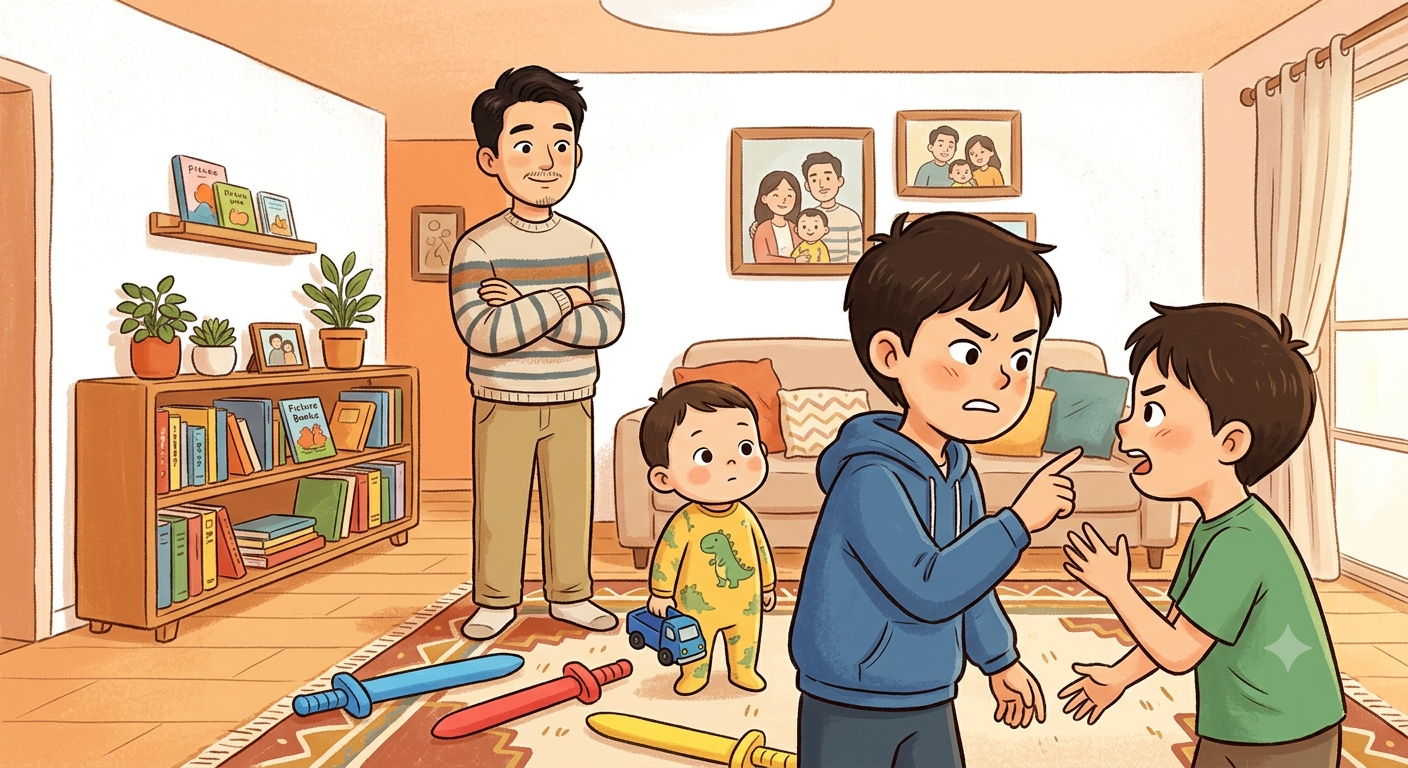
    Our roughplay has one real boundary: if it becomes violently dangerous, it stops. Not painful — dangerous. There’s a difference. I bought the boys sponge swords. They beat each other with those swords until bruises appeared. That’s fine. A nosebleed is fine. What’s not fine is using words as weapons — inappropriate names, things designed to humiliate rather than compete. That has consequences. Physical roughplay is sport. Verbal cruelty is something else entirely.

    The Dumbest Fight We Ever Had

    I have to tell you about the sound fight.

    Numbers 2 and 3 were playing. Number 3 made a sound — for fun, just a noise — and Number 2 said it sounded like something. Number 3 disagreed. Number 2 insisted. Number 3 insisted back.

    This went on. The volume escalated. The tone shifted. By the time I got there, they were screaming at each other with the conviction of men defending something deeply important.

    I separated them. Took them to their rooms. Did the full investigation — Room A, then Room B, then the verdict.

    Neither of them could tell me what they were fighting about.

    Literally. They did not remember. The argument had evolved past its own origin point and become its own creature, disconnected from whatever sparked it. I only found out what actually happened later, when Number 1 pulled me aside and explained the whole sequence.

    They had been screaming at each other over a sound.

    This is what happens with boys. The content of the fight becomes irrelevant almost immediately. What remains is the energy of the fight — and that energy needs somewhere to go.

    What We Actually Do — The Open Court and Its Limits

    For serious disputes, we use Open Court. Everyone in one room, cases made one by one, Dad as lawyer, prosecutor, and judge. I’ve written about this in detail in our discipline system — it works, the boys know the routine, and truth is the standard they all accept.

    But Open Court has limits. And the biggest one is this: most sibling fights aren’t about fault.

    They’re accidents. Roughplay that got out of hand. A sound that turned into a screaming match for reasons nobody can reconstruct afterward. You can’t hold a trial for an accident. There’s no guilty party. There’s just traffic that needs order.

    So my wife and I made a decision: let them handle it themselves.

    One note on Number 4 entering the picture specifically. When he joins the roughhousing, he almost always becomes the variable that tips it. He’s not physically built to hold his own against any of his brothers — but he charges in anyway, full speed, no strategy. When he misses and falls, he cries because he didn’t get to crash into anyone. When he connects, he looks around with an expression of complete innocence, takes one second to assess the damage, and delivers the most blunt apology you’ve ever heard from a two-year-old. The brother who is lying on the floor holding his stomach has no real choice but to accept it. You can’t stay angry at someone who genuinely doesn’t understand the weight of what they just did.

    Giving Number 1 the Job

    We’ve talked in previous articles about Number 1’s role in this house — the privileges that come with being the eldest, and the responsibilities that follow. This is where that responsibility becomes real.

    When things tip from play into conflict, Number 1’s job is to find a solution. My wife and I step back and watch.

    What we discovered surprised us. More often than not — they don’t need us. They’ll argue, they’ll debate, and then one of them will say something that breaks the tension, and suddenly they’re laughing again and back to roughhousing like nothing happened. The whole cycle resets in minutes.

    When you jump in immediately, you interrupt that natural resolution. You make yourself the solution instead of letting them build the skill of being each other’s solution. The most worrisome moments, left alone, turn out to not be worrisome at all.

    But Number 1 doesn’t always pull it off. And that’s worth saying honestly.

    Number 1 is not the charismatic older brother who commands a room. He’s the sensitive one — rule-follower, soft heart — who carries authority because we gave it to him, not because he was born with the kind of presence that makes younger brothers automatically stand down. Number 2 knows this. Number 2 has tested it. There have been incidents where Number 2 wanted to find out exactly how far he could push the boundary of Number 1’s authority — how far he could crawl up before something stopped him.

    In those moments, I step in. Number 2 always regrets it when I do. And I step in not just for Number 1’s sake, but because my authority is connected to his. When someone tests Number 1, they’re testing the system I built.

    I’ll be honest: sometimes I watch Number 1 trying to hold the line with his brother and I think, quietly, that I wish he would just smash the rebel once and settle it. But that’s not who Number 1 is. And maybe that’s fine. The world needs Captains who lead through order and not force.

    Growing up, crawling up on my older brother was not something I considered seriously. Doing so would have meant writing the final dates on my own gravestone. Growing up as Number 2 in my family taught me that some authority is enforced with presence alone. Number 1 is still learning how to build that. We’re patient.

    The Day Number 3 Became My Favorite

    I need to tell you about the snack incident.

    My wife distributed snacks equally among the four boys. Equal portions, everybody’s happy — that’s the theory. Then Number 2 looked at Number 1’s portion and decided he wanted some. He took some. Number 1 did not accept this peacefully.

    It escalated fast. Snacks are serious. The negotiation collapsed into conflict.

    And then Number 3 stood up, walked over to his angry brother, and handed him his entire portion.

    My wife and I looked at each other. Neither of us said anything for a second.

    We asked him later why he did it. He’s five years old. He thought about it for a moment and said:

    “Because fighting is bad.”

    We all know fighting is bad. Every kid knows fighting is bad — they’ve been told a thousand times. But Number 3 was the only one in that room who looked at a fight and asked himself what he could actually do about it. The answer he found was sacrifice.

    He became, unofficially, my favorite son. Don’t tell the others.

    What You Can Actually Control

    You cannot stop siblings from fighting — and any system that promises otherwise is selling something. What you can do is build a household where:

    Roughplay has boundaries. Not rules that eliminate it — boys need to wrestle, it’s developmental — but an understanding of when it’s gone too far. In our house, the moment someone is genuinely hurt or genuinely angry, the play stops. Full stop.

    The eldest has real responsibility. Not just nominal authority, but actual accountability for the peace of the group. Number 1 knows that when things tip, it’s his job to find a way through. That weight has made him more mature, not less happy.

    Resolution is their skill, not yours. Every time you solve it for them, you take a rep away from them. Let them argue it out. Let them find the exit. Step in when it’s necessary — not when it’s uncomfortable.

    The unexpected peacemaker gets celebrated. Number 3 giving away his snack was one of the best moments of my parenting life. We told him that. Explicitly. We named it, we praised it, and he has done it again since — not because we demanded it, but because he learned that generosity lands differently than force.

    You can’t stop siblings from fighting.

    But you might raise one who figures out how to end it.

  • The Chore System That Finally Got Our Kids to Help Without a Fight

    The Chore System That Finally Got Our Kids to Help Without a Fight

    Finding a chore chart for kids that works feels impossible — until you stop trying to reason with a parliament and start running a benevolent dictatorship.

    If you’ve ever asked a child to pick up their toys and received a fully prepared courtroom defense in return, welcome. You’re among friends here.

    For years, our house ran on what I call manual gear. That’s the control concept where you believe — genuinely, adorably believe — that you can simply tell your kids what to do and they’ll do it. Chores, favors, basic human cooperation. You give the command, they execute. That’s the theory.

    The reality? Kids have minds of their own. They don’t rebel with pitchforks. They rebel with debate. They’d rather negotiate the terms of picking up one Lego than actually pick up the Lego. And with four boys in the house, I wasn’t running a household. I was running a parliament where nobody had been elected and everybody had opinions.

    So we changed the system. And I’m going to tell you exactly how — including the part where I had to use what I can only describe as “good manipulation.”

    Our House Is Not a Democracy

    Let me say the thing out loud that most parenting blogs won’t: our house is not a democracy. It’s a dictatorship.

    Before you close the tab — hear me out. A benevolent one. I show the example first, and the boys follow. Rules are rules. Chores are not a choice. When I say the toys get cleared before bed, the toys get cleared before bed. There’s no vote. There’s no committee. There is Dad.

    And for Numbers 1, 2, and 3, this works beautifully. Number 1 is our Captain America — nine years old, rule-follower, soft heart. You give him a system and he practically salutes. Number 2 is Thor: full power, no filter, immediate regret. He’ll protest loudly, then comply, then feel bad about the protest. Number 3 is Spider-Man, our five-year-old peacemaker who’s rarely the problem and often the solution. When Numbers 1 and 2 argue about whose turn it is to water the dog, Number 3 will sometimes just do it himself — not because he was told to, but because fighting about it seemed like more effort than the chore.

    But Number 4? Number 4 is two years old, pure chaos, and here’s the thing about him: he doesn’t want to live under the dictatorship.

    He wants to be the dictator.

    The Robot Dinosaur Coup

    Every regime faces a coup eventually. Ours came in the form of a robot dinosaur.

    Number 4 seized Number 2’s favorite robot dinosaur and declared it his own. Not borrowed. Not shared. His. Full annexation. And he was not giving it back — not for anything.

    I tried the standard dictatorship move first. A firm NO. A direct command: return the dinosaur to your brother. This works on the older three every time.

    It bounced off Number 4 like rain off a window.

    So I switched systems. If dictatorship was stalling, it was time for a little socialism. What’s yours is ours. What’s ours is his. Everything is for sharing — which sounds lovely until you realize sharing cuts both ways.

    I crouched down and asked him, “Whose toy is this?”

    “Mine.”

    “No. It’s Number 2’s.” I said it right in front of Number 2, on purpose. The owner needed to hear Dad acknowledge the ownership just as much as the thief needed the correction.

    “Did you ask Number 2 for the toy?”

    “…No.”

    There it was. So I laid out the new terms: “You took Number 2’s toy without asking, right?”

    “Yes.”

    “Then you need to give what’s yours to Number 2. That’s only fair. If you keep being stubborn, I will give your toys to Number 2 — because you took his.”

    And for the first time in the entire standoff, Number 4 stalled. You could see the tiny gears turning. His toys? Going to Number 2? The math was suddenly not in his favor.

    In the end, he asked — actually asked — if he could play with the dinosaur. Number 2 lent it to him, kept it in Number 4’s hands until the little guy got bored, and got it back without a single scream. The dictatorship held. It just needed a policy update for one very specific citizen.

    The Chore Blueprint: Evening Tasks, First Floor Only

    Here’s what our actual system looks like, because the philosophy is fun but the blueprint is what you came for.

    Everything happens in the evening, on the first floor. We deliberately have no morning chores. Mornings are for a relaxed start — nobody should begin their day being nagged about toys. Instead, before bed, the boys handle their zone:

    – Clear all toys off the floor

    – Shelve their books

    – Give the puppy fresh water

    – Do their own dishes at least once a week

    That’s it. It’s not an elaborate chart with fifty stickers. It’s a small, repeatable set of tasks that protects the one thing every parent wants: a peaceful morning.

    And I want to be clear about the word “required.” These aren’t suggestions. I demonstrate everything myself — the dictator works too — and the boys are expected to follow at least to the bare minimum.

    The Gatekeeper Rule: No Chores, No Screen Time

    Every system needs an enforcement mechanism, and ours is simple: no chores, no screen time.

    Screen time in our house is already rare and scheduled. Friday night is movie night. Saturday is Fun Day — Switch 2 and their favorite (heavily filtered) content. Sunday follows the same weekend rhythm. That’s it. No weekday screens at all.

    Which means those weekend privileges are precious. And precious things make excellent leverage.

    We’ve pulled the trigger on this, too. We have a strict rule about verbal fighting — debating is fine, screaming at each other is not. Words can be as violent as fists. One week, the older boys got into a full shouting match and got caught. That Saturday, their favorite YouTube gaming content — the Roblox and Minecraft mission videos they love — was off the table.

    They once lost that show for an entire month. Believe me, they learned their lesson. Well — up until the lesson wore off, which is a topic for another article. But the point stands: the consequences are real, the boys know it, and the system enforces itself far better than my voice ever did.

    Number 4’s Internship

    A quick word on age boundaries, because I know someone’s asking, “You make your two-year-old do dishes?”

    No. Numbers 1, 2, and 3 are active participants in the system. Number 4 is in what we call his internship phase. His chores are: growing up, learning to use the potty, and watching his older brothers work. That’s the whole job description.

    What he actually does is undo. Number 1 stacks the books neatly — Number 4 unstacks them. Number 3 puts the toys on the shelf — Number 4 pulls three back off. The older boys find this deeply frustrating and somehow still love him anyway. He has also learned that the kitten eyes work on his brothers too, which he deploys strategically when his internship activities create conflict.

    He’s learning the system by osmosis, the same way interns everywhere learn — by hovering nearby and occasionally causing problems.

    The Mosquito Rule: Proof the System Works

    Here in Cambodia, we have one rule with a 100% compliance rate, and it’s not one I enforce at all.

    Our main entrance has two doors — a steel security door and a mosquito net door. The boys close them both, every single time, along with every window in the house. No reminders. No threats. Some of them check the windows subconsciously now, the way you pat your pocket for your keys.

    Why? Because one night, a window was left open, and the boys spent the entire night getting eaten alive. We had to run a full mosquito extermination operation the next day. It was miserable, it was itchy, and it was educational.

    That’s the secret hiding inside our whole chore system: kids follow rules perfectly when the consequence is immediate and personal. Mosquito bites teach themselves. Chores don’t — the consequence of a messy house is delayed and abstract to a seven-year-old. So the system’s job is to make consequences feel closer: skip your chores tonight, lose the Switch on Saturday.

    You can’t make every rule a mosquito rule. But you can build your system so the sting arrives close enough to the choice that even Thor thinks twice.

    The dictatorship endures. The dinosaur is back on Number 2’s shelf. And the mornings — the blessed, chore-free mornings — are peaceful.

    Mostly.

  • The Discipline System We Use for 4 Boys Under 10 (No Yelling — Mostly)

    The Discipline System We Use for 4 Boys Under 10 (No Yelling — Mostly)

    If you’re looking for how to discipline kids without yelling, I want to be upfront with you before we go any further:

    I yell.

    Not as a strategy. Not on purpose. But I am a dad of four boys under ten and sometimes my emotional governor fails and the volume goes up and the message comes out louder than intended. It happens. I’m not proud of every moment of it, and I’m also done pretending it doesn’t exist.

    That said — here’s what I’ve actually built into our house as a discipline system. The stuff that works more often than it doesn’t.

    The Goal of Discipline Is Not Guilt

    This matters before anything else.

    The goal is not to make the child feel bad. It’s not to punish for punishment’s sake. The goal is for them to genuinely understand that what they did was wrong — not because Dad is angry, not because there are consequences, but because the action itself was wrong.

    Getting that understanding into a small boy’s head takes time. Some boys longer than others. And if you’ve read my earlier posts, you already know that my four boys have four completely different operating systems.

    The discipline has to match the boy. One size does not fit all.

    What Dogs Taught Me About Raising Boys

    I’ve grown up with dogs my whole life. Right now we have a puppy poodle at home learning the rules of the house — and watching him go through training reminded me of something important.

    Dogs respond to training because it benefits them. Do something right, get a treat. The repetition builds the behavior. The dog doesn’t do it because it was told to. It does it because it learned that the behavior is good for it.

    I’m not saying boys are dogs. I want to be clear about that.

    But I am saying: we spend a lot of energy disciplining our kids when they do something wrong. How often do we actively praise them when they do something right? Do I tell my boys when they handled something well? Do I make a point of noticing the good behavior the same way I notice the bad?

    Discipline without recognition is imbalanced parenting. And imbalanced parenting produces kids who only learn what not to do — never what to reach for.

    In our house, praise comes with a treat. Literally. Ice cream when we have it, or coin chocolates when we don’t. Sometimes a little extra screen time for educational videos — Man vs. Wild with Bear Grylls is a favorite. When one of the boys spontaneously cleans up after himself, or suddenly decides to do the dishes without being asked — which is rare, but it happens — that gets rewarded immediately.

    Does it create permanent habits overnight? No. All discipline requires repetition. All treats do too. But here’s what it has built over time: the boys now know exactly what Mom and Dad are looking for. The next step — and we’re working toward it — is waiting for them to intentionally choose the good instead of accidentally stumbling into it. That’s the real finish line. We’re not there yet. But we’re closer than we were.

    The Volume Problem (Boys Have an Extra Input dB)

    I am convinced that boys are born with a higher hearing threshold than the rest of humanity.

    One afternoon I called Number 2 by name. Softly. Once. Twice. Three times. Four times. Nothing. He was right there. I could see him. He did not respond.

    I raised my volume. Called him again.

    He noticed. Not responded — noticed. Like something had finally penetrated the atmosphere.

    I tried once more. This time he looked up and answered.

    I asked him why he hadn’t responded when I called his name the first four times. He looked at me completely sincerely and said: “I didn’t hear you.”

    He wasn’t lying. That’s the thing. He genuinely didn’t hear me.

    Soft voices don’t land on little boys. And yet — whisper the words “snack,” “game,” or the name of literally any food they love, and they will hear it from two floors away through a closed door.

    This is not selective hearing. This is engineering. Boys are built differently.

    So I’ve learned to separate two things that look similar but aren’t: talking loudly and yelling. Talking loudly is simply adjusting the volume to reach the target. It carries a message. Yelling carries an emotion — and the boys know the difference immediately. They feel the difference. The message in a loud voice lands. The emotion in a yell lands differently, and not in a way that helps anyone.

    The Investigation System — Dad as Lawyer, Prosecutor, and Judge

    When there’s a dispute between the boys — which is daily, sometimes hourly — I don’t try to settle it in the room where it happened with everyone talking at once.

    I separate them.

    Room A gets one boy. Room B gets another. I go to Room A first and take the full account. Then I go to Room B. I get the full picture from both sides before I say a single word about what happened.

    Then I bring the verdict.

    When all four are involved — which happens — we move to Open Court. Everyone in one room. It’s louder. It’s more chaotic. At some point Number 4 will attempt to make his case despite being two years old and not having a firm grasp on the events in question. But we make it happen. They know the routine. They know the rules of engagement. They make their cases one by one, and we rely on truth — which, remarkably, they all accept as the standard.

    It took time to get here. I built the system with Number 1 first. Then Number 2. Then 3. Number 4 was born into it — he arrived to a household that already had a functioning court, and he’s learning the rules the same way the others did. One case at a time.

    I am the lawyer, the prosecutor, and the judge in this household — and I take all three roles seriously. Each boy has to understand specifically what he did wrong. Not just “you were fighting.” What exactly was the action, why was it wrong, and what should have happened instead.

    Then comes the apology. And I am specific about what the apology has to contain. “Sorry” alone doesn’t work. “I’m sorry I hit you because I was angry” is a start. They have to name the action. They have to say it to each other’s face.

    After that comes the warning: next time this same issue comes up, there will be consequences.

    Consequences — Wall Sits, and Yes, Spanking

    For smaller disputes, the consequence is a wall sit. One to three minutes depending on what happened. It’s physical, it’s uncomfortable, and it’s memorable without being harmful.

    For serious offenses, I spank. I know that lands differently depending on who’s reading this. Here’s exactly how it works in our house.

    The severity matters. If the offense involved violence that left a bruise or a mark — one spank. If it involved a dangerous object used intentionally against a brother — that’s three. The use of a weapon, even a toy used as one, shows intention. That’s a different level of wrong and the consequence reflects it.

    In our house it comes with strict rules that I don’t break:

    Rule 1: If I am angry, I do not spank. Spanking in anger is not discipline — it’s an emotional outburst with physical contact. I wait until I’m calm.

    Rule 2: Maximum three. Never more.

    Rule 3: Only the butt. Never anywhere else.

    Rule 4: After every single spanking, without exception — a hug. And I tell them: I love you more than anything in this world. It breaks my heart to do this. I do it because I need you to remember that what you did was morally wrong, and I love you too much to let you grow up thinking it wasn’t.

    My five-year-old already understands this. He knows that spanking in our house comes from love, not anger. The difference is real and he feels it.

    The Bluey Problem

    I need to talk about Bluey.

    If you’re a dad with young kids and you haven’t watched Bluey — prepare yourself. If you have watched it, you already know what I’m about to say.

    Bluey is a toxic cartoon for dads. Not because it’s bad. Because it’s too good. Bandit — the dad in the show — is patient, creative, present, playful, and emotionally intelligent in every single episode without fail, and watching him makes me feel a specific kind of guilt that no other piece of media has ever produced in me.

    I don’t know how Bandit does it. I would genuinely like to ask him. I think he has answers that the rest of us don’t.

    But here’s what I want to say to every parent who’s reading this after losing their cool today:

    It’s okay. You yelled. Your child probably earned it. Take a breath, remind yourself that this small person is still in development — their attention skills, their moral reasoning, their impulse control are all literally still forming — and get back to the work.

    You are disciplining your children for their future. Not for your comfort. Not for your reputation. For who they are going to become.

    The Alpha System — Number 1 Sets the Standard

    Now — if you’ve recovered from the Bluey guilt — one last thing that’s made a real difference in our house.

    Our government may be democratic. Our house is a dictatorship. Mom and Dad are King and Queen and that is not up for debate.

    But within the boys, there is a hierarchy that I’ve started to lean into rather than fight. Number 1 is nine years old and he is the alpha of the group. The younger three watch him. They follow his lead whether he intends it or not.

    So I’ve given him the privileges of Number 1 — and the responsibility of Number 1. He knows he’s in charge when Dad isn’t in the room. He knows his behavior sets the standard for his brothers.

    What does that look like practically? If Number 1 wants to try Roblox for the first time, we talk about it. If he wants to watch Minecraft content on YouTube, that’s a negotiation with responsibilities attached. If he wants to buy a game for the family Nintendo, I’m open to reasoning — but there are terms. We work it out together.

    Numbers 2, 3, and 4 have no such say. They know this. They try to talk their way into decisions anyway, because boys always try. It doesn’t work. But Number 1’s requests get heard, considered, and sometimes approved — because that’s what it means to be Number 1 in this house.

    I grew up as Number 2 in my own family. I know exactly how that works. You watch Number 1. You learn from Number 1. You follow Number 1.

    Give your eldest the weight of that role — respectfully, age-appropriately, with support — and you’ll find the whole system starts to run a little smoother on its own.

    The Same Offense, Four Different Boys

    I said earlier that the discipline has to match the boy. Let me show you what that actually looks like.

    Number 1 — Captain America. Rule-follower. Soft heart. When he does something wrong, a calm conversation is enough. He processes it, he feels it, and he corrects. He doesn’t need much. A look from Dad sometimes does the job.

    Number 2 — Thor. Seven years old, full power, no filter. He will do things without processing them first. Something happens, and two seconds later you can see it on his face — the realization that he crossed a line he didn’t even see coming. When he gets scolded, he goes full grumpy Thor in Asgard — bear belly, arms crossed, the whole production. I feel bad every time I have to discipline him because the regret is always genuine and immediate. I try to let him off with a warning more often than not. But he unintentionally crosses the line too much for warnings to always be enough. He doesn’t mean to. That almost makes it harder.

    Number 3 — Spider-Man. The peacemaker. He would hand over his own treat to end a dispute between his brothers. He rarely gets into trouble, and when he does, it’s almost always about not wanting to share — which for him is so out of character that the surprise alone is usually enough to correct the behavior.

    Number 4 — Joy Hulk. Two years old. Still learning that his body is larger than his awareness of it. The discipline for him is mostly redirection at this stage. He doesn’t fully understand consequences yet. But he’s watching. They’re always watching.

    Same household. Same rules. Four completely different approaches to getting through to each one.

    Actions have consequences. Love always comes after. And Number 1 sets the tone.

    That’s the system.