If you’re looking for how to discipline kids without yelling, I want to be upfront with you before we go any further:
I yell.
Not as a strategy. Not on purpose. But I am a dad of four boys under ten and sometimes my emotional governor fails and the volume goes up and the message comes out louder than intended. It happens. I’m not proud of every moment of it, and I’m also done pretending it doesn’t exist.
That said — here’s what I’ve actually built into our house as a discipline system. The stuff that works more often than it doesn’t.
The Goal of Discipline Is Not Guilt
This matters before anything else.
The goal is not to make the child feel bad. It’s not to punish for punishment’s sake. The goal is for them to genuinely understand that what they did was wrong — not because Dad is angry, not because there are consequences, but because the action itself was wrong.
Getting that understanding into a small boy’s head takes time. Some boys longer than others. And if you’ve read my earlier posts, you already know that my four boys have four completely different operating systems.
The discipline has to match the boy. One size does not fit all.
What Dogs Taught Me About Raising Boys
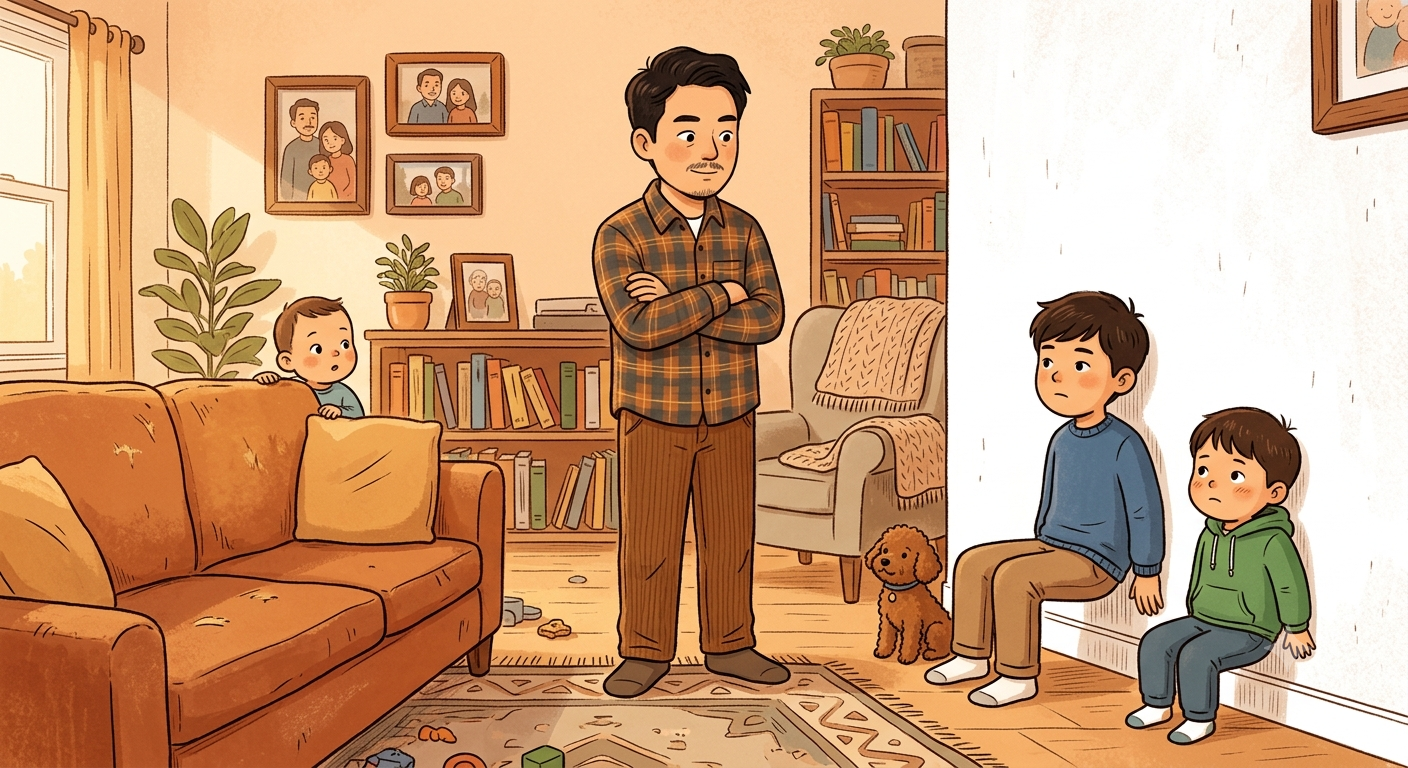
I’ve grown up with dogs my whole life. Right now we have a puppy poodle at home learning the rules of the house — and watching him go through training reminded me of something important.
Dogs respond to training because it benefits them. Do something right, get a treat. The repetition builds the behavior. The dog doesn’t do it because it was told to. It does it because it learned that the behavior is good for it.
I’m not saying boys are dogs. I want to be clear about that.
But I am saying: we spend a lot of energy disciplining our kids when they do something wrong. How often do we actively praise them when they do something right? Do I tell my boys when they handled something well? Do I make a point of noticing the good behavior the same way I notice the bad?
Discipline without recognition is imbalanced parenting. And imbalanced parenting produces kids who only learn what not to do — never what to reach for.
In our house, praise comes with a treat. Literally. Ice cream when we have it, or coin chocolates when we don’t. Sometimes a little extra screen time for educational videos — Man vs. Wild with Bear Grylls is a favorite. When one of the boys spontaneously cleans up after himself, or suddenly decides to do the dishes without being asked — which is rare, but it happens — that gets rewarded immediately.
Does it create permanent habits overnight? No. All discipline requires repetition. All treats do too. But here’s what it has built over time: the boys now know exactly what Mom and Dad are looking for. The next step — and we’re working toward it — is waiting for them to intentionally choose the good instead of accidentally stumbling into it. That’s the real finish line. We’re not there yet. But we’re closer than we were.
The Volume Problem (Boys Have an Extra Input dB)
I am convinced that boys are born with a higher hearing threshold than the rest of humanity.
One afternoon I called Number 2 by name. Softly. Once. Twice. Three times. Four times. Nothing. He was right there. I could see him. He did not respond.
I raised my volume. Called him again.
He noticed. Not responded — noticed. Like something had finally penetrated the atmosphere.
I tried once more. This time he looked up and answered.
I asked him why he hadn’t responded when I called his name the first four times. He looked at me completely sincerely and said: “I didn’t hear you.”
He wasn’t lying. That’s the thing. He genuinely didn’t hear me.
Soft voices don’t land on little boys. And yet — whisper the words “snack,” “game,” or the name of literally any food they love, and they will hear it from two floors away through a closed door.
This is not selective hearing. This is engineering. Boys are built differently.
So I’ve learned to separate two things that look similar but aren’t: talking loudly and yelling. Talking loudly is simply adjusting the volume to reach the target. It carries a message. Yelling carries an emotion — and the boys know the difference immediately. They feel the difference. The message in a loud voice lands. The emotion in a yell lands differently, and not in a way that helps anyone.
The Investigation System — Dad as Lawyer, Prosecutor, and Judge
When there’s a dispute between the boys — which is daily, sometimes hourly — I don’t try to settle it in the room where it happened with everyone talking at once.
I separate them.
Room A gets one boy. Room B gets another. I go to Room A first and take the full account. Then I go to Room B. I get the full picture from both sides before I say a single word about what happened.
Then I bring the verdict.
When all four are involved — which happens — we move to Open Court. Everyone in one room. It’s louder. It’s more chaotic. At some point Number 4 will attempt to make his case despite being two years old and not having a firm grasp on the events in question. But we make it happen. They know the routine. They know the rules of engagement. They make their cases one by one, and we rely on truth — which, remarkably, they all accept as the standard.
It took time to get here. I built the system with Number 1 first. Then Number 2. Then 3. Number 4 was born into it — he arrived to a household that already had a functioning court, and he’s learning the rules the same way the others did. One case at a time.
I am the lawyer, the prosecutor, and the judge in this household — and I take all three roles seriously. Each boy has to understand specifically what he did wrong. Not just “you were fighting.” What exactly was the action, why was it wrong, and what should have happened instead.
Then comes the apology. And I am specific about what the apology has to contain. “Sorry” alone doesn’t work. “I’m sorry I hit you because I was angry” is a start. They have to name the action. They have to say it to each other’s face.
After that comes the warning: next time this same issue comes up, there will be consequences.
Consequences — Wall Sits, and Yes, Spanking
For smaller disputes, the consequence is a wall sit. One to three minutes depending on what happened. It’s physical, it’s uncomfortable, and it’s memorable without being harmful.
For serious offenses, I spank. I know that lands differently depending on who’s reading this. Here’s exactly how it works in our house.
The severity matters. If the offense involved violence that left a bruise or a mark — one spank. If it involved a dangerous object used intentionally against a brother — that’s three. The use of a weapon, even a toy used as one, shows intention. That’s a different level of wrong and the consequence reflects it.
In our house it comes with strict rules that I don’t break:
Rule 1: If I am angry, I do not spank. Spanking in anger is not discipline — it’s an emotional outburst with physical contact. I wait until I’m calm.
Rule 2: Maximum three. Never more.
Rule 3: Only the butt. Never anywhere else.
Rule 4: After every single spanking, without exception — a hug. And I tell them: I love you more than anything in this world. It breaks my heart to do this. I do it because I need you to remember that what you did was morally wrong, and I love you too much to let you grow up thinking it wasn’t.
My five-year-old already understands this. He knows that spanking in our house comes from love, not anger. The difference is real and he feels it.
The Bluey Problem
I need to talk about Bluey.
If you’re a dad with young kids and you haven’t watched Bluey — prepare yourself. If you have watched it, you already know what I’m about to say.
Bluey is a toxic cartoon for dads. Not because it’s bad. Because it’s too good. Bandit — the dad in the show — is patient, creative, present, playful, and emotionally intelligent in every single episode without fail, and watching him makes me feel a specific kind of guilt that no other piece of media has ever produced in me.
I don’t know how Bandit does it. I would genuinely like to ask him. I think he has answers that the rest of us don’t.
But here’s what I want to say to every parent who’s reading this after losing their cool today:
It’s okay. You yelled. Your child probably earned it. Take a breath, remind yourself that this small person is still in development — their attention skills, their moral reasoning, their impulse control are all literally still forming — and get back to the work.
You are disciplining your children for their future. Not for your comfort. Not for your reputation. For who they are going to become.
The Alpha System — Number 1 Sets the Standard
Now — if you’ve recovered from the Bluey guilt — one last thing that’s made a real difference in our house.
Our government may be democratic. Our house is a dictatorship. Mom and Dad are King and Queen and that is not up for debate.
But within the boys, there is a hierarchy that I’ve started to lean into rather than fight. Number 1 is nine years old and he is the alpha of the group. The younger three watch him. They follow his lead whether he intends it or not.
So I’ve given him the privileges of Number 1 — and the responsibility of Number 1. He knows he’s in charge when Dad isn’t in the room. He knows his behavior sets the standard for his brothers.
What does that look like practically? If Number 1 wants to try Roblox for the first time, we talk about it. If he wants to watch Minecraft content on YouTube, that’s a negotiation with responsibilities attached. If he wants to buy a game for the family Nintendo, I’m open to reasoning — but there are terms. We work it out together.
Numbers 2, 3, and 4 have no such say. They know this. They try to talk their way into decisions anyway, because boys always try. It doesn’t work. But Number 1’s requests get heard, considered, and sometimes approved — because that’s what it means to be Number 1 in this house.
I grew up as Number 2 in my own family. I know exactly how that works. You watch Number 1. You learn from Number 1. You follow Number 1.
Give your eldest the weight of that role — respectfully, age-appropriately, with support — and you’ll find the whole system starts to run a little smoother on its own.
The Same Offense, Four Different Boys
I said earlier that the discipline has to match the boy. Let me show you what that actually looks like.
Number 1 — Captain America. Rule-follower. Soft heart. When he does something wrong, a calm conversation is enough. He processes it, he feels it, and he corrects. He doesn’t need much. A look from Dad sometimes does the job.
Number 2 — Thor. Seven years old, full power, no filter. He will do things without processing them first. Something happens, and two seconds later you can see it on his face — the realization that he crossed a line he didn’t even see coming. When he gets scolded, he goes full grumpy Thor in Asgard — bear belly, arms crossed, the whole production. I feel bad every time I have to discipline him because the regret is always genuine and immediate. I try to let him off with a warning more often than not. But he unintentionally crosses the line too much for warnings to always be enough. He doesn’t mean to. That almost makes it harder.
Number 3 — Spider-Man. The peacemaker. He would hand over his own treat to end a dispute between his brothers. He rarely gets into trouble, and when he does, it’s almost always about not wanting to share — which for him is so out of character that the surprise alone is usually enough to correct the behavior.
Number 4 — Joy Hulk. Two years old. Still learning that his body is larger than his awareness of it. The discipline for him is mostly redirection at this stage. He doesn’t fully understand consequences yet. But he’s watching. They’re always watching.
Same household. Same rules. Four completely different approaches to getting through to each one.
Actions have consequences. Love always comes after. And Number 1 sets the tone.
That’s the system.