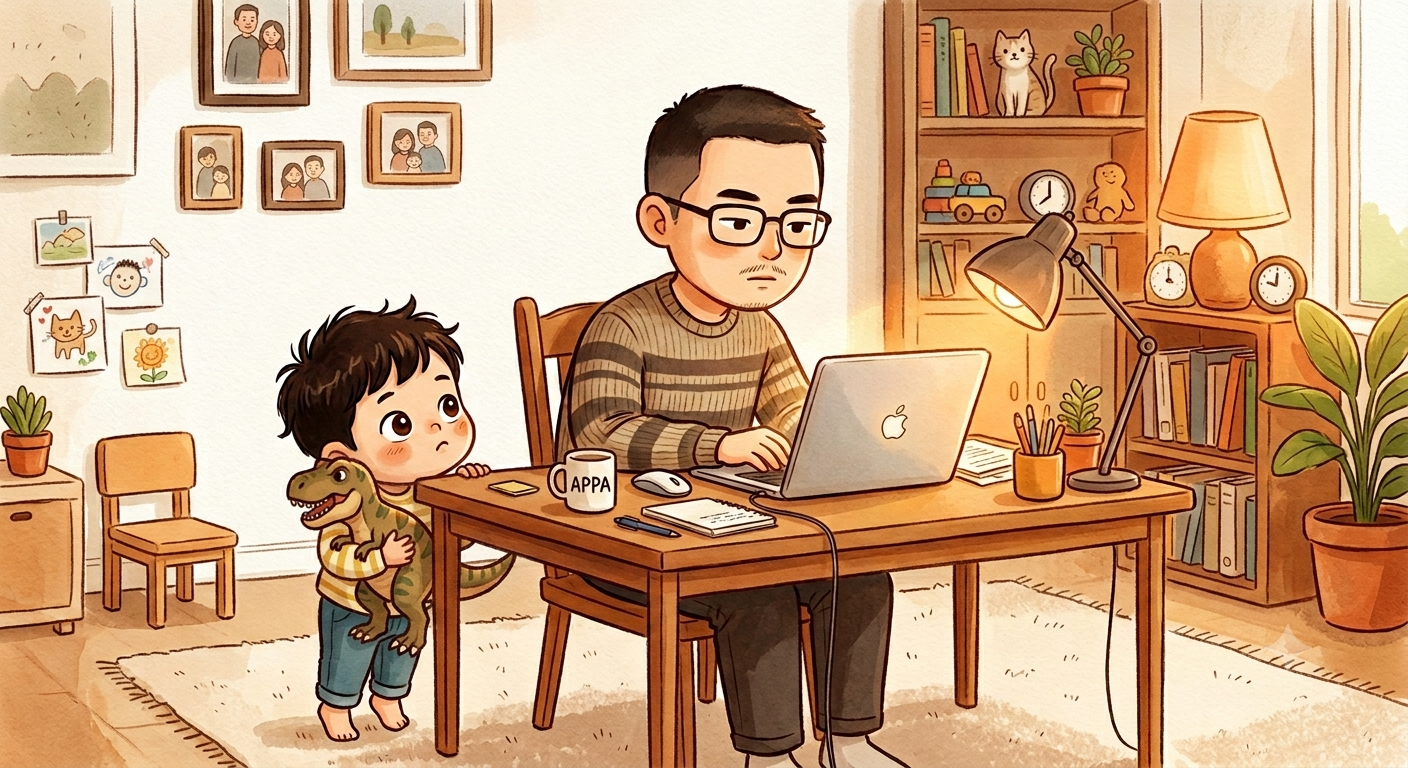
If you’re searching for how to focus with toddlers around, I want to start by telling you about Kronosaurus.
Kronosaurus is an aquatic dinosaur — think Mosasaurus from Jurassic World, but apparently cooler. I know this because my two-year-old has made it his entire personality. He is obsessed. He talks about it constantly. And apparently, when Dad is sitting at a desk staring at a screen, the only logical conclusion a two-year-old can reach is that Dad is watching Kronosaurus without him.
He walks up to my desk. He looks at the screen. He says, with complete sincerity:
“Kronosaurus?”
And the negotiation begins.
How to Focus With Toddlers Around — Teaching a Toddler What Work Is
I’ve been working on this longer than you might think. Ever since Number 4 started understanding even a little bit of what was happening around him, I’ve been deliberately giving him the message: Dad is busy. Dad is working. This is not screen time.
Does he fully understand? No. He’s two. But he’s getting there.
The concept I’m trying to install in his head is actually a complex one when you break it down: Dad is looking at a screen, but it’s not for fun. It’s work. Work is different from play. Dad gets to do it, and you don’t — not right now — and that’s not unfair, it’s just how it works.
Try explaining that to someone who learned the word “yes” before he learned the word “work.”
So for the most part, my strategy with Number 4 is simple: I zone in. I put on my focused face. I make it clear through body language and routine that when Dad is at the desk, Dad is in a different mode. And more often than not, he accepts this. He wanders off. He finds something else. The system works.
Until it doesn’t.
But here’s something that surprised me about Number 4 compared to his brothers — when the system is working and he’s accepted that Dad is busy, he’s actually a remarkably good solo player.
He takes the Kronosaurus — which technically belongs to Number 1, but Number 4 has declared full sovereignty over it and nobody is contesting this — and he builds entire story worlds with it. He collaborates with insects and other dinosaurs from across the room. He narrates things under his breath. He is creative and self-sufficient in a way I didn’t fully expect.
The key insight: he doesn’t want screen time as much as he wants company. Just knowing Dad is in the room is often enough. He’s not trying to take over your work session. He just doesn’t want to be alone.
Once I understood that, the whole dynamic shifted. I’m not fighting for isolation. I’m just holding a boundary on the screen — and as long as he has his Kronosaurus and a room with toys, he can work with that.
The Tantrum — Ah-Ni-Ya
There was a day when nothing went through.
He snapped.
He had been watching his brothers get screen time, watching Dad get screen time, and apparently reached the conclusion that he was the only person in the entire household being denied this basic right. The injustice was too much. He broke.
He screamed at the top of his lungs. He threw his favorite toy. He stood in the middle of the room and shouted “Ah-Ni-Ya” — over and over — which means “No” in Korean, and which he deployed with the energy of a seasoned protest leader.
My reaction?
The mask. No expression. Completely serious face.
Inside I was laughing so hard I could barely breathe. Because here’s the thing — I’ve already been through this exact scene three times. I’ve watched Number 1, Number 2, and Number 3 all run this same play. I know exactly what it is, I know exactly how it ends, and I know that the worst thing I can do is let him see that I find him adorable right now.
So I waited.
The System — Let the Tantrum Burn Out
Here’s what I’ve learned about toddler tantrums after four boys:
They are not a problem to solve. They are an energy source to wait out.
If you’re at home and a toddler is mid-meltdown, do not negotiate. Do not escalate. Do not try to reason with someone who just used their entire vocabulary to say “No” seventeen times in a row.
Make eye contact. Stay calm. Wait.
Some kids burn through it in thirty seconds. Some take longer. But eventually — always — they rev down. The engine runs out of fuel. The screaming softens. The crying slows. And somewhere in there, they look at you and something shifts.
That’s your window.
Once Number 4 started winding down, I got on his level and asked him:
“Are you okay?”
“Were you angry because you didn’t have screen time?”
“Were you sad because Dad said no?”
“But Number 4 — Dad told you why screen time isn’t allowed right now.”
“We can have screen time later. Is that okay?”
To every single question, he answered: “Yes.”
Did he understand half of what I asked? Probably not. But he knows that “yes” is the answer that moves things forward. And what changed during that whole exchange is that he was heard. He knew Dad saw him, understood what he wanted, and gave him a timeline.
He could work with a timeline. He just needed one.
The Nuclear Option — Kitten Eyes
I need to warn you about something.
His brothers taught him this.
When all else fails — when the tantrum didn’t work, when the negotiations failed, when Dad has held the line — Number 4 deploys the kitten eyes.
You know what I mean. The slow blink. The slightly pouty lower lip. The small, devastatingly cute sound effect that accompanies the look. The whole production.
His brothers figured out years ago that Mom and Dad have a specific soft spot — and that this soft spot becomes completely indefensible when activated by the youngest member of the household. So they passed the knowledge down. They taught him. He learned.
It works approximately 50% of the time.
Here’s the sound that goes with it: a high-pitched, soft hm~~~ — not a word, not a cry, just a sound effect. The closest I can describe it is a very gentle, very cute “please” that exists entirely outside the realm of human language. It’s something between a whimper and a melody. It should not be as effective as it is.
I try. I genuinely try to hold the line. But when those eyes lock onto yours and that sound kicks in — I’m not going to sit here and tell you I’m made of stone. I’m not. Nobody is.
After four boys, my overall success rate against manipulation tactics is probably around 78%. That number went up dramatically with Number 4 because I was trained by Numbers 1, 2, and 3. I’ve seen every play. I know every move.
Except this one. The kitten eyes with the sound effect. That one I still haven’t fully figured out how to counter. I’m not sure it’s possible.
The good news is that this is his last resort. He only brings it out when everything else has failed. Which means if you can survive the tantrum and the negotiation, you’ve got maybe a coin flip’s chance of making it through the kitten eyes.
Maybe.
How the Older Boys Learned — And Why Number 4 Is Different
The older three didn’t learn “Dad is working” the way Number 4 is learning it.
When Number 1 was two years old, I was in seminary. Living in a dormitory. I came home on weekends. He didn’t fully understand where Dad went during the week — but he understood one thing clearly: when Dad is home, Dad can wrestle with me, throw me on the mattress like Superman, and play. When Dad is away, none of that is available.
So he made a simple calculation. He wanted Dad home. And home meant accepting that sometimes Dad works — because that was still better than Dad being gone entirely.
Numbers 2 and 3 learned the same lesson naturally, by watching Number 1. They inherited the understanding.
Number 4 was born into a house where Dad is already home most of the time. He’s never had to want Dad home — Dad just is home. So the trade-off that trained his brothers doesn’t apply to him. He’s learning it from scratch, without that context.
That’s why he’s still in progress. And why I’m still losing 22% of the battles.
When You Absolutely Cannot Be Interrupted
There are moments when the regular system isn’t enough. High-stakes work — a video call, urgent sermon prep, something with a real deadline — requires a different protocol.
Here’s exactly what I do, in order:
Option 1 — Call in the wife. Same principle as always: explain everything, give a timeline, TMI is never TMI. She takes over. I disappear into the work.
Option 2 — Deploy Number 1. If all four boys are home, I call Number 1 and tell him to apprehend Number 4. He does it. Willingly. Because Number 1 is Captain America and he takes his responsibilities seriously. This works surprisingly well and has the added benefit of giving Number 1 a sense of authority he genuinely enjoys.
Option 3 — Give up. Give Number 4 what he wants and try again later. I don’t recommend this one. The side effects are real: he learns that Dad is vulnerable, and these kids will absolutely use that information against you every chance they get. But sometimes the work can wait and the two-year-old cannot. You make the call.
The system, in order of preference: wife, Number 1, retreat.
What Actually Works — The Real System
After all of this — the Chronosaurus requests, the Ah-Ni-Ya protests, the kitten eyes — here’s what actually helps me focus with toddlers around:
Establish the routine early. The earlier you start giving a toddler the concept of “Dad works now,” the faster they absorb it. Number 4 is two and he already understands the desk means something different from the couch. That didn’t happen by accident. It happened by consistency.
Don’t break under the tantrum. The moment you give in during a meltdown, you’ve taught them that the meltdown works. One capitulation costs you ten future battles. Hold the line, wait it out, then talk to them calmly after.
Give them a timeline, not a refusal. “No” is a wall. “Later” is a door. Number 4 can live with later. He cannot live with never. The distinction matters more than you’d think for a two-year-old.
Accept the 50% loss rate on kitten eyes. You’re human. They’re adorable. Some battles you lose and that’s okay. The key is that the routine and the consistency are doing the real work — the occasional kitten eye surrender doesn’t undo the system.
And when none of that works?
You put on the mask. You wait. You remind yourself that you’ve done this three times already.
And you do not — under any circumstances — let him see you smile.