If you’re searching for how to stop siblings from fighting, you’ve probably already tried everything. I need to tell you something honest
You can’t. Not completely. Not forever.
I grew up as the middle child of three boys. I know what sibling fighting looks like from the inside. I’ve had a dislocated shoulder. A dislocated jaw. My little brother once had a hole pierced into his forearm during a game of war with wooden spears. We were not gentle with each other. We also loved each other completely. Those two things coexisted without contradiction.
Now I watch my own four boys and I see the exact same pattern — because it was never really about us. It’s about boys. It’s about energy that has nowhere to go until it finds somewhere.
Let me be clear about something before we go further: I don’t think getting hurt is bad. A scratch, a bruise, a nosebleed — these are not emergencies. They build character. They teach resilience. They teach kids that actions have physical consequences, which is a lesson no classroom can replicate. When you treat a bruise like nothing, it becomes nothing to the child. They react as much as the parent reacts.
Growing up, my brother and I got our hands on long sticks and a camping knife our dad didn’t know about. We decided — logically, creatively — that making sharp wooden spears would be fun. It was fun. It was thrilling. Right up until my brother’s arm started dripping blood.
We didn’t scream. We didn’t panic. We were more worried about Dad finding out than about the wound itself. We found antibiotic ointment and gauze, patched him up ourselves, and went on with our lives. Dad didn’t notice until the scar had already formed. We still talk about that afternoon like it’s one of our best memories.
The spear story is not a cautionary tale. It’s a love story about brothers who trusted each other enough to do something genuinely stupid together.
How It Actually Starts
Here’s the thing about sibling fights that no parenting article ever says plainly: most of them don’t start as fights.
They start as fun.
Numbers 1, 2, and 3 will be roughhousing — genuinely laughing, genuinely enjoying themselves — and then something tips. A tackle that landed wrong. A grip that held too long. Someone’s elbow found someone else’s nose in a way that was nobody’s fault and everybody’s problem. One second it’s play, the next someone is screaming and someone else is crying and I’m standing in the doorway trying to figure out what exactly I walked into.
The fight wasn’t the point. The play was. The fight was just the exhaust.
Number 4 sometimes wanders into these situations, which adds an entirely new dimension. A two-year-old doesn’t understand that roughhousing has unspoken rules. He just sees his brothers doing something energetic and joins in at full speed without checking the terms and conditions first. This never ends smoothly.
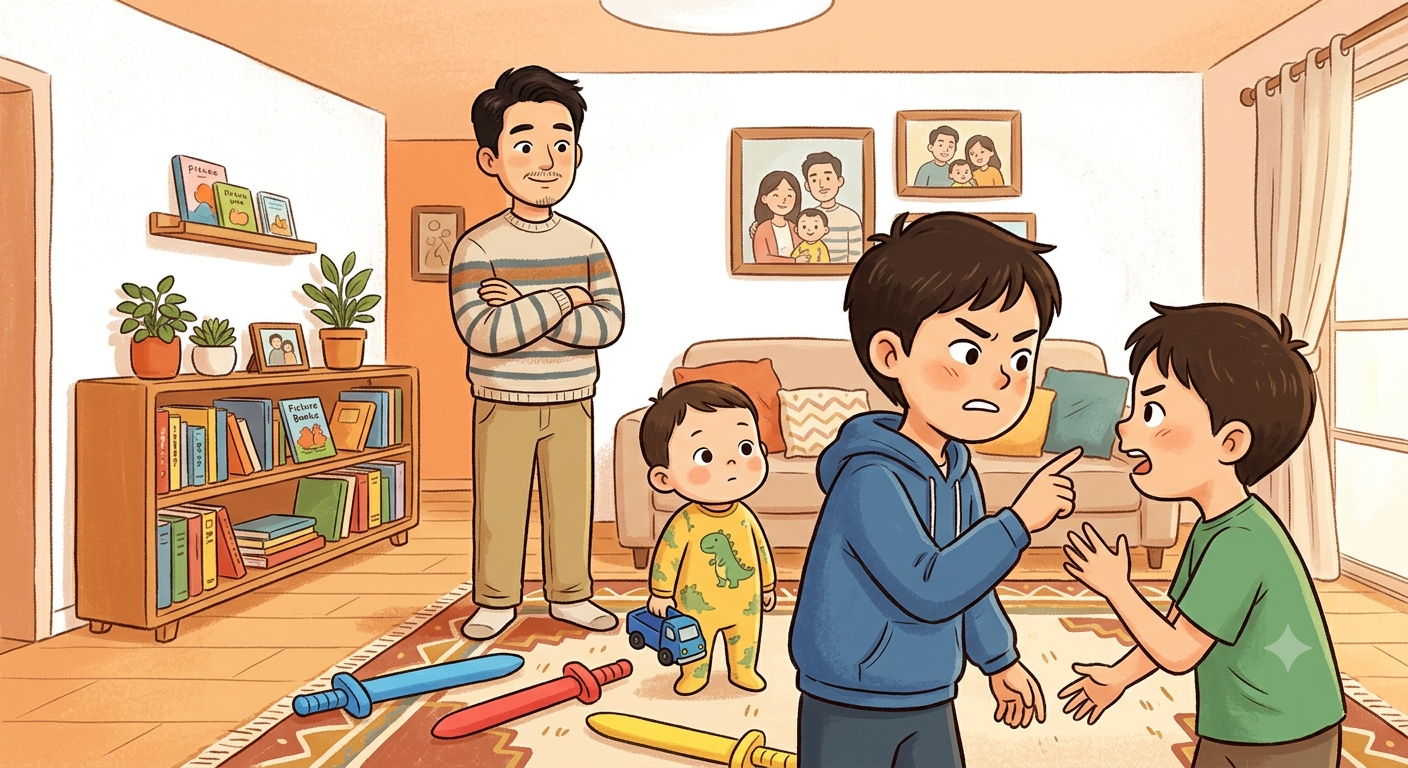
Our roughplay has one real boundary: if it becomes violently dangerous, it stops. Not painful — dangerous. There’s a difference. I bought the boys sponge swords. They beat each other with those swords until bruises appeared. That’s fine. A nosebleed is fine. What’s not fine is using words as weapons — inappropriate names, things designed to humiliate rather than compete. That has consequences. Physical roughplay is sport. Verbal cruelty is something else entirely.
The Dumbest Fight We Ever Had
I have to tell you about the sound fight.
Numbers 2 and 3 were playing. Number 3 made a sound — for fun, just a noise — and Number 2 said it sounded like something. Number 3 disagreed. Number 2 insisted. Number 3 insisted back.
This went on. The volume escalated. The tone shifted. By the time I got there, they were screaming at each other with the conviction of men defending something deeply important.
I separated them. Took them to their rooms. Did the full investigation — Room A, then Room B, then the verdict.
Neither of them could tell me what they were fighting about.
Literally. They did not remember. The argument had evolved past its own origin point and become its own creature, disconnected from whatever sparked it. I only found out what actually happened later, when Number 1 pulled me aside and explained the whole sequence.
They had been screaming at each other over a sound.
This is what happens with boys. The content of the fight becomes irrelevant almost immediately. What remains is the energy of the fight — and that energy needs somewhere to go.
What We Actually Do — The Open Court and Its Limits
For serious disputes, we use Open Court. Everyone in one room, cases made one by one, Dad as lawyer, prosecutor, and judge. I’ve written about this in detail in our discipline system — it works, the boys know the routine, and truth is the standard they all accept.
But Open Court has limits. And the biggest one is this: most sibling fights aren’t about fault.
They’re accidents. Roughplay that got out of hand. A sound that turned into a screaming match for reasons nobody can reconstruct afterward. You can’t hold a trial for an accident. There’s no guilty party. There’s just traffic that needs order.
So my wife and I made a decision: let them handle it themselves.
One note on Number 4 entering the picture specifically. When he joins the roughhousing, he almost always becomes the variable that tips it. He’s not physically built to hold his own against any of his brothers — but he charges in anyway, full speed, no strategy. When he misses and falls, he cries because he didn’t get to crash into anyone. When he connects, he looks around with an expression of complete innocence, takes one second to assess the damage, and delivers the most blunt apology you’ve ever heard from a two-year-old. The brother who is lying on the floor holding his stomach has no real choice but to accept it. You can’t stay angry at someone who genuinely doesn’t understand the weight of what they just did.
Giving Number 1 the Job
We’ve talked in previous articles about Number 1’s role in this house — the privileges that come with being the eldest, and the responsibilities that follow. This is where that responsibility becomes real.
When things tip from play into conflict, Number 1’s job is to find a solution. My wife and I step back and watch.
What we discovered surprised us. More often than not — they don’t need us. They’ll argue, they’ll debate, and then one of them will say something that breaks the tension, and suddenly they’re laughing again and back to roughhousing like nothing happened. The whole cycle resets in minutes.
When you jump in immediately, you interrupt that natural resolution. You make yourself the solution instead of letting them build the skill of being each other’s solution. The most worrisome moments, left alone, turn out to not be worrisome at all.
But Number 1 doesn’t always pull it off. And that’s worth saying honestly.
Number 1 is not the charismatic older brother who commands a room. He’s the sensitive one — rule-follower, soft heart — who carries authority because we gave it to him, not because he was born with the kind of presence that makes younger brothers automatically stand down. Number 2 knows this. Number 2 has tested it. There have been incidents where Number 2 wanted to find out exactly how far he could push the boundary of Number 1’s authority — how far he could crawl up before something stopped him.
In those moments, I step in. Number 2 always regrets it when I do. And I step in not just for Number 1’s sake, but because my authority is connected to his. When someone tests Number 1, they’re testing the system I built.
I’ll be honest: sometimes I watch Number 1 trying to hold the line with his brother and I think, quietly, that I wish he would just smash the rebel once and settle it. But that’s not who Number 1 is. And maybe that’s fine. The world needs Captains who lead through order and not force.
Growing up, crawling up on my older brother was not something I considered seriously. Doing so would have meant writing the final dates on my own gravestone. Growing up as Number 2 in my family taught me that some authority is enforced with presence alone. Number 1 is still learning how to build that. We’re patient.
The Day Number 3 Became My Favorite
I need to tell you about the snack incident.
My wife distributed snacks equally among the four boys. Equal portions, everybody’s happy — that’s the theory. Then Number 2 looked at Number 1’s portion and decided he wanted some. He took some. Number 1 did not accept this peacefully.
It escalated fast. Snacks are serious. The negotiation collapsed into conflict.
And then Number 3 stood up, walked over to his angry brother, and handed him his entire portion.
My wife and I looked at each other. Neither of us said anything for a second.
We asked him later why he did it. He’s five years old. He thought about it for a moment and said:
“Because fighting is bad.”
We all know fighting is bad. Every kid knows fighting is bad — they’ve been told a thousand times. But Number 3 was the only one in that room who looked at a fight and asked himself what he could actually do about it. The answer he found was sacrifice.
He became, unofficially, my favorite son. Don’t tell the others.
What You Can Actually Control
You cannot stop siblings from fighting — and any system that promises otherwise is selling something. What you can do is build a household where:
Roughplay has boundaries. Not rules that eliminate it — boys need to wrestle, it’s developmental — but an understanding of when it’s gone too far. In our house, the moment someone is genuinely hurt or genuinely angry, the play stops. Full stop.
The eldest has real responsibility. Not just nominal authority, but actual accountability for the peace of the group. Number 1 knows that when things tip, it’s his job to find a way through. That weight has made him more mature, not less happy.
Resolution is their skill, not yours. Every time you solve it for them, you take a rep away from them. Let them argue it out. Let them find the exit. Step in when it’s necessary — not when it’s uncomfortable.
The unexpected peacemaker gets celebrated. Number 3 giving away his snack was one of the best moments of my parenting life. We told him that. Explicitly. We named it, we praised it, and he has done it again since — not because we demanded it, but because he learned that generosity lands differently than force.
You can’t stop siblings from fighting.
But you might raise one who figures out how to end it.