Both halves of that are true and I’ve stopped trying to reconcile them.
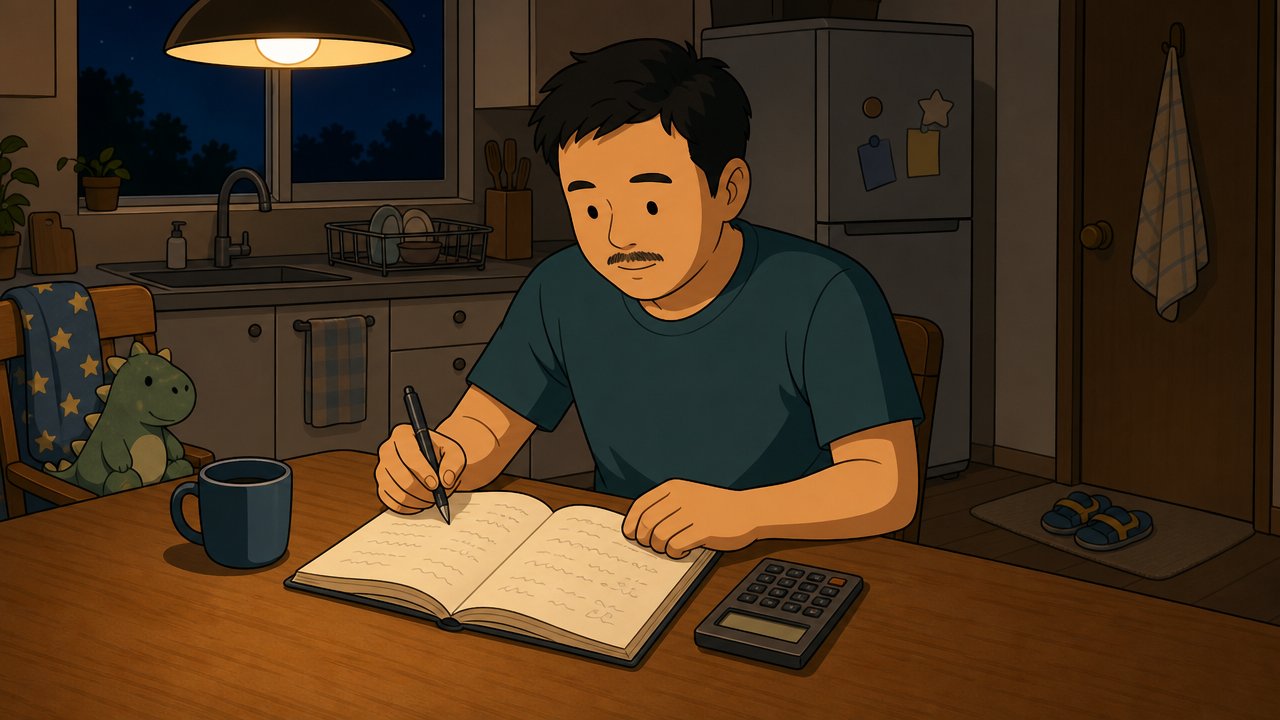
Family devotions happen at our house before bed. That’s the arrangement, that’s what we tell people, and it is genuinely what we aim at. It also doesn’t happen every night. Some nights it’s late and everyone is finished. Some nights the wheels come off between dinner and pajamas and the honest choice is between a rushed devotion and four children in bed at a reasonable hour, and I take the beds.
I’m a pastor. Running family devotions with kids is, on paper, the one thing in this house I should be professionally equipped for. It’s also the least consistent system we have, and I’ve written articles here about chore charts that run better.
That gap bothered me for a long time. It doesn’t much anymore, and this is the article about why.
What It Actually Is
Before anything else, the shape of it, because people imagine something more elaborate than it is.
We sing a worship song. We read a passage. Everyone says one thing they were thankful for that day. Then we pray.
That’s it. That’s the whole thing.
Four beats, no lesson plan, no discussion questions, nothing that needs preparing. The thankful round is the part the little ones can actually do — a two-year-old can’t follow a passage but he can tell you he liked the dog — and it’s usually the part that turns it from a recital into a conversation.
The Slot Is the Part That Fails
Every system I’ve built for this family works because it’s load-bearing. The morning has a workload attached. Bedtime has a sequence. The chore chart has consequences.
The devotion slot has none of that, and it sits at the exact worst hour of the day — the end, when the adults are spent and the children are past their best and the whole house is running on whatever’s left.
So it’s fragile by construction. On a good night we get through it properly. On a bad night we get four verses in and Number 4 has climbed onto the back of the sofa and the moment is gone.
And it’s competing with a bedtime that already has its own sequence and its own momentum — teeth, pajamas, the monster hunt, lights out at a defensible hour. Every one of those has a natural consequence attached if you skip it. The devotion is the only piece of the evening where nothing visibly breaks when it doesn’t happen, which is exactly why it’s the piece that goes.
For years I read that failure rate as a verdict on our family. I’d hear about households where this runs like clockwork and quietly conclude something was wrong with ours.
What Doesn’t Fail Is the Frame
Here’s what I eventually noticed, and it reorganized the whole thing for me.
The formal devotion is the part that breaks. The rest of it never turns off.
When we talk about effort — why you finish the thing you started, why you don’t quit because it got hard — that conversation runs through what Jesus did. When we talk about how you treat your brother after he’s wronged you, same. When one of them asks why we live here instead of Korea, same. Morals, relationships, work, fairness, all of it comes back to how Jesus handled it and what he told us to do.
Take those three in turn, because they’re where it actually shows up.
Effort: they get told to finish what they started, and the reason given isn’t that quitters are losers. It’s that we follow someone who finished something considerably harder while it was costing him everything.
Morals: when one of them has done something to a brother, the question isn’t only what the rule was. It’s what Jesus said about the person you’ve wronged and what he did about people who wronged him, which is a much less comfortable conversation and a much more useful one.
Relationships: how you treat somebody who can’t do anything for you, why you don’t rank people, why the smallest kid in the room gets a say. All of that has a source and my sons know what it is.
That isn’t a curriculum and there’s no slot for it. It’s just the frame every other conversation happens inside — and it’s why family devotions with kids, in our house, is the smaller half of the faith we’re actually passing on.
Jesus is in all the pictures. And the boys know it.
That sentence is the actual state of faith in my house, and it’s more accurate than any answer I could give about our devotional consistency.
The Older Model Was Never the Slot Anyway
There’s a passage that Jewish and Christian households have organized this around for a very long time — the instruction in Deuteronomy that sits at the center of the Shema: teach these things to your children, talk about them when you sit in your house and when you walk by the way, when you lie down and when you rise.
Read that as a schedule and it’s four appointments. Read it as it’s written and it’s the opposite of a schedule. It’s a description of a day. Sitting, walking, lying down, getting up — that’s not a devotional slot, that’s every waking hour, and the instruction is that the conversation is available in all of them.
I’m not using that to excuse the nights we miss. I’d rather we didn’t miss them. But it did stop me measuring my family against a standard that the text itself doesn’t set.
The Evidence Isn’t the Devotion
If you want to know whether any of this is landing, don’t look at attendance. Look at what comes out of them when nobody set it up.
At dinner once, my wife asked the boys the standard question about what they want to be when they grow up. Number 1 said he wanted to help people like his parents do — and then, seriously, asked whether he could be a missionary and still study the things he actually loves. He wasn’t performing. He was trying to work out whether the two halves of his life were allowed in the same sentence.
Another time, a snack-time dispute between two of his brothers was about to go properly wrong, and Number 3 — five at the time — got up, walked over, and handed his entire snack to the angry one. Asked afterward why, he said fighting is bad. Every child in the world has been told that a thousand times. He’s the one who did something about it while it was happening.
And when I was working seven days a week, it was Number 1 — then still working out who Jesus was and what salvation even meant — who asked my wife whether Dad was going to his own house, because the pattern in front of him didn’t match the words around him.
None of those three came out of a devotion. They came out of boys who have been living inside the frame long enough that it’s how they reason.
Family Devotions With Kids Shouldn’t Feel Like a Class
The occupational hazard here is real. I do this for a living. I can prepare and deliver a lesson, and if I let myself, family devotion becomes a small congregation of four with terrible attendance and one member in diapers.
The trouble is that the second it feels like a class, I stop being their father in the room and become the person delivering material — and children can tell the difference instantly. I’d be teaching a lesson to an audience obligated to sit through it, which is a fairly bleak thing to do to your own kids at bedtime.
So it stays small. Short, unimpressive, sometimes barely a thing at all. That’s on purpose now, rather than a failure I’m apologizing for.
The Two-Year-Old Contributes Nothing
I should be honest about the operating conditions.
Number 4 is two. He does not participate in family devotions. He participates in the room in which family devotions are occurring, which is a different activity with different objectives, mostly involving climbing.
This is fine. He’s absorbing that this is a thing his family does, which is the entire assignment at his age, and nobody is grading him. His brothers manage to concentrate around a small heckler, which is probably its own spiritual discipline.
What I’d Say to a Parent Who Feels Behind
I’d have found this article useful ten years ago, so here’s the short version.
The nightly slot is worth having and worth defending, and you will still miss it a lot. Missing it is not the scoreboard.
The scoreboard is whether your children can tell, from the way you talk about ordinary things — money, effort, a brother who took something — that there’s a person at the center of how your family decides what to do. That part doesn’t require an evening slot. It requires you to actually think that way, out loud, at the times things come up, which is harder than a devotion and can’t be scheduled.
We try most nights. We fail a decent share of them. And in between, on the drive to school and at the table and in the middle of a fight over a snack, the conversation keeps going.
Jesus is in all the pictures. The boys know it. That’s the part I’d defend if I could only keep one.