Before I was an ordained pastor, before I was an appointed missionary, and years before I was married with four sons in Cambodia, I spent five years running an informal halfway house for returning missionary kids in Seoul.
I didn’t have church funding. I didn’t have an organization’s logo on my email signature. I had a rented apartment, a set of cheap pots, and a revolving door of eighteen-to-twenty-four-year-olds who had landed at Incheon Airport with a Korean passport in their pocket and sheer panic in their eyes.
They were third culture kid returnees—children who had grown up in Central Asia, Southeast Asia, Africa, or South America, now trying to re-enter a homeland they had only ever visited on three-week vacation furloughs. Some of them could barely speak their mother tongue. They knew enough Korean to say hello and thank you to an elder, but hand them a government registration form or put them in front of a university registrar, and they would freeze.
Long before I ever thought about raising third culture kids of my own, I was living with the aftermath of what happens when that transition breaks down.
I didn’t need a textbook to understand what they were feeling. I was one of them.
The Passport Says You Belong. Your Bones Disagree.
My own childhood didn’t happen in a single school district. I was moved to Uzbekistan when I was six years old, surrounded by Cyrillic signs and Russian grammar. At sixteen, I moved to Austria. At nineteen, I moved to the United States. It wasn’t until I was twenty-three that I returned to live in Korea as an adult.
Here is the central paradox of raising third culture kids that people who have never lived overseas fail to understand:
If you are a foreigner in a foreign country, your identity is clear. If an American walks into a restaurant in Seoul or a market in Battambang, everyone knows they are a foreigner. The locals give them grace for not knowing the customs. The domestic rules are obvious because the boundaries are visible.
For a returning TCK, those boundaries disappear.
On paper, you are Korean. Your face is Korean. Your family registry is in a government office in Seoul. Society expects you to instinctively know the unspoken hierarchy, the age-based honorifics, the subway etiquette, and the precise social posture required when an older man hands you a drink.
When you get it wrong—when you speak with the wrong politeness level because your Korean vocabulary stopped developing in the second grade—people don’t think you’re a traveler. They think you are defective. They think you are rude, arrogant, or poorly raised.
It is an acute identity crisis. You look in the mirror and see someone who belongs nowhere: too foreign for your passport home, and an outsider in the country you just left behind.
Pots, Housing, and Listening
When I started meeting these kids through my parents’ mission network, I realized almost immediately that I couldn’t solve their problems.
You cannot wave a hand and fix ten years of missing cultural context. You cannot give someone an intuitive grasp of a society they didn’t grow up in. But I realized something narrower: I can’t solve their problems, but I can help them solve it through.
I started doing the only practical things I knew how to do. I have cooked daily since I was eleven years old, so I cooked home meals for them. I made warm, familiar food and sat with them at the table while they vented about being mocked at work or failing a basic language placement exam.
When they had nowhere to stay, I helped them find proper housing. When the emotional weight of re-entry became heavier than a shared meal could carry, I reached out across my network to professional counselors who were willing to take on TCK cases pro bono or at subsidized rates.
I ground away at that work on self-suppliance for five years. Eventually, that ministry gained traction. I went to seminary, was ordained as a pastor, was appointed as a missionary, and found churches that saw the necessity of the work and stepped up to support it.
The greatest gift of that work is that it didn’t depend on me. When my wife and I eventually answered the call to Cambodia, the community didn’t collapse. Those who had settled and found their footing in Korea took over the mantle. Today, former returnees are the ones welcoming the newer kids, cooking the meals, and walking them through the gauntlet of re-entry alongside the same counselors and sponsoring churches.
And now, a decade later, I am sitting in our home in Battambang, looking at my four sons, realizing with sudden weight: I am raising four TCK boys of my own.
What Raising Third Culture Kids Taught Me About Exposure
The biggest mistake people make about overseas family life is assuming exposure is an education.
I wrote before about learning the local language and how easy it is to spend ten years in an overseas city without ever actually mastering the grammar of the people outside your gate. Parents do this with languages, and they do the exact same thing with culture.
We assumed that because our boys lived in Battambang, attended activities in the community, and walked down dirt roads every afternoon, the host culture would simply seep into their skin through osmosis. And conversely, we assumed that because my wife and I spoke Korean and English inside the house, the heritage culture would automatically take root without cultivation.
Neither assumption is true.
When our boys were enrolled in an international school in Cambodia, we watched them spend their days in an English-speaking container that left them disconnected from both the Khmer community outside the gate and the Korean heritage inside our home. Natural exposure produced children whose default language was American cartoon dialogue and whose cultural reference point was plastic building blocks.
Culture isn’t inhaled from the atmosphere. It is built out of deliberate, non-negotiable domestic routines: the specific meals on the table, the bedtime rituals you repeat, the way you resolve conflict between brothers, and the order of the day.
The Kitchen Is Not a Crisis
In our house, the anchor has always been the kitchen.
I do the cooking. I have cooked almost every day for more than twenty years, from my first burned batch of fried rice at eleven to daily meals for a family of six in Cambodia. Because the kitchen is systematized, our mornings are not chaotic.
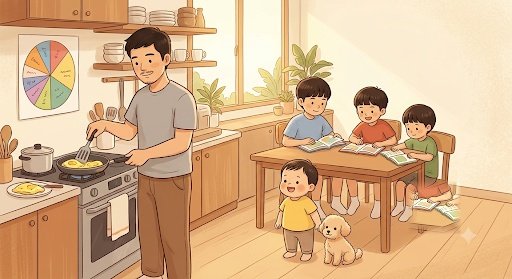
Breakfast is an omelet at seven o’clock—onions and carrots diced down to the size of rice grains, seasoned, folded, and served. The boys know the drill: fuel up, chew, don’t inhale, and put the plates in the sink.
When your family is living on missionary support on the other side of an ocean, the outside world is inherently volatile. Exchange rates drop. Visas get delayed. Power grids fail in the middle of a ninety-five-degree afternoon.
If the environment outside the front gate is fluid, the environment inside the front door must be aggressively predictable.
Our boys don’t get stability from a nation-state; they get stability from the rhythm of our house. The borders of their country are effectively the four walls of our home. As long as those walls are filled with predictable rules, familiar food, and steady affection, the fact that the street outside changes languages doesn’t destabilize them.
The Wheel on the Wall
During our summer break, that consistency took physical form. It sits on the wall right where nobody can pretend they didn’t see it: a pie chart labeled THE BOYS’ DAY WHEEL.
The subtitle reads: Official Wall Copy. No Arguing With the Circle. Round and round it goes. Find the time, do the thing, brag about it.
It is not an aspirational Pinterest chart. It is an operational law:
The morning side runs the learning:
- 7:00–8:00 AM: Breakfast. Fuel up.
- 8:00–9:00 AM: Reading Time. Eyes on words, not on the wall.
- 9:00–10:00 AM: Study Time. Brain push-ups. Pencil moving.
- 10:00–11:30 AM: Educational TV. Sneaky learning. Still counts.
Then the afternoon shifts:
- 11:30 AM–1:00 PM: Lunch. Round two. Plates in the sink.
- 1:00–4:00 PM: Gaming. Thumb Olympics. Three hours.
- 4:00–5:30 PM: TV. Couch mode. Feet off cushions.
- 5:30–7:00 PM: Dinner. Round three. Yes, the vegetables.
- 7:00–8:00 PM: Freetime. Your hour, your rules. Mostly.
- 8:00–8:30 PM: Get Ready for Bed. Teeth, pajamas, one water.
- 8:30 PM–7:00 AM: Sleep Time. Power down. Charge the legs.
The rule at the bottom is absolute: If the wheel says Reading Time, it is Reading Time. The wheel has never once been wrong.
And here is the quiet finding that surprised me after years of counseling drifting teenagers: the wheel works.
When we started, reading was an uphill fight. Number 1 used to freeze when Korean syllables looked too dense. English was scattered. Today, after months of holding the line between 8:00 and 10:00 AM, both Number 1 and Number 2 are reading fluently in both Korean and English. Number 3 is right behind them, sounding out sentences with his finger on the page.
They didn’t get there through a crisis, and they didn’t get there through parental panic. They got there because the circle said it was Reading Time, the table was clear, the food was already handled, and there was no exit until the work was finished.
We Stopped Apologizing for Being Out of Place
The second anchor we give them is permission to be different.
One of the most exhausting traps for missionary and expat parents is the constant internal shame of your children looking awkward. You worry they are too loud for Cambodian norms, or too foreign for the relatives back in Seoul, or too uncultured for Western families.
Our boys are pastor’s kids, missionary kids, Korean boys, and boys with Cambodian red dirt under their fingernails. They are going to stick out.
When they visit Korea, they will bow slightly too low at the convenience store counter because of the Cambodian sampeah. When they speak English, they will have cadences borrowed from three continents.
We tell them plainly: You have two passports, two home cultures, and you belong to a third space that isn’t on a map. People will look at you twice. Don’t shrink. Smile, bow respectfully, and carry your own bag.
The Grandparents Get Direct Lines
The hardest cost of raising children overseas is the distance between them and their grandparents.
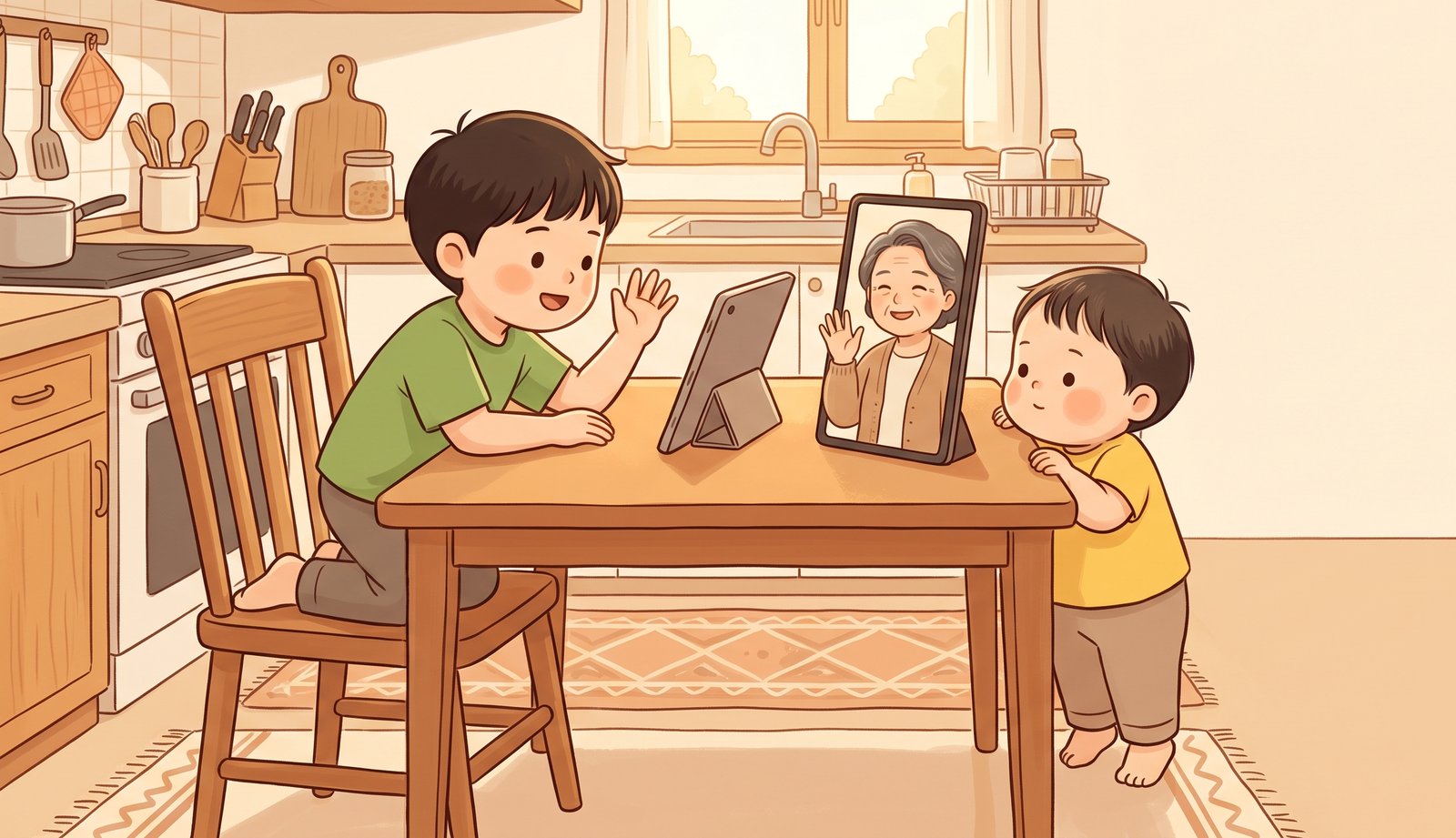
We don’t allow Sunday video calls to become staged, polite recitals. They are thirty minutes of noisy, uncurated reality. Number 2 shows off a wooden slingshot. Number 3 displays a missing tooth. Number 4 holds the phone upside down while chasing Tori under the table.
It is loud, but it builds the emotional muscle memory that keeps them tethered to a family tree that lives five thousand miles away.
The Boy at the Window
Last night after a heavy monsoon shower, Number 1 stood at the second-floor window looking out over the banana trees behind our house. The smell of wet red clay and woodsmoke from the neighbors cooking rice was drifting through the screen.
“Dad,” he said, without looking back. “When we visit Korea, do they have frogs that sound like the ones here?”
“No,” I told him, stepping up beside him. “Korean frogs have a different song. Quicker. Quieter.”
He stayed quiet for twenty seconds, watching the dusk settle over the canal.
“That’s going to be weird,” he said softly.
Not fearful. Not angry. Just the honest assessment of a nine-year-old realizing his world has more than one soundtrack.
I spent ten years counseling young people about that exact sentence. I had a dozen clinical explanations for the psychological disorientation of acoustic transition.
I didn’t say a single one of them.
I just reached out, put my hand on his shoulder, and listened to the canal frogs with him in the dark.
“Yeah,” I said. “It will be. We’ll listen to them together anyway.”