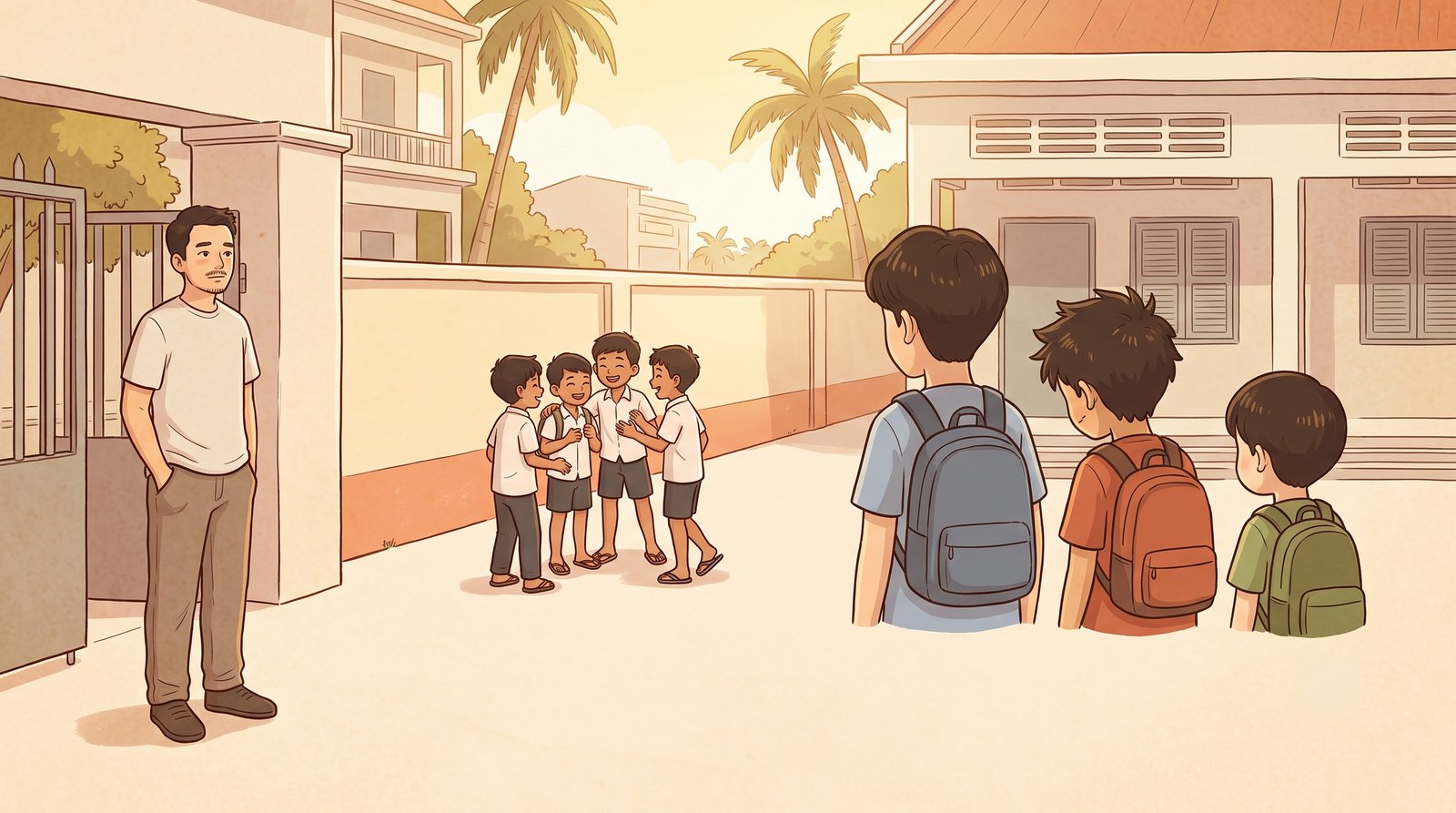
Every conversation I have with my sons’ teachers ends the same way. It starts with me, it gets about two sentences in, and then it becomes a conversation between my wife and the teacher while I stand there and wait.
She speaks fluent Khmer. I speak fluent English. This is supposed to be an English-medium school.
Choosing an international school in Cambodia looked, on paper, like the one decision in our move here that wouldn’t require a translator.
What’s Actually on the Menu
There were three real options in front of us, and I want to lay them out plainly, because nobody hands a new missionary family this list.
A local Khmer school. This was genuinely appealing — our boys would relate to Cambodian kids, make Cambodian friends, live where they actually live rather than in a bubble on top of it. We said no on the education. The system here is still being built, and that isn’t a criticism of anybody, it’s a fact about a country’s timeline.
An international school, which is really two options wearing one name. There’s the legitimate international school, and it is very pricey. And there’s the localized international school — affordable, still teaching a real curriculum, still full of Cambodian children. We took the second one. That was the whole point: quality education without removing them from the country they live in.
Homeschooling. Several families we know do it and do it well, and a lot of my own childhood friends were homeschooled. Abeka and BJU Press were what we looked into, and the cost lands about where the school fees do, so it isn’t the cheap option people assume. What stopped us was the same thing that made the local school attractive — homeschooled kids here get far fewer hours with local children, and that’s the currency we’re actually trying to spend.
We pay about a hundred dollars a month per child.
Somebody reading that in the States will think it sounds like nothing. Here is the number that reframes it: a hundred dollars is close to half the average Cambodian family’s monthly income. What surprised me most in this country isn’t the fee. It’s how many families pay it anyway.
The English School Where Nobody Speaks English
An international school in Cambodia is sold to you as English-medium. The reality at ours is that most of the teachers are local, most of them barely speak the language, and the children speak Khmer to each other at every break.
I could have lived with that. Here’s what I couldn’t.
My boys told us they can’t play with their classmates, because their classmates don’t speak English.
Sit with that for a second. The school’s English was good enough to isolate my sons from the children sitting next to them, and not good enough to actually teach them anything. We were paying for the worst possible position — a language that separates without educating.
That was the flag we didn’t see coming.
What My Sons Actually Know
I want to be fair to them before I go further, because none of this is an education problem.
All three of the school-age boys are fine on the basics. Numbers 1 and 2 do multiplication and division without hesitating. Their science is somewhere around middle-school level, and that isn’t the school’s doing — it’s mine. I was a science guy. So we talk. The structure of plants. Human anatomy and physiology. Why gravity does what it does. No textbook has ever been opened for any of it; he asks, I answer, and it turns into a Q&A that runs until somebody’s hungry.
They are not behind. My one and only problem with their education was language.
And then we changed our minds about which language that was.
The Curriculum That Broke My Oldest
Their first school here, in Phnom Penh, was bilingual. Khmer and English curriculum, eight in the morning until five in the afternoon.
The boys still remember that school as a fun place. The teachers were kind. I want that on the record, because what I’m about to say isn’t a complaint about the people there.
It was the wrong curriculum. Two full languages of instruction, in a nine-hour day, for children who had just arrived in the country. Number 1 is the one who couldn’t carry it — he couldn’t do the homework, couldn’t ask a teacher for help, couldn’t tell a friend what he meant, and it eventually came out through his body badly enough that we took him back to Korea for five months.
So was it the wrong call? I’ve thought about this more than I’ve thought about most things, and no. It was the wrong curriculum, and it was one of the cheapest schools available to us at the time — three hundred dollars a month per child, which is nearly a thousand dollars a month across the boys.
That’s the honest version, and it’s the version I’d want another family to hear. We didn’t pick badly out of carelessness. We picked the best thing we could reach, and the thing we could reach was wrong for one of our children.
What an International School in Cambodia Costs a Family Like Ours
A hundred percent of our income is support. No second job, no second stream, nothing underneath it.
That isn’t an accident of our situation — for Korean missionaries, and for missionaries sent from plenty of other countries, a second income is quietly disapproved of. Never in writing. It’s why genuinely working a trade on the field is harder than it should be, and I think the paradigm has to shift, because the question in front of the church now isn’t may I but how should I.
Meanwhile the arithmetic moved underneath us. The won was around 1,240 to the dollar in early 2024. It peaked near 1,534 and has since come back to about 1,340. Cambodia effectively prices in dollars, so at the worst of it support raised in won bought close to a fifth less than it had — and on top of that we lost sponsors who were dealing with their own economic pressure. At the bottom, call the total drop about thirty percent. The rate easing has given some of that back. It has not given all of it back.
So the thousand-dollar-a-month tier isn’t a school I’m declining on principle. It’s a door that closed.
The move I’m describing is cost-neutral: a hundred a month per child at the school they’re in, a hundred a month per child at the school they’re going to. What we’re buying with it isn’t cheaper. It’s different.
Why We Chose the Khmer One
The new school teaches in Khmer. English is the second language, not the first.
For a man who writes in English for a living, whose fluency is the most portable thing he owns, this looks like a strange call. Here’s the reasoning.
English can be learned later. It is everywhere, most of the quality material in the world is in it, and a motivated adult can go and get it. I’m not pretending my sons won’t need it — they will. But Khmer is not a language you casually pick up at twenty-five in another country, and right now, in the town where my children actually live, friendship happens in Khmer. All the international schools in the world haven’t changed that. The kids at break are speaking Khmer.
Right now none of my boys can speak Khmer. If I’m honest, none of them really speak English either — not the way I do. They have basic phrases and all the letters, from their time at the school in Phnom Penh. So if they’re going to be surrounded by a language regardless, it may as well be the one that’s actually being spoken around them.
And the load is lighter, which is the part that finally settled it for me. One language of instruction instead of two. Eight to three instead of eight to five, with lunch and two recesses inside it. The thing that broke my oldest wasn’t a foreign language. It was two of them and a nine-hour day.
Number 2 is the one I expect to move fastest. He’s already the boy who makes a friend before he has the words for it, and he’s also the one most visibly frustrated — he complains that his friends can’t understand him. Change the rule set and tell him plainly that the language here is Khmer, and he’ll adapt on the fly. That’s just how he’s built.
The Regret I’m Actually Trying to Prevent
I grew up in Uzbekistan in the nineties, a few years after the Soviet Union came apart, when Russian was still what everybody spoke.
My parents first tried a semi-local school. It went badly and it went badly fast. We came home with foul language we didn’t understand. Bribing a teacher was a normal cost of doing business. Discrimination was the least of what you worried about. There were third graders smoking at recess. My parents pulled us out quickly and put us in the school for missionary kids, where every teacher was American or British — missionaries themselves, who had come out to teach other people’s children. It was the best school available and it was easily the safest, and I know exactly how fortunate I was to sit in it.
I flunked a year there, because my English wasn’t good enough.
That sentence and my son’s story are the same sentence, one generation apart.
Years later, out of Uzbekistan, I kept ending up in work alongside Russian speakers, and every single time I regretted not learning it properly. They’d tell me the same thing: go to Russia for two years, that’s all you’d need. They said it because my pronunciation is nearly local — on the phone, people don’t hear a foreigner. It’s good enough that I can do a Russian accent to make my friends laugh.
And it’s good enough that people answer me the way they’d answer a local: fast, and half-swallowed.
My Russian sounds good. My hearing doesn’t.
I can get around. I can be polite, I can handle a transaction, I can be pleasant at a table. What I have never once been able to do is sit down with a Russian friend and have a conversation with any depth in it. That’s the gap. It doesn’t close on its own and it has not closed in twenty years. My mother still speaks Russian to me on the phone so I don’t lose what’s left of it. She and my father are in Ukraine, still at it — but that’s another story.
So no, I don’t think my parents were wrong. Their local option had bribery and third-grade smokers in it. Mine has a Christian curriculum and teachers I’ve met. Same instinct, different menu.
I just know precisely what it costs to grow up somewhere and leave without the language, because I’m still paying it.
What Actually Decided It Wasn’t the Language
Here’s the part that surprised me about our own decision.
The new school being Christian mattered, but it wasn’t the deciding factor — if it hadn’t been, I’d still have considered the school seriously. What decided it was the tour. The rules, and the fact that they were actually applied. The hours. The curriculum. And above all the staff: how they carried themselves, how they spoke to us, what they seemed to expect of themselves.
For me the system comes second. A teacher’s character and attitude is the thing I want for my sons, and honestly for every kid in that building — and finding good teachers is like finding a needle in a haystack. It’s also, not coincidentally, why the teachers there handle both English and Khmer better than I expected. Most of them have long relationships with foreign missionaries. That’s a green flag you can’t fake.
If a new missionary family arrived in Battambang tomorrow and asked me how to pick an international school in Cambodia, I’d point them at this one. As long as it keeps its expectations where they are.
What I’m Actually Hoping For
I’m not doing this so my sons will be impressive.
What I want is for them to grow up healthy, make real friends, and eventually find partners who know the love of Christ inside the relationship rather than as a label on it. To be salt and light where they happen to be standing. That’s the whole ambition, and for missionary kids it is not a small one.
The gift I’m actually trying to hand them is smaller and harder to name. There’s a shell around every person that stops them stepping out of the comfortable thing, and cracking it open is the most useful thing that ever happened to me. If my boys learn to open up, to take the risk, to be the good influence in the room instead of the quiet one at the edge of it, I have nothing else to ask for.
A language is just the tool that makes it possible. You cannot be salt and light to people you can’t talk to.
Hopefully it works. I’m aware that’s the operative word in every paragraph of this, and I’d rather say it than pretend otherwise. What I can control is being a good father to them and, increasingly, a good partner in Christ — because they have a calling of their own, all four of them, and how a person takes that up is the only part that’s really theirs.
And if I’ve decided to see my sons as partners, then I don’t get to disrespect them later, when they’re grown and making calls I wouldn’t have made.
Back to That Classroom Doorway
So we’ll move them, and for a while it will be hard, and Number 1 will want to know the plan before he can sleep.
And somewhere down the line I’m going to be standing in a school corridor in Battambang while my son talks to his teacher in Khmer, at full speed, and I’m going to catch about one word in five.
I’ve been on that side of it my whole life. I know exactly how it feels.
I’m looking forward to it.