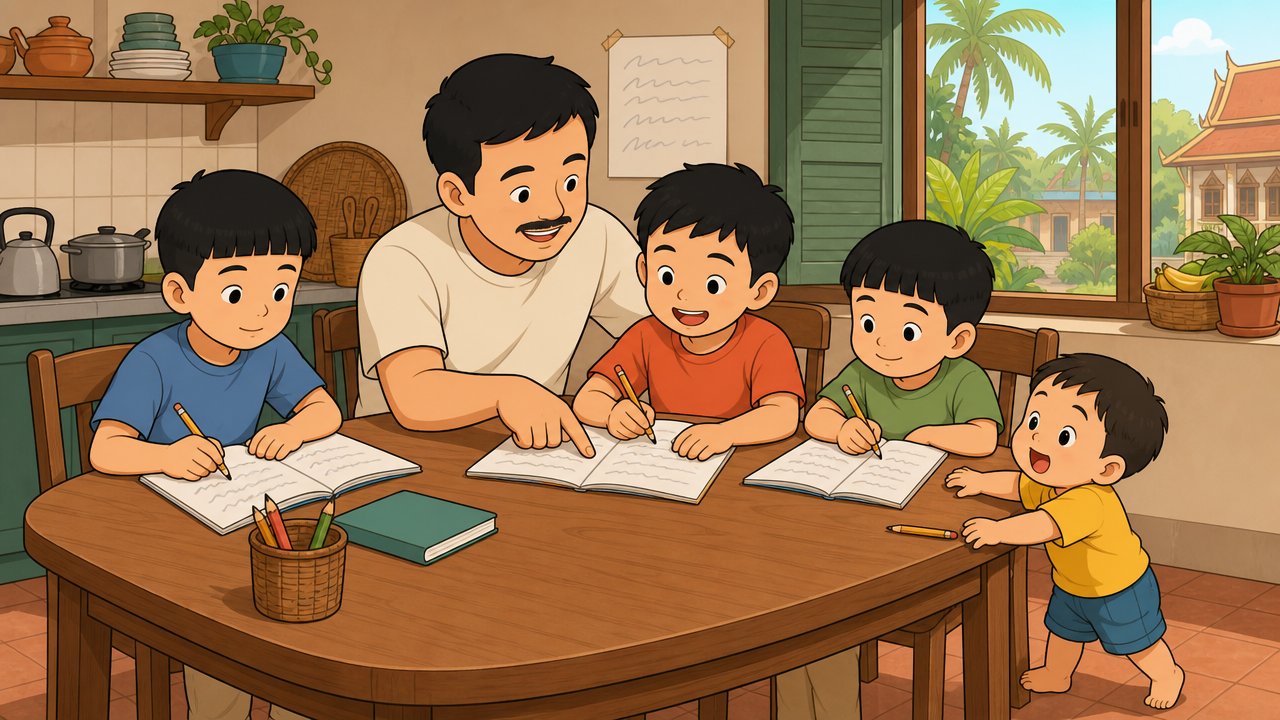
Number 1 can read a Korean book. So can Number 2. Number 3 is nearly there — slow, sounding things out, but getting there. Nobody enrolled them anywhere to make that happen. It happened at our kitchen table, in the morning, between Math problems.
Those same boys have spent about two years in an English-medium international school, and they cannot hold a conversation in English.
I’ve been turning that over for months. It is the single most useful thing I’ve learned about learning English at school, and it cost me two years and a tuition bill to learn it.
They Know Words. They Can’t Build a Sentence.
I want to be precise about what the failure actually looks like, because “their English isn’t good” is too vague to be useful to anybody.
They have vocabulary. Ask them what a word means and you’ll often get it. They can pick individual words off a page. What they can’t do is assemble any of it — take the words they know and put them in an order that becomes a sentence, out loud, in real time, to a person who is waiting for an answer.
Reading is the same story. Decoding happens. Comprehension mostly doesn’t. There’s a difference between a child who can produce the sounds on a page and a child who knows what just happened in the paragraph, and my sons are on the wrong side of that line after two years of being taught in the language.
So it isn’t that nothing went in. Things went in. Nothing assembled.
That distinction is easy to miss from the outside, and it’s why learning English at school can look like it’s working for a long time before anybody checks. A child who knows two hundred words can pass a vocabulary quiz, hand in a worksheet, and go a whole term without ever being made to produce a sentence of his own. The report card measures the words. Nobody measures the assembly.
Meanwhile, Nobody Taught Them Korean
Here’s the part that made me rethink all of it.
Korean is the language our house runs on. The boys have never had a Korean class, never had a Korean tutor, never sat in a Korean classroom. They play in it, argue in it, and tattle on each other in it, all day.
And in the mornings, before school, they sit at the table and do their work — Math, and Korean Language Arts. That’s it. That’s the entire program.
Numbers 1 and 2 came out of it reading fluently. Number 3 is close behind.
I did not out-teach a school. I am not a better educator than their teachers, and I’d like that on the record. The difference isn’t the quality of instruction. It’s that one of these languages was unavoidable and the other one was optional, and everything else follows from that.
The System Is the Workload, Not the Clock
One correction to how I used to describe our mornings, because I had it wrong in my own head for a while.
The morning block isn’t a length of time. I don’t set twenty minutes and let them run out the clock. They have a designated daily workload, and the morning ends when the work is done.
That distinction turns out to matter more than almost anything else in the system. A timed session teaches a child to wait. Give a seven-year-old twenty minutes and a reason not to want them, and he will spend eighteen of them sharpening a pencil with real commitment. An assignment can’t be waited out. The only exit is through it.
It also means a good morning is short. Finish quickly, go play. That’s the deal, and they take it.
Learning English at School Assumes the School Is Where the Pressure Is
The theory behind an English-medium school is language immersion: put the child in the language for seven hours a day and the language happens. It is a real thing that really works, which is why learning English at school sounds so obviously correct that most parents never inspect it — I didn’t.
That theory needs one thing to be true. Something inside those seven hours has to actually require English.
At my sons’ school, nothing does. Most of the teachers aren’t fluent themselves, so instruction drifts. Every child in the building shares Khmer, so the second the bell goes, break is in Khmer. English is a subject on a timetable, not the medium anybody is living in.
Which means my sons spent two years in an English school with a working exit from English available at every moment of the day. And a child with an exit takes it, every time, because taking it isn’t a decision — it’s just the conversation continuing.
That’s the same trap I fell into with Russian for ten years, and I’d argue it’s the more expensive version, because at least nobody billed my parents monthly for mine.
I Don’t Get to Blame the School Either
Here’s the part I can’t put on anyone else.
English is my best language. I write in it, I think in it, I’m more articulate in it than I am in Korean. That resource has been sitting in the house the entire time, and my sons still don’t speak English with me.
So the school had seven hours a day and no pressure, and I had a fluent native speaker at the dinner table and no pressure, and we produced exactly the same result. That’s not a coincidence, it’s the whole finding. Exposure is not the input. Necessity is.
Korean didn’t work because we ran it well. Korean worked because there was no version of the day where a boy could get what he wanted without it.
So What Do You Actually Do
I’m wary of turning this into advice, because I’m reporting a failure, not a method. But two things follow from it that I’d stand behind.
First: stop reading the tuition line as if it buys the language. It buys hours of exposure. Whether those hours require anything is a separate question, and it’s the only question that matters. Go find out what actually happens at break.
Second: whatever language you’ve decided your family is going to have, put it where it can’t be avoided. Not a class. A workload, a chore, a conversation your child has to complete in order to get something they want. Ours ended up in a morning slot between Math problems mostly by accident, and the accident is what worked.
We’re moving the boys to a Khmer-language school, which sounds like the wrong response to this article and isn’t. English will keep. It’s everywhere, the materials are endless, and an adult who wants it can get it. What can’t be got later is the language of the country you’re actually living in, which is the thing I know most precisely, because I’m the man who left Uzbekistan without Russian.
By My Own Argument, the Khmer School Should Work
If I’m right about all this, then I owe you the test of it, because the same logic makes a prediction about where we’re going next.
A Khmer-language school should work on my sons in a way the English one didn’t — not because it’s a better school, but because there’s no exit inside it. Every child in that building already shares Khmer. At break, in the corridor, in the arguments over whatever boys argue about, Khmer is the only thing that gets you anything. The pressure I couldn’t manufacture at an English school is simply lying around at a Khmer one.
That’s the bet. It’s the same bet that Korean already won at my kitchen table.
And if it fails, the theory in this article fails with it, and I’ll write that one too. I’d rather put the prediction in writing now than quietly adjust the story in two years.
Number 4 Is Running All Three at Once
The two-year-old is not part of any of this yet, and he’s my favorite evidence.
He is assembling Korean, English and Khmer simultaneously, with no idea they’re separate systems, and sometimes a single sentence comes out with all three in it. It’s very funny and completely incoherent and nobody is correcting it.
He’ll sort them out. They all do. And when he does, it won’t be because of a curriculum — it’ll be because of which of the three he couldn’t get through a day without.
That’s the whole finding, standing in my kitchen in a yellow shirt, making no sense at all.
Number 1 will read a Korean book tonight. Nobody made him fluent. We just never gave him another option.