Tori is our puppy — a tiny poodle, entirely adorable, and completely aware of it. Every morning I let her out of her fence and go make her breakfast, and every morning she plants herself on the kitchen floor a foot from my ankles, watching the bowl like it might try something. It’s the single most reliable event in this house. So the morning I turned around and she wasn’t there, I knew something was wrong before I knew what. That’s usually how it goes with a strong willed child in the house — you don’t catch him breaking the rule. You notice the shape of the room is off.
Not by the fence. Not by the door.
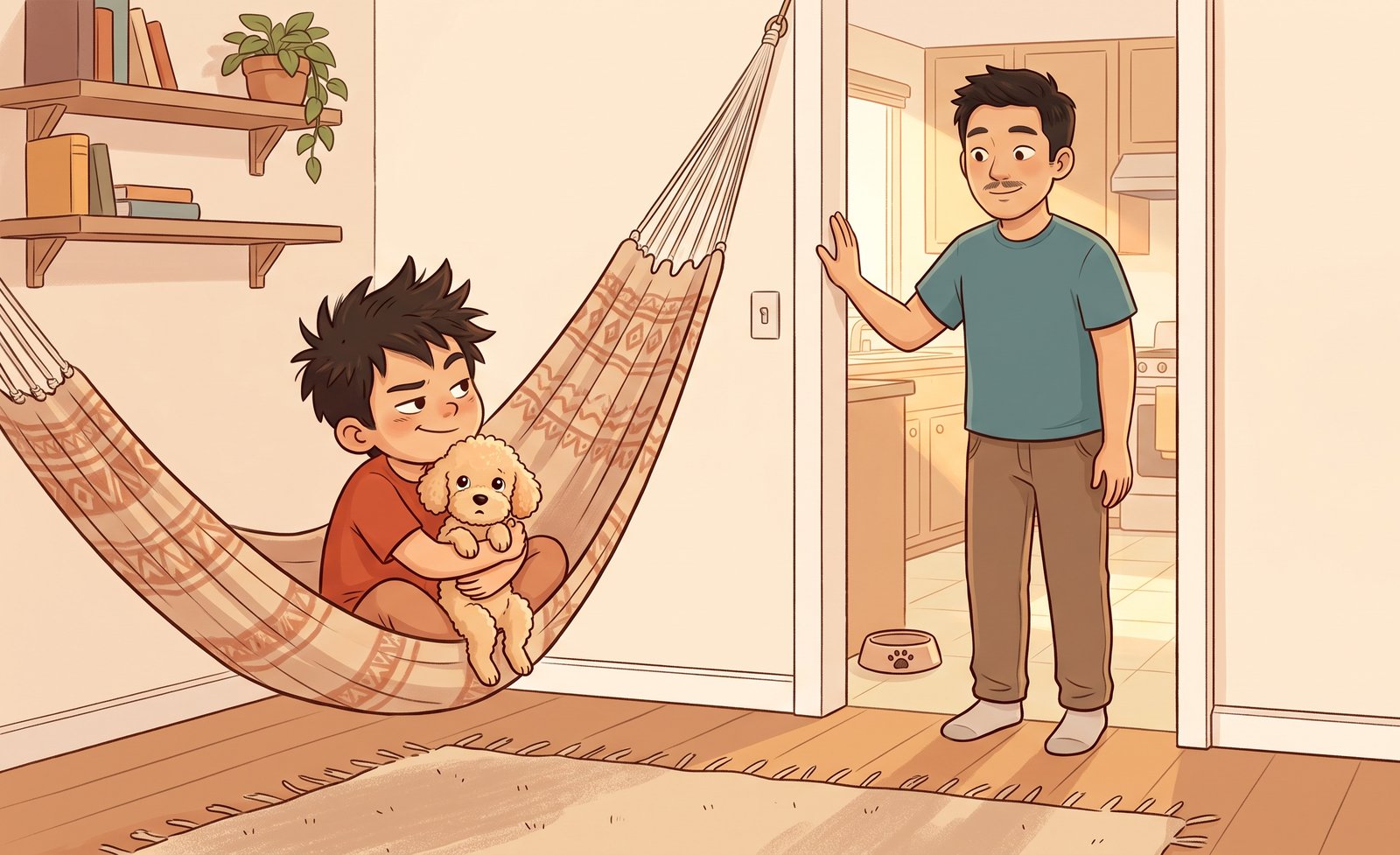
She was in the hammock in our living room, held against the chest of Number 2, who had the specific stillness of a boy who has heard footsteps.
I Am a Rule-Loving Man. I Was Also That Kid.
I should explain my own wiring before I describe his, because half of this story is me.
If a rule is set in this house, I want it kept word for word. Not in spirit. Not mostly. Word for word. Rules aren’t sacred, though — I’ll change one the moment somebody makes the case. But making the case is the point. A debate. A full conference. A vote. I’d rather this house ran on something closer to the rule of law than on whoever is loudest that afternoon.
Here’s the part it took me embarrassingly long to connect.
I was never the kid who took no as a no. I needed an explanation for everything — a thing had to make sense before I’d agree to carry it. And if I had an opinion, I made sure it was known, and that I’d like to discuss it. That wasn’t confidence, exactly. I was shy at school and genuinely dreaded standing in front of an audience. A negotiation was a different activity entirely. That one I’d walk into all day.
It didn’t stop when I grew up, either. I’ve spent a fair share of my adult life asking questions about rules and authority inside the churches I’ve been part of — privately, one to one, to my Senior Pastor and later to my seminary professors. That’s a longer story, and I’ll tell it properly on Thursday.
So when Number 2 picks up a rule and turns it over to check its weight, I know exactly what I’m looking at. I’m looking at me.
Number 1 is built the other way. Tell him the rule and it goes in like a screw — he’ll follow it, and he’ll be quietly bothered when someone else doesn’t.
Number 2 has never once accepted a rule on arrival. For a long time I read that as a discipline problem. It took a poodle to make me see it was a family trait.
The Rule About the Puppy
Here is the rule, and it exists for a reason: nobody picks up Tori.
Not because she’s fragile-looking, though she is. Because the boys picked her up and dropped her. More than once. So we made the call: nobody holds the puppy without a parent right there.
Everything else stays open. Pet her. Play tug. Play chase, which she wins. The rule isn’t “leave the dog alone” — it’s one specific prohibition on one specific action, and the boys know exactly why it’s there, because I told them.
Numbers 1 and 3 have never tested it. Number 2 has tested it roughly as often as he has been in the same room as the dog.
The Hostage Situation
So: the hammock.
I walked in, and — this next part is completely subjective and I’m not going to pretend otherwise — the look in that dog’s eyes was a cry for rescue. My wife would tell you the dog was fine. The dog was probably fine.
I didn’t raise my voice. I asked him one question.
“What’s the rule?”
He didn’t get in trouble. It was a warning, nothing more. And what I got back before he let go was the smirk — the small, unbothered look of a boy who had already priced the warning in and decided the hammock was worth it.
He set her down. And Tori, freed at last from her ordeal, sprinted to the kitchen entrance and sat in front of the bowl, vibrating with excitement, exactly as she does every morning of her life.
What a Strong Willed Child Actually Does With a Rule
This is the part I misread for years.
A strong willed child is not ignoring your rule. He heard it. He can recite it back to you. What he’s doing is running a cost-benefit calculation you weren’t invited to, and then paying the cost on purpose.
When he was smaller, that calculation was terrible. He’d go behind my back, get caught almost immediately, and be genuinely surprised by the consequence every time. He wanted the thing, so he went and got the thing. That’s not strategy, that’s appetite with legs.
What’s changed is that he now thinks the goal through first, and weighs whether it’s worth getting in trouble for. Most of the time these days he decides it isn’t — and I never see those. Which means the only evidence I have that his judgment is improving is the handful of standoffs that survive it. The hammock survived it. He weighed a few seconds of holding that dog against a warning from Dad and called it a fair price.
I don’t love that he broke the rule. I do notice that he’s now the kind of person who checks the price first.
The Counter-Offer
Here’s what tells me this isn’t defiance.
Some mornings now the same scene starts — Tori out of the fence, Number 2 tracking her across the room — and instead of the hammock, he comes and asks. Would it be okay if he sat down on the floor first, and then held her? Sitting. Nothing to fall from.
That is a genuinely good-faith offer. He found the actual hazard in my rule, engineered it out, and brought me the improved version. Most of the rules in this house got rewritten by someone doing exactly that.
I still said no. But I owed him the reason, so he got it.
The reason is Number 4. He has no working sense yet of what’s okay and what isn’t — he watches his brothers and copies. If Number 2 can hold the dog sitting down, Number 4 won’t retain the sitting clause. He’ll retain “we hold the dog.” So for now, standing, sitting, or slung in a hammock all count identically, and the older brother models the version the youngest can safely copy.
Which is a heavy thing to ask of a boy who only wanted to hold a puppy correctly. I said it anyway.
And I’ll note for the record that the real problem here has never been the one who negotiates. It’s the one who doesn’t ask at all. Number 4 doesn’t ask — Number 4 grabs, with no hesitation whatsoever, and no interest in the terms. Tori has tried biting him about it. Never hard enough to matter, partly because she’s still a pup and partly because she has clearly worked out that biting isn’t permitted in this house either. She loves these boys. She loves most of them. She’s still deciding about Number 4.
The Deal We Actually Made
Here’s how it ended, and this is the part I want on the record: when Number 4 is old enough to understand the sitting clause, we legalize it. That’s not a maybe to get him off my back. That’s the deal, and he can hold me to it.
There was healthy ground for a negotiation, and when there’s healthy ground, I’m in. That’s not generosity. That’s the system doing what I said it does — bring the case, and the rule can move.
He didn’t get what he wanted this morning. He got a date on it. And a date is worth more to a strong willed child than to any of his brothers, because he’s the one keeping track.
Number 1 does something that looks similar and isn’t. He makes deals — I’ll do the dishes tonight, can I have ice cream. That’s a trade. The rule stays exactly where it is and he buys an exception to it — a genuinely useful skill, and I say yes more often than not.
Number 2 isn’t shopping for an exception. He wants the rule itself rewritten, and he wants it rewritten on the merits. One of my sons negotiates around the rule. The other negotiates with it.
He’s the Explorer. He’s Also the Negotiator.
A few weeks ago I published a piece on the seven child temperament types, and in it I called Number 2 the Explorer — where he goes, events happen. He is exactly that. I’d write it the same way today.
He is also, unmistakably, the Negotiator: the one who treats every rule as an opening offer, for whom “why?” is due diligence rather than defiance. Same boy, both at once. The Explorer is what sends him at the hammock. The Negotiator is what walked him back over to me with a better proposal.
That’s not the framework failing. That’s the thing I said in that article turning out to be true — twelve questions can’t hold a person. You know your kid better than any quiz does, including mine. So if you want to know which of the seven is walking around your house, it’s free and it takes three minutes — then overrule the answer wherever you already know better. That’s not misusing it. That’s using it correctly.
What the Hammock Was Actually About
I don’t think this option existed when he was little. There was wanting, and taking, and the consequence arriving like weather. If you’d told me then that this was the same boy who’d one day propose a safety modification to one of my own rules, I’d have assumed you meant his older brother.
But he’s in first grade now, and somewhere in there he worked out that the road to what he wants runs through me instead of around me — that asking has better terms than the hammock. It only took a few years and a great many warnings.
Tori, for the record, has no notes on any of this. She got her breakfast. She always does — she just has to sit in front of the bowl and wait for someone to notice she’s earned it.
I’ve started to think she and Number 2 understand each other better than either of them lets on.