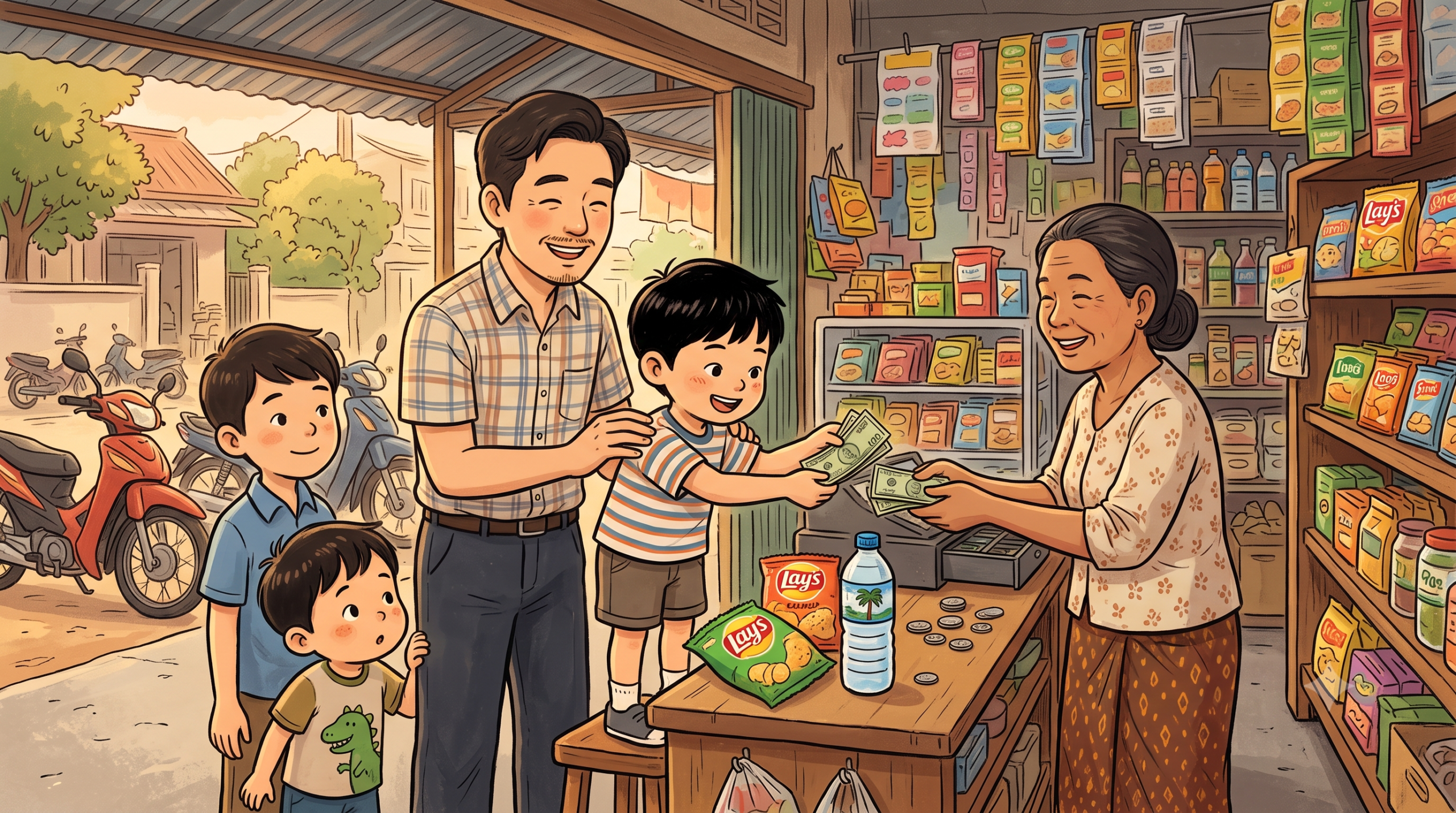
Money lessons for kids come up early for every dad of four boys — ages nine down to two, growing up here in Battambang, Cambodia — because eventually you get asked the money question: do the kids get an allowance? The honest answer is no, not yet. Not because we can’t afford it, but because we haven’t needed to. Their living expenses are covered. What they need right now isn’t cash sitting in a drawer — it’s understanding what money actually is and does, before we hand any of it over.
Money Lessons for Kids Before the Cash
Instead of allowance, we give them missions. A mission is simple: walk into the shop, buy the snacks or the bottled water, hand over the bill, count the change. That’s it. There’s no rigid system behind it, honestly — just teaching them to be smart with what’s in front of them, one trip to the shop at a time. They’re the ones doing the math, the ones learning that money runs out if you’re not paying attention to it.
Why We’re Waiting Until Sixth Grade
We’re planning to start real allowance once the oldest hits sixth grade. I picked that age specifically because that’s usually when money stops being optional and starts being expected. Before sixth grade, allowance is a nice-to-have. After it, there are more social events, more friends, more hangouts — the kind of things you can’t really opt out of without your kid feeling left out. That’s the point where money stops being a lesson and starts being a real need. When we do start, I’m thinking $10 a week, maybe $20 a month. That sounds generous until you do the math on where we live. This is Battambang — a small pack of Oreos, six pieces, runs about 1,000 riel, roughly 25 cents. Twenty dollars is eighty packs of Oreos. I already feel like I’m being too generous, and that’s before I mention that if we lived in Phnom Penh instead, the number would have to at least double to $50 a month, because everything there costs more.
Privilege, Not Payment
Even without a set allowance, their privileges are tied to chores and behavior. But it’s not a strict pay-for-work system either — some of it is unconditional, because they’re my sons. Until they move out or grow up, supporting them is my job, not something they have to re-earn every day.
Where the Money Actually Goes
There isn’t much to spend on here besides snacks, drinks, and the occasional trip to a kids’ cafe. Kids cafes are still fairly new around here — they used to only exist in Phnom Penh, but a few have made their way to Battambang recently. At least a few times a month, the boys get the choice of going to one instead of playing at home again. Once we’re there, all four of them disappear into the ball pool, the slides, the little play houses. They play hide and seek in there, they run their own little detective games, making up situations out of nothing. It’s one of the few places here that gives them something different to do, and one of the few things their saved-up money actually gets spent on. When they get money as a gift — from friends or grandparents — we put it straight into savings instead of letting it disappear on snacks within the week. That way, when we travel to Korea, they land with real money waiting for them, enough to actually buy something they want: a toy, or a game for the Nintendo.
The Grandparent Problem
Korea trips come with a complication: grandparents who want to buy gifts. When it was just two boys, Number Two wanted whatever Number One got — a predictable pattern. Now, with four boys, the pattern has broken down completely. Number Two wants what he wants. Number Three gets what he wants. Number Four wants everything. He’ll ask for the same dinosaur as Number One, the same robot as Number Two, the same Police Hero toy as Number Three — option (d), all of the above. That doesn’t happen. Ever. And when he tries his best kitten eyes on the grandparents, my wife and I step in before they cave.
Who’s in Charge
Right now, I manage all of it — savings, investments, everything. The goal is for each of them to have at least $10,000 saved by the time they’re adults, a real starting point instead of nothing. Until they’re old enough to take that over themselves, it’s on me.
What My Mother Taught Me About Money
I’ll be honest — there’s a part of the older generation of Korean missionaries and pastors I question, at least on this one point. There’s a financial philosophy running through a lot of the Korean Christian church that treats holding onto money — money not immediately spent on missions or ministry — as something close to wrong. That was the atmosphere I grew up around, especially in the more conservative, traditional churches. I don’t think it’s really about sin, though. I think it’s more about a lack of financial understanding than actual doctrine. The Bible is full of financial wisdom, more than people give it credit for — if you actually read into it, there’s enough in there to manage money well and still be faithful.
My mother is the one who helped me see that. She knew the churches around us wouldn’t approve of saving in any real sense, but she explained the biblical case for it in a way that let me think a step further than what I was hearing on Sundays. Once I started getting allowance as a kid, I saved almost all of it toward my first camera, a Canon 450D. It took two years of snack money, and I made sure not to touch a cent of it. Even with all that effort, I still came up short, and that’s where my dad stepped in and chipped in the rest. I bought the camera, and I’ve been shooting ever since. I still love cameras enough that if I had a few thousand dollars sitting around, I’d buy two — one for ministry, one just for myself.
What Faith Has to Do With It
That same mix of faith and practicality is what I’m trying to pass down now. We come from a family of pastors and missionaries, and growing up, there wasn’t much of a financial philosophy beyond “God will provide.” I still believe that. But I also believe God gave us the knowledge and wisdom to be smart, to invest, to prepare — and that using it is part of being responsible and faithful, not separate from it. Faith in provision doesn’t only look like ravens bringing food to Elijah. Sometimes it looks like being a tentmaker. Or a carpenter.
Number Four Already Knows Enough
Number Four doesn’t understand money yet, not really. But he understands exactly what it’s for. He’s taken to grabbing Grandpa’s wallet and announcing, “Let’s go to the mart” — like it’s going to become a daily routine now. It’s not funny anymore, mostly because he means it. When I say no, he doesn’t argue with me. He just goes and finds Grandpa instead.
Money Lessons Are Just Another Piece of the System
This isn’t really about money. It’s the same project as everything else in this house: raising boys who grow into responsible, respectable men. The Chore System teaches them that work has value. The Discipline System teaches them that boundaries hold even when it’s inconvenient. Money is just the next lesson in that same line — that what you have doesn’t appear out of nowhere, and that patience now buys something better later. Whether it’s a camera, a bag of Legos, or eighty packs of Oreos, the lesson is the same either way.
Leave a Reply