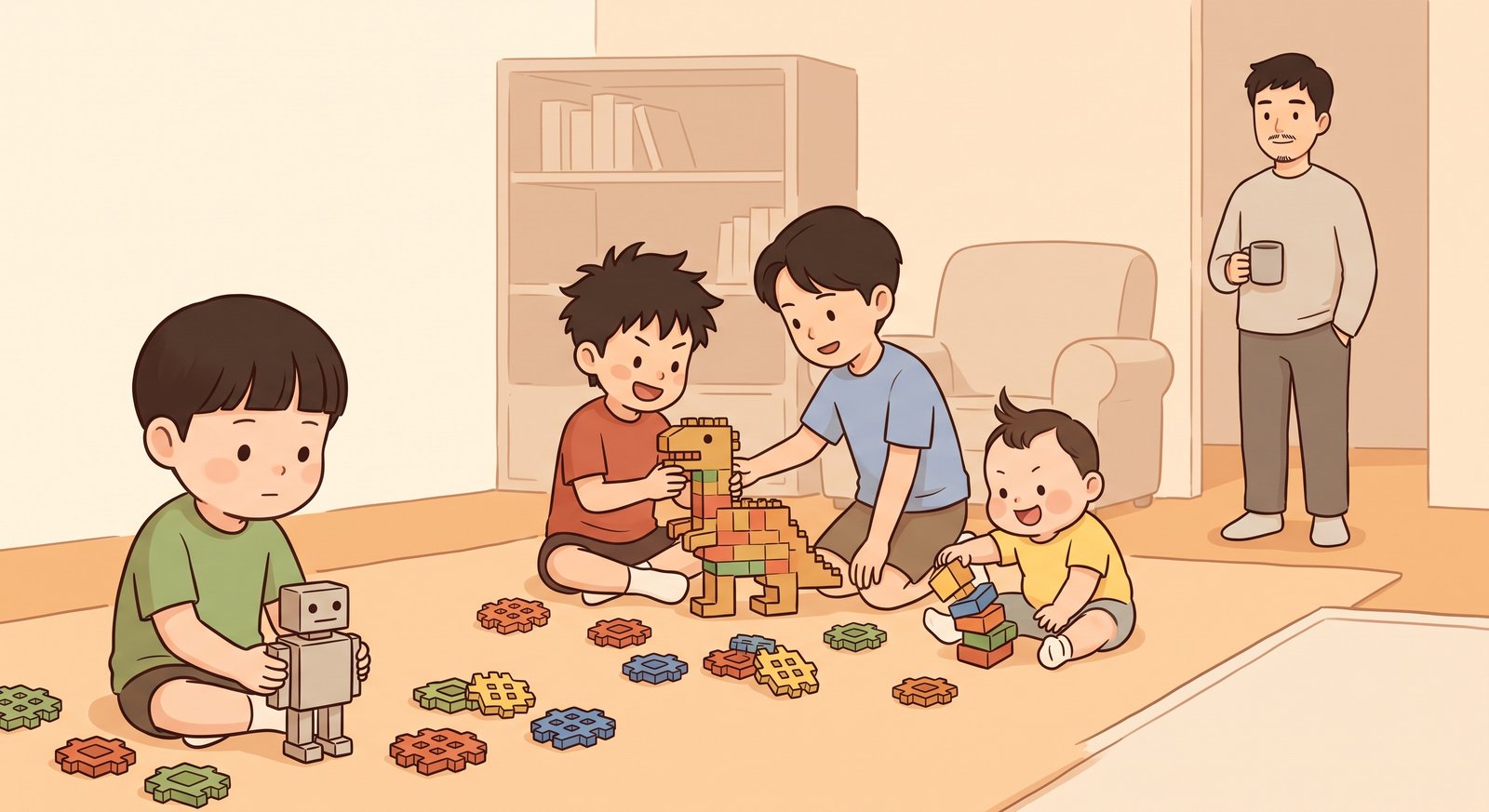
The boys were building blocks, which in this house is a competitive sport. If you have a people pleasing child in the house, the next two minutes are the ones you’d have walked straight past, the same as I nearly did. Number 2 was deep in a dinosaur, the way he always is. Number 4 was undoing things. And Number 3 was building a robot, and doing it perfectly well, and he just wasn’t lit up about it.
That was the whole tell. Not a complaint, not a sulk. A boy at the same table as his brothers, working at the same speed, with the excitement turned down about two notches from where it usually sits.
I almost let it go. He’s the easy one, and the easy one is the one you skip when you’re triaging four boys on a Tuesday. That’s the entire problem, and it took me four sons to see it: nothing he does ever makes it to the top of the list.
“Easy” Measures the Wrong Person
Let me be accurate here, because I’ve called him the easy one in these articles and I’m not going to pretend otherwise now.
He is, technically, the easy child. Adaptable, even-keeled, rarely in trouble. By every measure a tired parent actually uses, that’s true.
But every one of those measures is a measure of me. How much noise did I absorb this week. How many arguments did I have to hold. How many times did somebody call me into a room. “Easy” is a description of the invoice, not of the boy.
And what I got wrong — for years — was assuming those two things matched. That easy for us meant easy for him. It looked easy from the doorway. Inside, it wasn’t.
What I Asked Him in the Living Room
Later that day I got him alone. That part wasn’t an accident; with this particular son it never can be, because he will not raise anything in a room with his brothers in it.
I asked him straight: did you not like the robot?
He said he liked it. Then he said he had really wanted to make dinosaurs.
I want to be clear about how small that sentence was. No drama in it, no accusation. Just an answer to a direct question that nobody had thought to ask him.
So I told him what I actually thought — that his robots were good, that I was proud of him, and that it was completely fine for him to build dinosaurs if that’s what he wanted.
And he had an argument ready.
Number 2 wouldn’t have liked it if their themes overlapped.
He’d already run the whole calculation. He’d worked out what his brother had claimed, worked out what it would cost to claim it too, and quietly routed around it — and then built robots for months without mentioning it to anyone. He was five.
That was my job, right there, and I’m glad I got that one. I told him it was okay. That no matter what, it was okay for him to want the same thing his brother wanted. That nobody in this house owns a category.
The Peacemaker Is Paying for the Peace
Here’s what I’ve come to think that behavior actually is, and it isn’t manipulation and it isn’t shyness. It’s the good instinct running without a brake.
He’s the peacemaker. I don’t use that word lightly in a pastor’s house, and I notice I’ve never once used it about the other three. He’s genuinely loving, he genuinely cares, and in a house with four boys those two qualities carry a specific cost: he is constantly pouring himself out for his brothers, and nothing is going back in.
That’s the part a parent has to catch. Giving something up for peace is a good instinct. Giving something up for peace forty times, quietly, with nobody ever noticing that a transaction happened — that’s an account being drawn down with no deposits. It doesn’t look like a problem for years. Then one day it is one.
And I now assume the block thing wasn’t rare. Once you’ve seen the shape of it, you start counting backwards, and there were almost certainly a lot of other afternoons where he gave something up and I registered it as the house being peaceful.
The People Pleasing Child Needs More of You, Not Less
When I wrote about the seven child temperament types I called this one the Harmonizer, said easy kids get overlooked, and moved on to the next type in the list. That was true and it was far too gentle. So I’d put it more strongly now.
The quiet child is very often the deepest child in the house. The most considerate. The one running the most calculations about everyone else before he opens his mouth. That isn’t a child who needs less of you because he’s low maintenance.
A people pleasing child needs more of you, precisely because he is.
He needs the love and the care, and he needs the specific thing that a loud kid gets automatically and he never does — the evidence that somebody noticed. And he needs to know we’ve got his back, which is a different message from “well done.” Well done is about what he produced. Having his back is about what he’s allowed to want.
The System, Such As It Is
I’d love to hand you a chart here. I don’t have one. What I have is four steps that I now run on purpose instead of by luck:
Watch the volume, not the behavior. There’s no misbehavior to catch with this kid, so the signal isn’t what he does — it’s the excitement dropping a couple of notches while everything else looks normal. That flatness is the entire alarm system. It is very quiet and it is very easy to walk past.
Get him alone. Always. He will not say a true thing in front of his brothers, because the true thing might cost one of them something. Same information, different room, completely different answer.
Ask a direct question and then shut up. Not “are you okay” — he’ll say yes, because yes is cheaper. Something specific enough that agreeing to it isn’t an option. Did you not like the robot? And then wait longer than is comfortable.
Give explicit permission, out loud. This is the one I’d underline. He didn’t need encouragement, he needed a ruling — that he’s allowed to want the same thing his brother wants, and that nothing bad happens to anyone if he does. He’d already decided the opposite on his own, and a five-year-old’s private ruling stands until somebody overturns it.
What I Can’t Do
I’m not going to pretend this fixes him, because it doesn’t, and I don’t think it’s supposed to.
I can’t stop him from doing this. It’s his character. He is going to keep handing his portion to whoever is angriest in the room, because that’s who he is, and honestly it’s one of the best things about him — I’ve watched him end a fight by giving away his own snack and then look genuinely relieved about it.
So the goal was never to make him louder or less generous. The goal is that he isn’t doing it alone and unnoticed. He can keep pouring himself out. Somebody just has to be paying attention to the other side of the ledger, and in this house that has to be us, because he is never once going to bring it up.
Back to the Robots
He still builds robots. He’s good at them now, in the way you get good at anything you’ve done for years, and I don’t think he’d give up the lane even if dinosaurs came free tomorrow.
But I’ve stopped telling that as a story about creativity.
A five-year-old looked at a shelf, worked out what was already spoken for, and routed around it without telling anyone. Nobody taught him that. Nobody had to. And if he can do it with blocks at five, he can do it with a friendship at twelve, and a job at twenty-five, and a marriage at thirty — always choosing the lane nobody’s contesting, always costing nobody anything, and never once being any trouble.
That’s the part I’m actually working on. Not making him different. Just making sure that somewhere in this house, at least once a week, somebody sits him down on his own and asks him a question that “yes” is not a good enough answer to.