Category: Family Life

  • My Son Wants to Be a Missionary and a Marine Biologist (Here’s What I Told Him)

    My Son Wants to Be a Missionary and a Marine Biologist (Here’s What I Told Him)

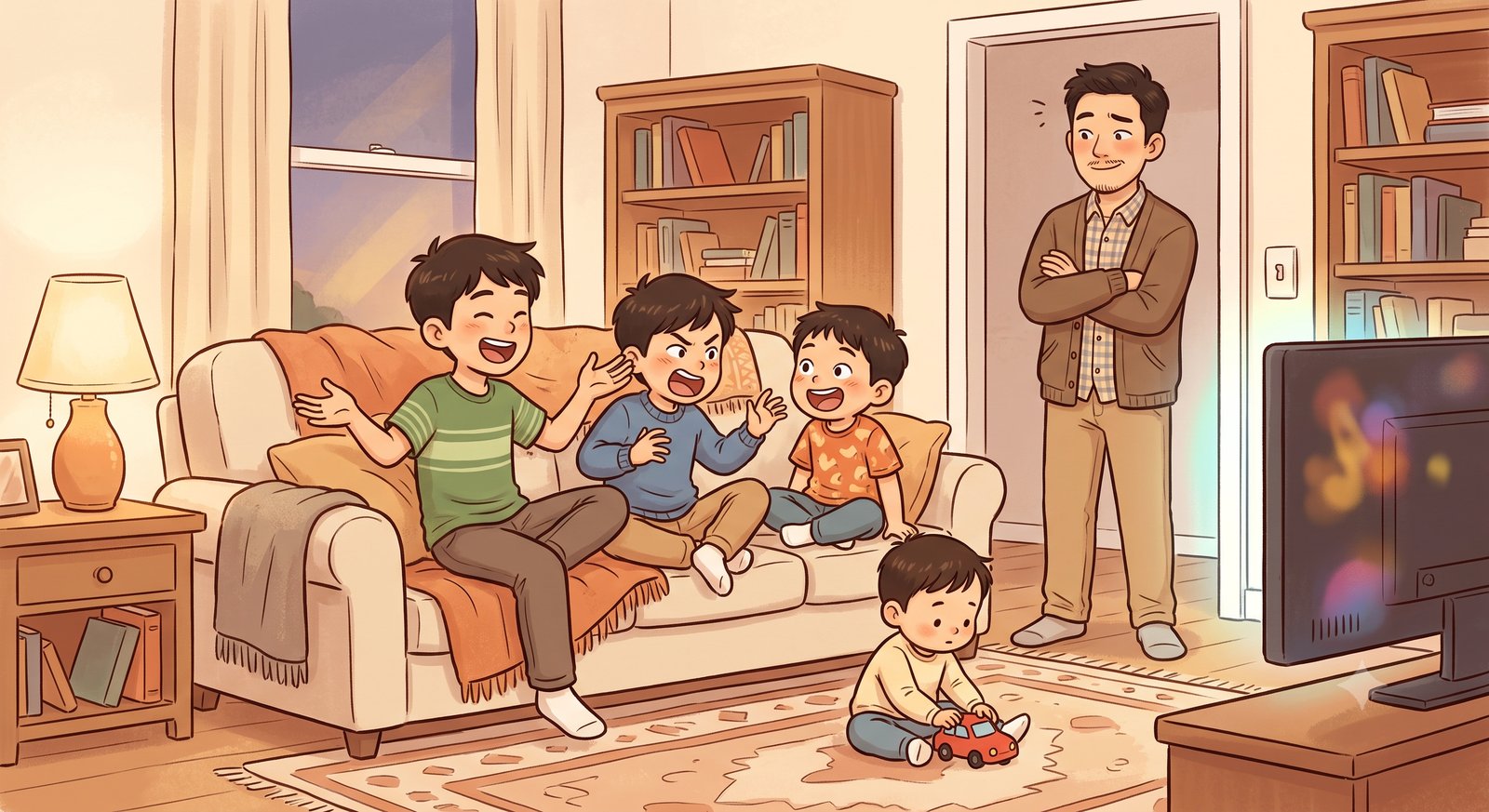
    We were at dinner, plates half-cleared, the boys still picking at rice, when my wife asked the question every parent eventually asks: “What do you want to be when you grow up?” Neither of us knew it yet, but that ordinary question was about to turn into a real conversation about teaching kids to serve others — not the planned kind, the kind that just shows up while you’re clearing plates.

    It’s usually a throwaway question. You expect “astronaut” or “YouTuber” or whatever cartoon he watched that morning. Number 1 didn’t answer it like a throwaway question.

    “I want to help people. Like you and mom.”

    That part came out fast, like he’d already decided it a while ago. Then came the part he’d clearly been sitting with, turning over on his own, maybe for weeks. He loves marine life — he can tell you the difference between a manta ray and a stingray without blinking. He loves robotics, the kind of love where he asks for parts instead of toys. He loves insects, watches documentaries about them the way his brothers watch cartoons, the narrator’s voice basically background music in our house at this point. But somewhere along the way he’d also decided he wanted to be a missionary, and in his head, those things didn’t belong in the same sentence. Missionaries preach. Missionaries plant churches. Where does a kid who wants to study octopuses and build robots fit into that?

    He said it like a real dilemma, not a passing thought — the kind of thing he’d been carrying quietly and finally decided to hand to us at the dinner table, hoping we could solve it. “But I don’t know if I can be a missionary and do those things too,” he said. He wasn’t looking for permission to change his mind. He wanted to know if he actually had to choose.

    Where the Question Actually Came From

    To understand why this mattered so much to him, you have to back up a few months, to something that had nothing to do with career questions at all.

    Late last year, a border conflict between Thailand and Cambodia displaced a huge number of families near us. At the peak of it, there were roughly 60,000 displaced people within about 50 kilometers of Battambang — entire villages that emptied out overnight because the fighting made it too dangerous to stay. Some of those border villages are still occupied even now, months later, still unreachable to the families who used to live in them. The Cambodian government is working through it. In the meantime, people just needed help, and we were close enough to give some.

    Our church and ministry network ended up helping at four different camps — bringing food, hygiene supplies, care packages, whatever we could raise money for and physically deliver. It wasn’t a one-time drop-off. It was weeks of going back, checking on the same families, learning names.

    I missed a chunk of that season. Right in the middle of it, I flew to Korea for ear surgery I’d been putting off, and recovery kept me out of commission for weeks — no lifting, no long car rides on rough roads, no camp visits. While I was gone, my wife kept going without me. On one of those visits, she and Number 1 found out that fifty or sixty kids his own age at that particular camp had nothing for school. No notebooks. No pencils. No uniforms. Nothing. Kids who’d been going to school just like him a few months earlier, now with no way to.

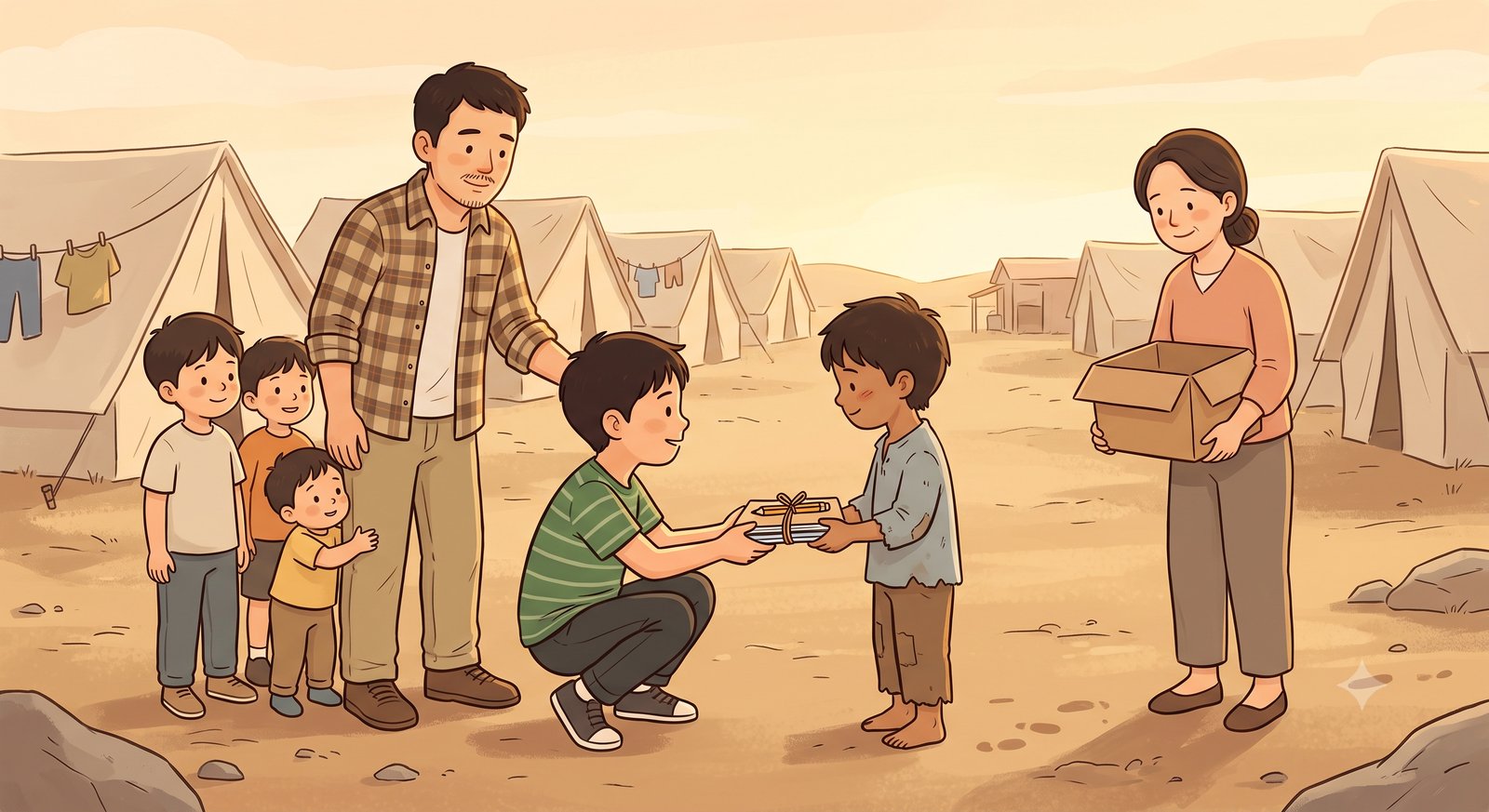
    So we raised what we could from our own network, and my wife made a supply run — pencils, notebooks, sharpeners, erasers, uniforms, enough for every kid at that camp who needed one. She and Number 1 went together to hand them out.

    He didn’t just tag along and watch from behind her legs. He was the one crouching down, putting a bag directly into another kid’s hands, the two of them close enough in age that there wasn’t much distance between “the boy giving” and “the boy receiving” except circumstance.

    I wasn’t there for it. I heard about it secondhand, after I’d flown back and was still moving slowly, my hearing not fully returned yet. But I recognized the look on his face when he told me about it — not the performance of being proud of himself, something quieter than that. He kept circling back to it in conversation over the following weeks, the way you do with something you haven’t fully processed yet. A detail here, a detail there. What one kid said to him. How heavy the boxes were. He wasn’t announcing that it mattered to him. He just couldn’t stop thinking about it, and it kept leaking out sideways. Looking back, that afternoon probably did more for teaching kids to serve others than any conversation we could have planned at home.

    Teaching Kids to Serve Others Starts Before They Understand the Word “Missionary”

    That’s really what was sitting underneath his dinner-table dilemma, even if he couldn’t have explained it that way himself.

    He didn’t need a theology lesson before any of this made sense to him. He’d already felt what it was like to hand something real to someone his own age who had nothing, and to watch that kid’s face change because of it. Teaching kids to serve others isn’t something you accomplish with a conversation and then hope it sticks later — it’s putting them inside the actual moment first and letting the feeling do the teaching. The words come after. The words are just how we help them make sense of what they already felt in their hands. It’s not so different from how we’ve handled money and giving with him in general — the lesson lands because he’s lived it, not because we lectured him into it.

    So when he told us at dinner that he wanted to help people like his mom and dad, he wasn’t reaching for an abstraction he’d absorbed from a sermon. He was reaching for that specific afternoon at that specific camp, a memory with weight and texture to it, not a value we’d successfully installed.

    You Don’t Have to Choose

    So we told him the truth as we understand it, as best as I could put it to an eight-year-old without losing him halfway through.

    A missionary isn’t just someone who plants churches or preaches from behind a pulpit. The church matters enormously — it’s the headquarters. It’s where people are discipled, taught, trained. It’s where we come to understand that we’re children of God, saved by faith, not by our own effort. It’s where we return again and again to be recharged, to have real fellowship with the Lord and with each other. None of that is optional or secondary. But the church was never meant to be the only place missions happens, and it was never meant to be the finish line either.

    You are not required to become a pastor to live a missional life. You are required to actually live it — professing Jesus through what you do, what you say, even what you privately think, wherever you happen to be standing. If you can become genuinely skilled at something, anything, that serves and benefits other people, you can live out your faith through that skill. It doesn’t need a pulpit underneath it. And when the moment comes — and it will come, usually when you least expect it — you say something true about why you live the way you do.

    Relief work. Education. Medicine. Media. Marine biology. Robotics. None of these are distractions from missions or a lesser calling you settle for if the “real” ministry doesn’t work out. They’re tools for it, the same as preaching is a tool for it. The specific tools shift with the era — a missionary a hundred years ago didn’t have social media in his toolkit, and today it might be one of the most effective ones we have. The strategy has to keep shifting with the world it’s trying to reach. What doesn’t shift, what can’t shift, is the calling sitting underneath all of it.

    So no, I told him, he doesn’t have to choose. He can love God, love Jesus, and be willing to talk about that love in whatever he ends up doing with his life — including, if that’s really where his curiosity takes him, spending his days studying coral reefs or teaching a robot to walk or naming every insect in a rainforest canopy. That isn’t a compromise version of being a missionary. That, done honestly, is the whole point of it. That’s the real shape of teaching kids to serve others — showing them the calling fits inside any profession, not just a pulpit.

    What I Actually Learned Sitting There

    I’ve spent years thinking hard about what it actually means to raise my boys to live out their faith instead of just performing the motions of it in front of us. I didn’t expect the clearest version of that lesson to arrive by watching my own son wrestle, in his eight-year-old way, with almost the exact question I’ve spent my adult life trying to answer for myself.

    He handed a kid his own age a bag of pencils and felt something he didn’t have language for yet. Weeks later, sitting across from us at dinner, he was still trying to figure out where that feeling was supposed to live — whether it belonged behind a pulpit, inside a marine biology lab, or somewhere he hadn’t even heard of yet. The honest answer, the one I actually believe, is that it belongs wherever he ends up, as long as he’s willing to carry it there with him.

    Growing up the way he is — moving between cultures, raised as a third culture kid in a country that isn’t the one on either of his parents’ passports — he’s already learning to hold more than one identity at once without treating them as a contradiction. Missionary and marine biologist is just the next version of that same skill.

    I don’t know yet if he’ll grow up to study the ocean, build robots, chase insects through a jungle, stand in front of a congregation, or somehow end up doing all of it at once — kids that age contain multitudes, and most of it will change six more times before he’s twenty. I don’t actually need to know which one it is. What I know, what I actually watched happen with my own eyes months apart, is that he’s already done the hardest part of this. He’s felt, firsthand, what it costs and what it gives you to hand something real to someone who needed it. Everything else — the career, the title, the “what do you want to be” answer he eventually settles into — is just deciding what container he ends up carrying that feeling in.
  • I’m Fluent in English. My Kids Still Won’t Speak It.

    I’m Fluent in English. My Kids Still Won’t Speak It.

    Teaching kids to speak English at home sounds like it should be the easy part of my story. English is my mother tongue now — I’ll say that plainly, even though it isn’t the language I was born into. I grew up Korean, and when my family moved to Uzbekistan, my two brothers and I didn’t speak a word of English between us. I started learning at six. Somewhere in the years after that, English quietly became the language I think in, joke in, and dream in. I speak it better than I speak Korean today — ask my wife, she’s the first to remind me of my limits in her language, not mine.

    Here’s the part I don’t lead with, because it sounds like bragging and isn’t meant to be: I’m actually quadrilingual. English with my brothers. Korean with my parents. German with cousins in Austria. Russian with the friends and church members I grew up around in Uzbekistan. That sounds impressive until you’re the one carrying it. These days my mind mixes German and Russian without asking me first, and lately Khmer keeps sneaking into the blend too. Holding four languages at once isn’t a party trick. It’s a cost, and I pay it daily. So when it came to my own boys, I assumed the hard part was already solved — I’d done it myself, more than once. Surely they’d manage one more language, with a fluent parent right in the house.

    I was wrong. Teaching kids to speak English at home turned out to be a completely different job than learning it myself ever was.

    What I Actually Expected

    Our boys spent over four years living in Korea before we moved to Cambodia. For most of that stretch, Korean was the only language in the room — school, friends, TV, everything. There was no daily reason to reach for anything else, so nothing else took root. We’ve been in Battambang for about a year now. School is entirely in English. Khmer is what they pick up from friends and at church — they know the basics now, numbers, simple words, enough to get by, but real conversation in Khmer is still a step away. And Korean is still what runs the house. They play in it, talk in it, argue in it — loudly, and often. English is a subject they pass at school, not a language they live in once they’re home.

    Teaching Kids to Speak English at Home, and Why We Made It First

    Our original plan was Korean first, Khmer second, English third — Korean for who they are, Khmer for where they live, English last. Then we noticed something in Battambang: a lot of the local families we know, especially middle and upper class ones, quietly prioritize English over Khmer for their own kids. It made sense once we sat with it. Higher education, better careers — English is close to a requirement for both. We agreed with that logic enough to change our own order. Pushing English first was my call, specifically, because I’m the one in the house who actually speaks it. I can’t pretend English doesn’t carry more weight and more doors than most other languages right now. If our boys were going to be sharp — the kind of kids who could stand out, not just get by — I wanted English to be the language they had first, not last.

    My wife complicates this more than people expect. She grew up in Cambodia, so her Khmer is close to fluent, just rusty after years in Korea. Her English is genuinely decent — good enough to hold a real conversation. But she still finds it awkward to actually speak English to our own boys. It doesn’t come naturally as a parent-child language for her, even though she can use it fine elsewhere. So the one adult in the house with real, native-level Khmer speaks Korean and Khmer with the boys, not English — which means the “English environment” I was counting on was never as built-in as I assumed.

    What I Actually Tried

    I didn’t just wait around, either. I ran through a real list:

    • Morning English-only rule. Whoever spoke first at breakfast had to speak English. Lasted about four days before Korean quietly took back over.
    • Research. I went looking for actual methods to teach English to my three school-age boys. I’ll be honest — I’m not a language teacher, and it showed. Nothing I found translated into anything that stuck.
    • The reward system. Whichever kid used the most English during the day got some kind of small prize. It turned into a competition about the prize, not the language.
    • English-only screen time. This felt like the one that should’ve worked, closest in spirit to the screen time rules that actually work for everything else in this house. It didn’t work here — not the way I expected.
    • A private English tutor. We actually looked into this seriously. It’s genuinely hard to find one in Battambang, or really anywhere outside Phnom Penh. We specifically wanted someone without a strong Khmer-accented pronunciation pattern — not because Khmer speakers can’t teach English well, plenty do, but because Khmer phonics shape pronunciation in ways that are hard to unlearn later, and we wanted our boys hearing a specific model early. We never found the right fit.

    The Disney Workaround They Found Instead

    Here’s what actually happened when I switched all their screen time to English: they put on a Pixar or Disney movie they’d already watched a dozen times in Korean, and instead of listening to the English, they narrated the Korean dialogue to each other from memory, scene by scene, while the English played in the background. They weren’t ignoring the movie — they knew exactly what was happening on screen. They just weren’t hearing it in English anymore. Maybe that’s doing something for comprehension underneath the surface. I genuinely don’t know. But it is nowhere close to a conversation, and a conversation was the whole point.

    The Real Reason, I Think

    After all the rules and systems failed one by one, I landed on something simpler and harder to fix: our boys don’t feel like they need English. They’re a tribe of four. They have each other, in Korean, all day, every day. There’s no friction in their world that a new language would solve — no barrier they run into with each other that makes reaching for English feel necessary. Kids learn survival vocabulary fast because survival is real pressure. Ours get exactly enough English to get through a school day, and then they go home to a world where Korean already covers everything that matters to them. Without that pressure, motivation just isn’t there, no matter how many rules I put around it.

    What My Mom Did That I Forgot

    Somewhere in the middle of all this frustration — me talking to my boys in English, getting a blank “uhm…” and a retreat back into Korean — a memory came back to me that I hadn’t thought about in years. My mom taught my brothers and me to read English using a whiteboard. She wasn’t fluent herself. Her English was more limited than what I’m dealing with in reverse now. But she sat us down, board and marker, and made it happen anyway, without any of us feeling the daily survival pressure that usually forces a language to stick.

    I hadn’t thought about that whiteboard in a long time, and when I did, it landed hard. I’ve been assuming that switching a rule here or a screen there was the same kind of effort my mom put in. It wasn’t close. She sat down and taught, deliberately, sound by sound, letter by letter, with less English than I have and four languages’ worth less experience with exactly how draining this can get. I’ve been hoping proximity and a few house rules would do the work that she actually sat down and did by hand. Real teaching kids to speak English at home, it turns out, was never going to happen by osmosis alone — it needed a whiteboard, not just fluency in the house.

    Where That Leaves Me

    I don’t have this one solved. I wish I could end this the way some of the other systems in this house end — here’s the rule, here’s why it works, here’s what changed. This one’s still open. What I do know is that fluency, even four languages of it, isn’t the thing that’s going to teach my kids English. Effort is. The kind my mom put in with a whiteboard and less English than I have now. That’s the part I forgot, and the part I’m going back to.

  • Why I Still Don’t Have a Camera (And What My Dad Taught Me About Capturing Family Life)

    Why I Still Don’t Have a Camera (And What My Dad Taught Me About Capturing Family Life)

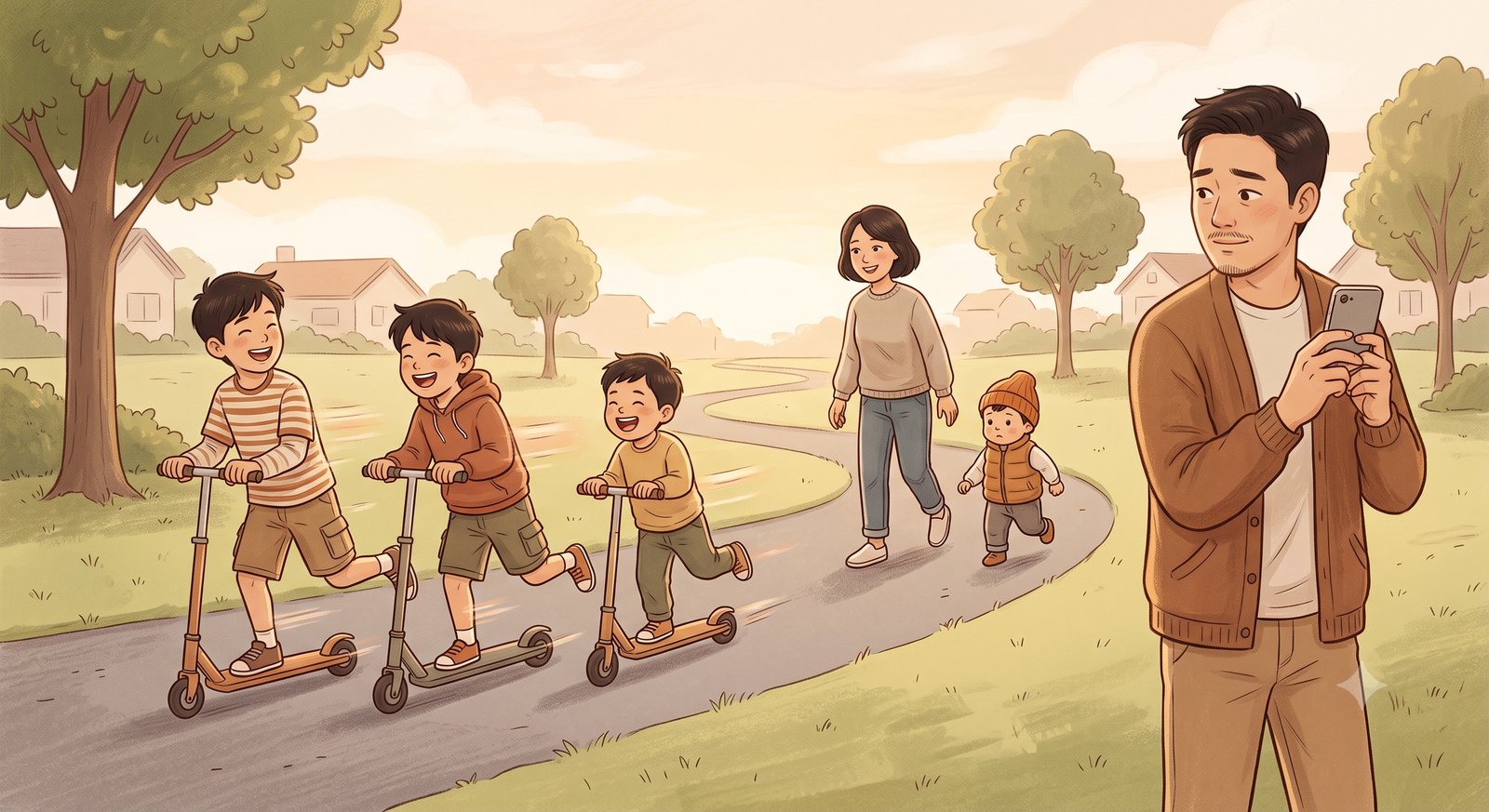
    Every morning lately, our family goes out to exercise in the open area near our house. The boys ride their kickboards ahead of us. My wife walks. Number 4 — two years old, short legs, full commitment — trails along behind, refusing to be left out of whatever his brothers are doing. It’s an ordinary fifteen minutes. It is also, most mornings, the best fifteen minutes of my day.

    And every morning, I stand there wanting to capture it, and all I have in my hand is my phone. Capturing family memories used to be second nature to me — now it’s the thing I miss most.

    My phone camera is good. It is not a camera. It doesn’t take in the scene the way I’m experiencing it — the light, the noise of four boys, the specific way my wife laughs at something Number 2 just said. It flattens the whole thing into a clip I’ll scroll past in a month. And that gap between what I’m feeling and what the phone gives back to me is when I realized: I really want a proper camera in my hand again.

    Capturing Family Memories Runs in My Family

    This isn’t a new feeling. It’s inherited.

    Before we moved from Korea to Uzbekistan, when I was a boy, my dad had a Nikon F-501. He carried it everywhere. I remember one day at an amusement park with my parents and my two brothers — all three of us running through a fountain area where water shot up randomly from holes in the ground, no pattern, just chaos and shrieking and getting completely soaked. We only had one spare set of clothes between us: our taekwondo uniforms. So that’s what we changed into. And my dad, camera in hand as always, photographed the three of us running through the fountain in our dobok, and then sitting together afterward, still dripping.

    That photo is still hanging in my parents’ living room in Korea today. Every time I visit, it’s there.

    My dad didn’t just own a camera. Camera and camcorder both, always within reach — every birthday, every ordinary Saturday, every trip, documented without anyone having to ask him to. I can go back to that house right now and open an album and watch our whole childhood play back. That’s not a small thing. That’s a father who decided, quietly and consistently, that this family was worth recording.

    I didn’t choose to inherit that instinct. It just came with growing up in his house.

    The Restless Years

    I’ve owned more cameras than I’d like to admit as an adult. A Sony a7III first, after I got married — beautiful image quality, but the color science felt flat to someone who’d grown up loving what Canon does with color. So I sold it for a Fuji X-T4, which I loved — small in the hand, endless film-simulation profiles to play with. Then the pull of full-frame got me again with a Sony a7C, then a Panasonic S5II for the video specs, until the lenses got heavy enough to hurt my shoulder on hikes. Then a Nikon Zf, which might be the one I regret losing the most — the dials, the black-and-white monochrome shots, the whole feel of it in my hands.

    I’m not proud of the churn. But underneath the restlessness was always the same thing my dad had: I wanted to carry something that could actually hold what I was seeing. Capturing family memories was never really about the gear — I wanted to take pictures with my sons, of our family, of whatever was happening in front of me. I loved it enough that I once took a picture of my own foot, just because the light was doing something interesting. (It’s the same instinct, I think, that shows up in how a hobby passes from one generation to the next in this house — you don’t teach it so much as you just keep doing it in front of them.)

    The Camera I Sold on Purpose

    My wife wanted a camera too. She’d started thinking about vlogging — documenting our ministry, our kids, our life here — and she needed real tools for it, not just my hand-me-down enthusiasm.

    So I sold the Zf. In its place, I got her two cameras: a DJI Pocket 3 and a Sony ZV-E10 II.

    There was a real conversation behind that decision, not just a budget spreadsheet. I knew she’d spent years living with my camera obsession — watching me buy, sell, upgrade, agonize over color science like it was a moral question. She’d earned the right to have what she wanted without a fight. So when the moment came, I didn’t hesitate. It felt like the right thing to do, and it still is. She uses those two cameras almost every day now. She’s happy. That part worked exactly like I hoped.

    What I didn’t expect was how losing the Zf would actually feel, months later. It was the right call. I’d make it again. And I’ve also learned, with more honesty than I expected to need, that I love cameras more than I thought I did. Both of those things are true at the same time, and I’ve stopped trying to resolve them into one clean feeling.

    The ZV-E10 II is a genuinely great camera. It also sits on a tripod in our room, because it was never really mine. I only pick it up when my wife asks me to — birthdays, anniversaries, the moments that need documenting. The best camera is supposed to be the one you actually carry with you. Right now, the one I carry is my phone.

    The Part I Didn’t See Coming

    Here’s what I didn’t plan for, and what’s made the whole thing feel less like a loss and more like a relay.

    Number 1 recently discovered vlogging. On a trip with his mom, he picked up her DJI Action 6 and started talking to it — unprompted, completely on his own. “This is a zoo,” he’d announce, then explain something about whatever animal was in front of him. “This is the swimming pool,” and then a full breakdown of how fun it was. He’s awkward doing it — you can see him working out that he’s talking to a lens, not a person, and it doesn’t quite sit naturally yet. But underneath the awkwardness, you can see he’s actually enjoying it. That part isn’t performance.

    Before all that, when I still had the Zf, he asked if he could hold it. I let him. He strapped it around his neck the way he’d seen me do a hundred times, put it on auto, and took a photo of Number 3 — his little brother, mid-moment, nothing posed. It came out genuinely decent. Not luck-decent. Actually good.

    That’s the photo that did it, I think. Something clicked for him right there, holding a real camera and getting a real result. The curiosity that followed — the vlogging, the narrating, the wanting to hold the camera again — didn’t come from me teaching him anything. It came from one photo he took himself, of his brother, on a camera that wasn’t even his.

    What I Actually Learned From All This

    My dad carried a Nikon F-501 through a fountain full of shrieking kids in taekwondo uniforms because he wanted to hold onto that afternoon. I’ve cycled through six cameras chasing the same feeling. And now my son is narrating zoo animals into a lens, badly and joyfully, because one time he got to hold a camera that actually worked.

    None of that required me to have the right gear. It didn’t even require me to have any gear at all — for months now, I haven’t. Capturing family memories, it turns out, was never actually about which camera was in my hands. It required a family that kept showing up to be recorded, and one photo that let my oldest feel what it’s like to actually catch a moment instead of just living through it.

    I’m still hoping to get my hands on a Fuji again by the end of the year. I won’t pretend I’ve made peace with not having one. But I’ve stopped thinking the camera is the thing that matters. My dad’s F-501 is sitting in a drawer in Korea right now, not doing anything. The photo it took is still on the wall. That’s the part that lasted.

    Whatever ends up in my hands next — or in Number 1’s, someday, if I have anything to say about it — I think that’s the only part I actually need to get right.

  • Why We Never Have Enough Building Blocks (And What My Boys Taught Me About Creativity)

    Why We Never Have Enough Building Blocks (And What My Boys Taught Me About Creativity)

    Every parent who’s ever bought building blocks for kids knows the drill: no matter how many boxes you own, it’s never enough. I learned exactly how true that is on the day my two-year-old climbed a kitchen chair to bring down his brother’s proudest creation.

    Number 2 spent close to two hours on it. When he finished, it genuinely looked like something out of a cartoon — a tyrannosaurus built entirely from waffle blocks, except this one had blaster cannons mounted on both sides and one more on its back. Three cannons. A Mecha T-Rex, fully armed, and it was easily the most impressive thing any of my boys had built up to that point. He shelved it on the top shelf in the living room, the way you’d display a trophy, and we all went back to whatever we were doing.

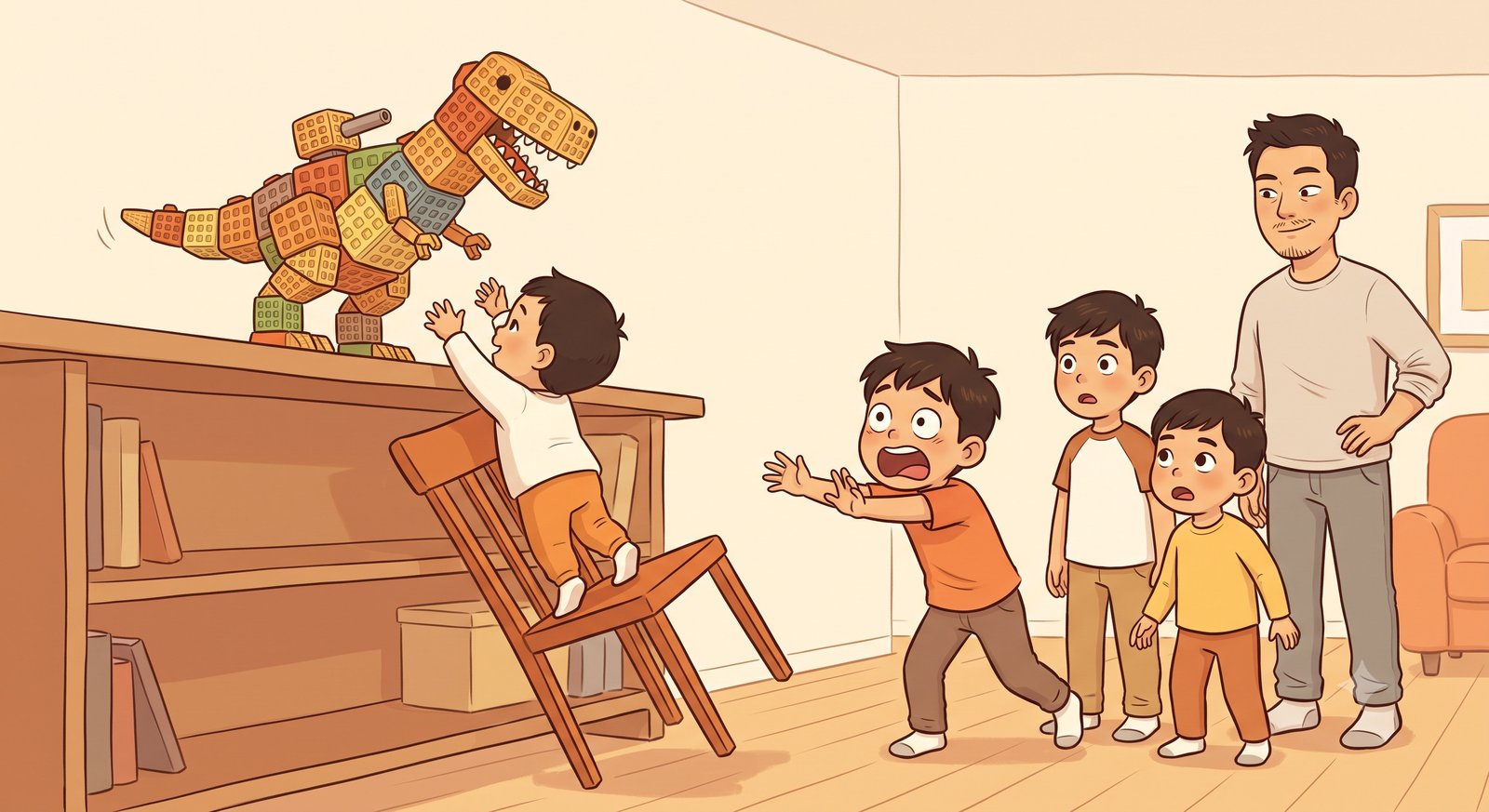
    A few minutes later, Number 4 started dragging a kitchen chair — all the way from the kitchen to the living room — and climbed it like a ladder until he was standing at the top shelf, both hands wrapped around the Mecha T-Rex.

    He made eye contact with Number 2 across the room. I still don’t know if he was surprised he’d been caught, or if some part of him had climbed up there specifically to watch it shatter. Either way — he dropped it.

    Number 2 screamed. Not a small scream. A full “NO” that carried through the house, and he was still screaming it as he ran across the room toward the wreckage. Number 4 was already gone — gone like the wind — sprinting for the couch and wedging himself behind it, convinced, apparently, that nobody would think to look there. He looked genuinely terrified when we found him. It was, I’ll admit, very funny.

    That’s the highlight reel. It’s also just an ordinary Tuesday in our house, because this happens constantly, in one form or another, and it’s the whole reason we can never seem to have enough building blocks no matter how many boxes we buy.

    Why Building Blocks for Kids Are Never Enough

    We have a lot of blocks. Boxes and boxes of waffle blocks. Lots and lots of wooden blocks. Two full boxes of MagFormers — the magnetic kind, not cheap, bought with the confidence that surely, finally, this would be enough building blocks for kids who build like ours do.

    It is never enough. If you’ve ever wondered why the same open-ended building blocks show up on every kid’s wish list generation after generation, this is why — they’re infinitely reusable, which means the “shortage” is never really about the blocks themselves.

    I used to think this was a supply problem. Buy more blocks, solve the shortage. I’ve since learned it isn’t a supply problem at all. It’s a demand problem, and the demand is bottomless, because of one simple rule none of us wrote down but all four of my boys somehow agreed on: every finished build has to sit on a shelf like a trophy.

    The Gundam Connection

    I understand this rule better than I’d like to admit, because I grew up building the exact same way.

    When I was a kid, I built plastic models — Gundam kits, the robot models every boy I knew was obsessed with at some point. You’d spend hours snapping pieces together, and when it was done, it didn’t get boxed back up. It went on the shelf. It sat there as proof: I made this. It stayed until the shelf was full, and then you needed a new shelf.

    I actually tried starting Number 1 on his first Gundam kit not long ago. It didn’t go well — the pieces are smaller and more complex than I remembered, and he wasn’t quite ready for them yet. We shelved that attempt too, in a manner of speaking. I’m hoping to try again next year, once his hands and his patience have both caught up.

    In the meantime, his generation builds the same instinct out of different material. Finish something, and it doesn’t get broken down for the next build. It goes on display. Which means every new project needs its own fresh pile of blocks, because the last pile is now a museum exhibit and museum exhibits are not for touching.

    Four boys, four museums, one shrinking supply of blocks. That’s the actual math behind why we’re always short.

    The Professionals

    Here’s where it gets interesting, though — because the shortage isn’t really the story. What the blocks revealed was something about how creativity moves between siblings.

    Number 2 is our dinosaur professional. The Mecha T-Rex was his masterpiece so far, but it didn’t come from nowhere — he’s been building dinosaurs out of these blocks for a while now, and each one has been more ambitious than the last. This one just happened to level up into a dinosaur-robot hybrid, cannons and all.

    Number 3 picked a different lane entirely: robots. Not because anyone assigned it to him — because dinosaurs were already taken, and he needed his own trophy, his own thing to be known for.

    Number 1, the oldest, never picked one specialty. He builds everything else — trains, houses, whatever the day calls for. He’s the generalist, and somehow that fits him exactly the way dinosaurs fit Number 2 and robots fit Number 3. Maybe that’s also why the Gundam kit didn’t click yet — a generalist needs the freedom to build whatever’s in his head that day, not follow somebody else’s instruction booklet.

    One brother’s masterpiece never just sits there being admired. It becomes a blueprint, a challenge, an invitation the others couldn’t turn down. Somebody makes something new, and suddenly everybody wants to be part of what’s next. (We’ve written before about how this kind of creative play unfolds in our house — blocks are just the version with the highest body count.)

    The Demolitioner

    And then there’s Number 4.

    Number 4 does not build. Number 4 destroys. He is, without question, the most efficient force of chaos in this house — the toddler who will drag a kitchen chair across two rooms and climb a shelf just to get his hands on somebody else’s two hours of work.

    His brothers are not thrilled about this. I understand why. The Mecha T-Rex is gone. Hours of concentration, gone in the second it took to fall.

    But here’s what I’ve noticed, watching this happen over and over: the demolition isn’t just a loss. It’s a reset. Once the Mecha T-Rex was gone, Number 2 didn’t have a model sitting on the shelf to copy anymore. If he wants another one, he has to build it from memory — and a dinosaur rebuilt from memory instead of copied from a standing model is never quite the same dinosaur. It’s a different one. Usually a better one, because he’s had practice now and he’s not just recreating. He’s improving.

    The old one is gone. There’s nothing left to mimic. So it has to be something new.

    Why Nothing New Feels New Anymore

    Watching these four cycle through building and losing and rebuilding got me thinking about something bigger than blocks.

    We live in a world completely obsessed with new. New ideas, new content, new products, new everything — and the moment something genuinely creative or intuitive shows up, everyone wants to be part of it. That’s not a modern flaw. I think it’s wired into us. It’s in the human genome the same way it’s apparently in my sons’ genome: somebody makes a Mecha T-Rex, and now everyone needs to be a professional at something too.

    But intuition and real creativity aren’t things that show up on command. They don’t arrive every day. And the more of life you’ve experienced, the harder genuine newness is to come by — because you’ve already seen so many versions of new that very little actually surprises you anymore.

    I’m a millennial dad. I got to live through both worlds — the analog one and the digital one. I remember when new meant a plastic model kit and a free afternoon. My boys were born entirely inside the digital world; for them, sometimes it’s the old analog stuff that actually feels new. The physical block in your hand, the toy with no screen and no app, the thing you have to build with nothing but your own hands and whatever’s already inspired you.

    So now I bring them my old stuff on purpose — old games, old toys, the analog things that shaped me — and drop them into their fast, digital lives. And it works. They slow down. They get curious. Something that’s decades old to me is brand new to them, and for a little while, everyone at the table has found something genuinely new again.

    What the Shortage Actually Taught Me

    We are never going to have enough building blocks for kids in this house, and at this point I’ve stopped trying to fix that. The shortage isn’t the problem. The shortage is the whole system working exactly as it should.

    One boy creates something and it becomes a trophy. The trophy inspires the others to become professionals in their own right. And when Number 4 tears it all down — which he will, without fail, without warning, chair-dragging and all — nobody gets to coast on the old blueprint. Everybody starts over. Everybody has to be creative again, for real this time, instead of just rebuilding what already worked.

    I used to think starting over was the demolition’s cost. The longer I watch these four, the more I think it’s the demolition’s gift.

    Because once you’ve lived a little, you learn that starting something new was rarely ever optional in the first place. Somebody — a toddler, a season of life, circumstance — is going to knock the shelf down eventually. The only real question is what you build next, once the blueprint is gone and it’s just you and the blocks again.

    Sometimes the thing that feels like it broke you is the thing your kids genuinely needed to see happen. Not because it didn’t hurt. Because watching you start over anyway is its own kind of lesson — one no instruction booklet can teach them.

  • Money Lessons for Kids: Why My 4 Boys Don’t Get Allowance (Yet)

    Money Lessons for Kids: Why My 4 Boys Don’t Get Allowance (Yet)

    Money lessons for kids come up early for every dad of four boys — ages eight down to two, growing up here in Battambang, Cambodia — because eventually you get asked the money question: do the kids get an allowance? The honest answer is no, not yet. Not because we can’t afford it, but because we haven’t needed to. Their living expenses are covered. What they need right now isn’t cash sitting in a drawer — it’s understanding what money actually is and does, before we hand any of it over.

    Money Lessons for Kids Before the Cash

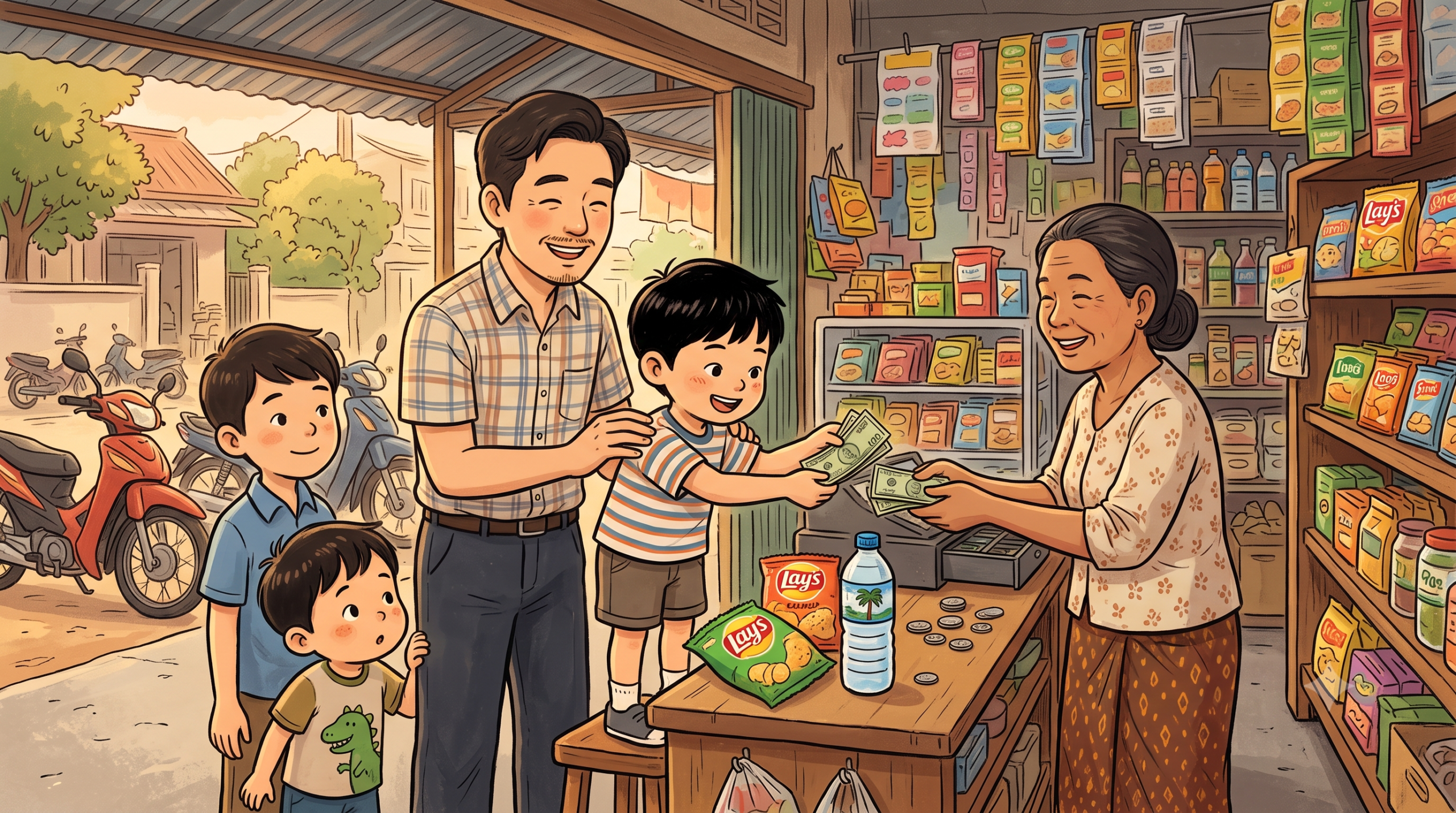
    Instead of allowance, we give them missions. A mission is simple: walk into the shop, buy the snacks or the bottled water, hand over the bill, count the change. That’s it. There’s no rigid system behind it, honestly — just teaching them to be smart with what’s in front of them, one trip to the shop at a time. They’re the ones doing the math, the ones learning that money runs out if you’re not paying attention to it.

    Why We’re Waiting Until Sixth Grade

    We’re planning to start real allowance once the oldest hits sixth grade. I picked that age specifically because that’s usually when money stops being optional and starts being expected. Before sixth grade, allowance is a nice-to-have. After it, there are more social events, more friends, more hangouts — the kind of things you can’t really opt out of without your kid feeling left out. That’s the point where money stops being a lesson and starts being a real need. When we do start, I’m thinking $10 a week, maybe $20 a month. That sounds generous until you do the math on where we live. This is Battambang — a small pack of Oreos, six pieces, runs about 1,000 riel, roughly 25 cents. Twenty dollars is eighty packs of Oreos. I already feel like I’m being too generous, and that’s before I mention that if we lived in Phnom Penh instead, the number would have to at least double to $50 a month, because everything there costs more.

    Privilege, Not Payment

    Even without a set allowance, their privileges are tied to chores and behavior. But it’s not a strict pay-for-work system either — some of it is unconditional, because they’re my sons. Until they move out or grow up, supporting them is my job, not something they have to re-earn every day.

    Where the Money Actually Goes

    There isn’t much to spend on here besides snacks, drinks, and the occasional trip to a kids’ cafe. Kids cafes are still fairly new around here — they used to only exist in Phnom Penh, but a few have made their way to Battambang recently. At least a few times a month, the boys get the choice of going to one instead of playing at home again. Once we’re there, all four of them disappear into the ball pool, the slides, the little play houses. They play hide and seek in there, they run their own little detective games, making up situations out of nothing. It’s one of the few places here that gives them something different to do, and one of the few things their saved-up money actually gets spent on. When they get money as a gift — from friends or grandparents — we put it straight into savings instead of letting it disappear on snacks within the week. That way, when we travel to Korea, they land with real money waiting for them, enough to actually buy something they want: a toy, or a game for the Nintendo.

    The Grandparent Problem

    Korea trips come with a complication: grandparents who want to buy gifts. When it was just two boys, Number Two wanted whatever Number One got — a predictable pattern. Now, with four boys, the pattern has broken down completely. Number Two wants what he wants. Number Three gets what he wants. Number Four wants everything. He’ll ask for the same dinosaur as Number One, the same robot as Number Two, the same Police Hero toy as Number Three — option (d), all of the above. That doesn’t happen. Ever. And when he tries his best kitten eyes on the grandparents, my wife and I step in before they cave.

    Who’s in Charge

    Right now, I manage all of it — savings, investments, everything. The goal is for each of them to have at least $10,000 saved by the time they’re adults, a real starting point instead of nothing. Until they’re old enough to take that over themselves, it’s on me.

    What My Mother Taught Me About Money

    I’ll be honest — there’s a part of the older generation of Korean missionaries and pastors I question, at least on this one point. There’s a financial philosophy running through a lot of the Korean Christian church that treats holding onto money — money not immediately spent on missions or ministry — as something close to wrong. That was the atmosphere I grew up around, especially in the more conservative, traditional churches. I don’t think it’s really about sin, though. I think it’s more about a lack of financial understanding than actual doctrine. The Bible is full of financial wisdom, more than people give it credit for — if you actually read into it, there’s enough in there to manage money well and still be faithful.

    My mother is the one who helped me see that. She knew the churches around us wouldn’t approve of saving in any real sense, but she explained the biblical case for it in a way that let me think a step further than what I was hearing on Sundays. Once I started getting allowance as a kid, I saved almost all of it toward my first camera, a Canon 450D. It took two years of snack money, and I made sure not to touch a cent of it. Even with all that effort, I still came up short, and that’s where my dad stepped in and chipped in the rest. I bought the camera, and I’ve been shooting ever since. I still love cameras enough that if I had a few thousand dollars sitting around, I’d buy two — one for ministry, one just for myself.

    What Faith Has to Do With It

    That same mix of faith and practicality is what I’m trying to pass down now. We come from a family of pastors and missionaries, and growing up, there wasn’t much of a financial philosophy beyond “God will provide.” I still believe that. But I also believe God gave us the knowledge and wisdom to be smart, to invest, to prepare — and that using it is part of being responsible and faithful, not separate from it. Faith in provision doesn’t only look like ravens bringing food to Elijah. Sometimes it looks like being a tentmaker. Or a carpenter.

    Number Four Already Knows Enough

    Number Four doesn’t understand money yet, not really. But he understands exactly what it’s for. He’s taken to grabbing Grandpa’s wallet and announcing, “Let’s go to the mart” — like it’s going to become a daily routine now. It’s not funny anymore, mostly because he means it. When I say no, he doesn’t argue with me. He just goes and finds Grandpa instead.

    Money Lessons Are Just Another Piece of the System

    This isn’t really about money. It’s the same project as everything else in this house: raising boys who grow into responsible, respectable men. The Chore System teaches them that work has value. The Discipline System teaches them that boundaries hold even when it’s inconvenient. Money is just the next lesson in that same line — that what you have doesn’t appear out of nowhere, and that patience now buys something better later. Whether it’s a camera, a bag of Legos, or eighty packs of Oreos, the lesson is the same either way.

  • Creative Play With 4 Boys: The Games We Actually Play at Home

    Creative Play With 4 Boys: The Games We Actually Play at Home

    Creative play with kids is the answer every dad of four boys — ages eight down to two, growing up here in Battambang, Cambodia — eventually gets asked about: what do you actually do with them all day? The honest answer is that most of it isn’t complicated. It’s not curated activities off a Pinterest board. It’s a countdown, a rubber ball, a pile of blocks, and me pretending to lose at video games. The equipment barely matters. What matters is that whatever we’re doing gets turned into a challenge, a rule, a version of the game nobody else plays quite the way we do.

    Games That Need Nothing But Us

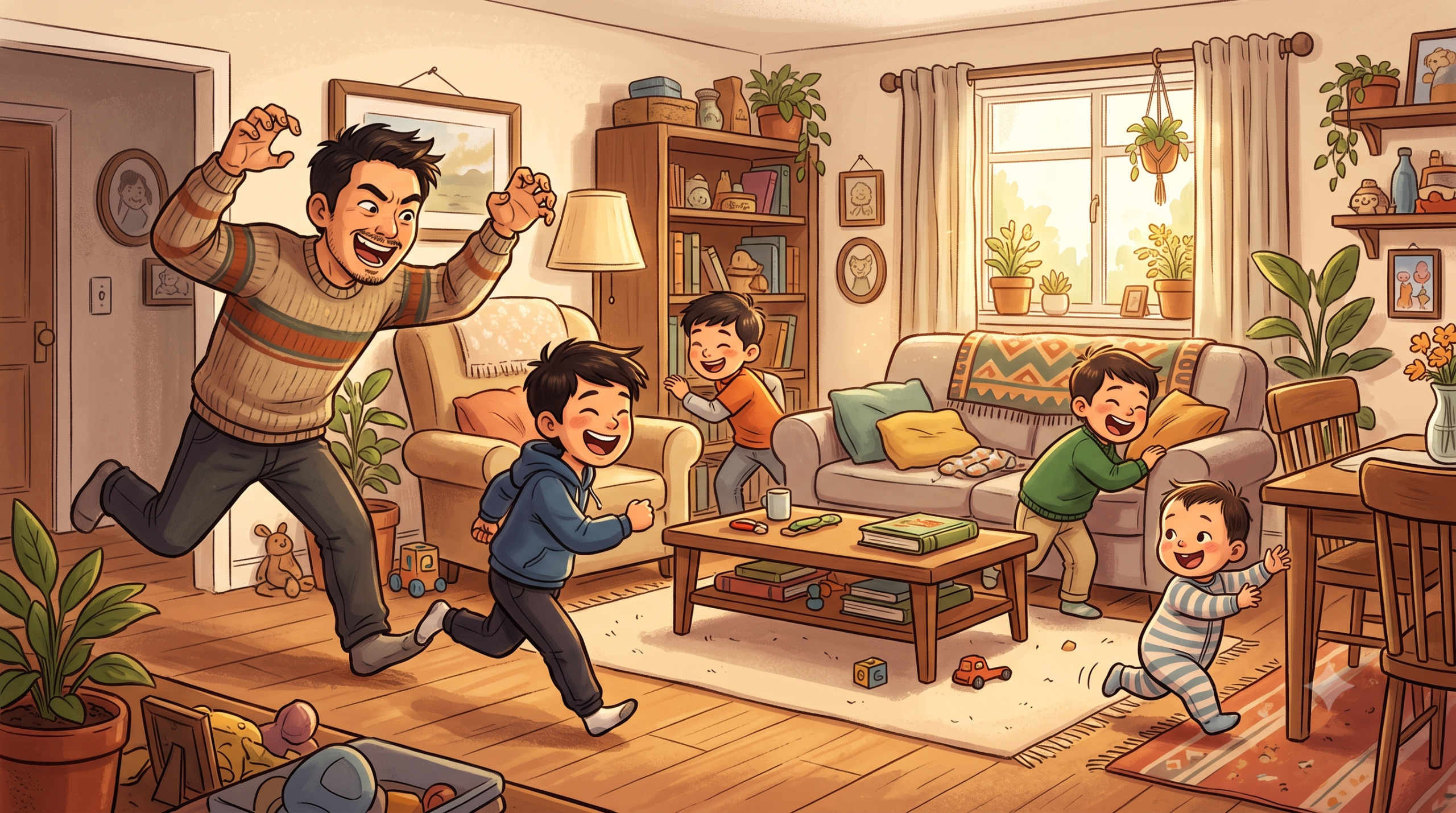
    Some of our best games use zero equipment. Hide and seek was the starting point, but it evolved into something the boys love a lot more: the monster hunt. I do a countdown, they scatter and hide wherever they can find, and the second the countdown hits zero, it’s my job to become the monster. The better the acting, the bigger the fun — it’s not really about finding them fast, it’s about making the hunt feel real.

    The other one is red light, green light. Most people know it now from Squid Game, but it’s actually a traditional Korean game I grew up with long before Netflix got involved. Our boys love the thrill of it — the stopping, the freezing, the risk of getting caught mid-step.

    Games That Need One Ball

    A single soft rubber ball covers a surprising amount of ground in our living room. We play dodgeball with it, monkey in the middle, and a version of squash where we bounce it off the wall back and forth. It has to be the soft rubber kind — anything harder and this list gets a lot shorter, given the furniture.

    The Number Game With the Blocks

    Our newest favorite uses number-shaped blocks. We pick a target number — say, 34 — and each boy has to build a tower using number blocks that add up to exactly that. It’s part math, part creativity, part figuring out how to stack four blocks so the tower doesn’t fall over before you get to the total. Even I find it genuinely challenging, and I’m not the one learning addition for the first time.

    Where Screens Fit In

    We’re not a no-screens-ever house when it comes to play, but video game time still runs through the same Gatekeeper System we use for screens generally — it’s earned, not automatic. When it’s game time, I join in and make it a 2v2 — Number Four isn’t old enough to really play yet, so it’s usually me and one of the older three against the other two. Gang Beasts is a current favorite: a ragdoll physics game that’s either co-op or a free-for-all where the goal is throwing each other off a building, and it’s exactly as stupid and hilarious as it sounds. We also play a game called Boomerang, where you pick an item — a fruit, a vegetable, coffee, hot sauce — and throw boomerangs at each other to score. Simple rules, but control is harder than it looks. Mario Kart World and Mario Party are both in rotation, and Just Dance is on the wish list for whenever we can get our hands on it.

    The Age Gap Isn’t the Problem You Think It Is

    People assume a two-year-old and an eight-year-old can’t really play the same game. Boys are boys. If something is interesting, the age gap stops mattering — Number Four needs help with the math on the block towers, but he’s in there building right alongside his brothers. It’s the same kid who won’t sit still through a meal, and somehow he’ll sit and stack blocks for twenty minutes straight if the challenge is right. The trick, if there is one, is making it a challenge. The moment a game feels like a test of skill or cleverness, all four of them are in, regardless of age.

    Who Starts the Game

    I’m usually not the one calling for playtime. It’s Number Two or Number Three who starts it, or the boys just start playing on their own and pull me in because, according to them, it’s more fun with Dad in it. That might have something to do with the fact that I try very hard to lose “unintentionally.” When things get genuinely tense, though, I take the win.

    Where Mom Fits In

    For anything that’s sit-down and brain-exercise — the block challenges, that kind of thing — my wife leads the way. Anything more physical, the running-around, rough-housing kind of play, that’s mostly a dad thing in our house.

    The Game They Invented Themselves

    Traditional games don’t stay traditional for long around here. The boys added a new move to Rock, Paper, Scissors: Bomb. Bomb beats everything. It’s not fair, and it’s not supposed to be — it has to be played at random, and whoever draws Bomb first wins, no questions asked, just some screaming afterward. It gets chaotic, but it’s the same kind of chaos we handle without raising our voices. The Discipline System doesn’t clock out just because we’re playing a game.

    Blocks Over Robots

    If I had to give one piece of toy advice, it’s this: skip the robots unless your kid has a real passion for them, and buy blocks instead. Wood blocks, magnetic blocks, Duplo — whichever kind, they last for years and the challenges you can build around them are basically infinite. Kids today love Roblox and Minecraft, and blocks scratch that same itch for creativity and problem-solving, just in your living room instead of on a screen.

    Eventually, if you can manage it, get Legos — not the licensed sets, the classic ones, so the boys can build their own blueprint instead of following someone else’s. Fair warning: Legos aren’t what they used to be. When I was a kid, you could buy a bucket of them for a few dollars. Now the pricing feels closer to gold, and I’m not exaggerating much. We’ve found decent deals on the used market in Korea, but even those run over $100 for 5 kilograms. With four boys, I’d guess we need at least 15 kilograms of pieces to keep their creativity satisfied — and once something’s built, they won’t want you taking it apart for something new. But things need a reset sometimes, whether they like it or not.

    Back when I was a kid, blocks were a luxury. Boredom forced us to get creative with sticks and rocks instead — I played GI Joe with pebbles, and it was still fun.

    What Creative Play With Kids Is Really About

    I grew up with a dad who invested real time in us — wrestling with us, getting on the floor, being present. That was rare in the early ’90s. Most dads back then were upright and responsible, but busy, checked out the moment they got home. Mine wasn’t like that. He went the extra mile for me and my two brothers, and growing up knowing what it felt like to have a dad who actually wanted to play with us shaped something in all three of us.

    My dad was mature, a grown-up in every sense, but loving in a way that made us want to be around him. I miss those days. That experience is exactly why I gladly invest in playing, roughhousing, and getting down on the floor with my own four boys. It’s part of the same project as everything else in this house — raising boys who’ll grow into respected, respectable men — this just happens to be the part that’s the most fun. It’s memories being built now that I hope will give them strength later, whenever they need it.