Category: Family Life

  • Money Lessons for Kids: Why My 4 Boys Don’t Get Allowance (Yet)

    Money Lessons for Kids: Why My 4 Boys Don’t Get Allowance (Yet)

    Money lessons for kids come up early for every dad of four boys — ages nine down to two, growing up here in Battambang, Cambodia — because eventually you get asked the money question: do the kids get an allowance? The honest answer is no, not yet. Not because we can’t afford it, but because we haven’t needed to. Their living expenses are covered. What they need right now isn’t cash sitting in a drawer — it’s understanding what money actually is and does, before we hand any of it over.

    Money Lessons for Kids Before the Cash

    Instead of allowance, we give them missions. A mission is simple: walk into the shop, buy the snacks or the bottled water, hand over the bill, count the change. That’s it. There’s no rigid system behind it, honestly — just teaching them to be smart with what’s in front of them, one trip to the shop at a time. They’re the ones doing the math, the ones learning that money runs out if you’re not paying attention to it.

    Why We’re Waiting Until Sixth Grade

    We’re planning to start real allowance once the oldest hits sixth grade. I picked that age specifically because that’s usually when money stops being optional and starts being expected. Before sixth grade, allowance is a nice-to-have. After it, there are more social events, more friends, more hangouts — the kind of things you can’t really opt out of without your kid feeling left out. That’s the point where money stops being a lesson and starts being a real need. When we do start, I’m thinking $10 a week, maybe $20 a month. That sounds generous until you do the math on where we live. This is Battambang — a small pack of Oreos, six pieces, runs about 1,000 riel, roughly 25 cents. Twenty dollars is eighty packs of Oreos. I already feel like I’m being too generous, and that’s before I mention that if we lived in Phnom Penh instead, the number would have to at least double to $50 a month, because everything there costs more.

    Privilege, Not Payment

    Even without a set allowance, their privileges are tied to chores and behavior. But it’s not a strict pay-for-work system either — some of it is unconditional, because they’re my sons. Until they move out or grow up, supporting them is my job, not something they have to re-earn every day.

    Where the Money Actually Goes

    There isn’t much to spend on here besides snacks, drinks, and the occasional trip to a kids’ cafe. Kids cafes are still fairly new around here — they used to only exist in Phnom Penh, but a few have made their way to Battambang recently. At least a few times a month, the boys get the choice of going to one instead of playing at home again. Once we’re there, all four of them disappear into the ball pool, the slides, the little play houses. They play hide and seek in there, they run their own little detective games, making up situations out of nothing. It’s one of the few places here that gives them something different to do, and one of the few things their saved-up money actually gets spent on. When they get money as a gift — from friends or grandparents — we put it straight into savings instead of letting it disappear on snacks within the week. That way, when we travel to Korea, they land with real money waiting for them, enough to actually buy something they want: a toy, or a game for the Nintendo.

    The Grandparent Problem

    Korea trips come with a complication: grandparents who want to buy gifts. When it was just two boys, Number Two wanted whatever Number One got — a predictable pattern. Now, with four boys, the pattern has broken down completely. Number Two wants what he wants. Number Three gets what he wants. Number Four wants everything. He’ll ask for the same dinosaur as Number One, the same robot as Number Two, the same Police Hero toy as Number Three — option (d), all of the above. That doesn’t happen. Ever. And when he tries his best kitten eyes on the grandparents, my wife and I step in before they cave.

    Who’s in Charge

    Right now, I manage all of it — savings, investments, everything. The goal is for each of them to have at least $10,000 saved by the time they’re adults, a real starting point instead of nothing. Until they’re old enough to take that over themselves, it’s on me.

    What My Mother Taught Me About Money

    I’ll be honest — there’s a part of the older generation of Korean missionaries and pastors I question, at least on this one point. There’s a financial philosophy running through a lot of the Korean Christian church that treats holding onto money — money not immediately spent on missions or ministry — as something close to wrong. That was the atmosphere I grew up around, especially in the more conservative, traditional churches. I don’t think it’s really about sin, though. I think it’s more about a lack of financial understanding than actual doctrine. The Bible is full of financial wisdom, more than people give it credit for — if you actually read into it, there’s enough in there to manage money well and still be faithful.

    My mother is the one who helped me see that. She knew the churches around us wouldn’t approve of saving in any real sense, but she explained the biblical case for it in a way that let me think a step further than what I was hearing on Sundays. Once I started getting allowance as a kid, I saved almost all of it toward my first camera, a Canon 450D. It took two years of snack money, and I made sure not to touch a cent of it. Even with all that effort, I still came up short, and that’s where my dad stepped in and chipped in the rest. I bought the camera, and I’ve been shooting ever since. I still love cameras enough that if I had a few thousand dollars sitting around, I’d buy two — one for ministry, one just for myself.

    What Faith Has to Do With It

    That same mix of faith and practicality is what I’m trying to pass down now. We come from a family of pastors and missionaries, and growing up, there wasn’t much of a financial philosophy beyond “God will provide.” I still believe that. But I also believe God gave us the knowledge and wisdom to be smart, to invest, to prepare — and that using it is part of being responsible and faithful, not separate from it. Faith in provision doesn’t only look like ravens bringing food to Elijah. Sometimes it looks like being a tentmaker. Or a carpenter.

    Number Four Already Knows Enough

    Number Four doesn’t understand money yet, not really. But he understands exactly what it’s for. He’s taken to grabbing Grandpa’s wallet and announcing, “Let’s go to the mart” — like it’s going to become a daily routine now. It’s not funny anymore, mostly because he means it. When I say no, he doesn’t argue with me. He just goes and finds Grandpa instead.

    Money Lessons Are Just Another Piece of the System

    This isn’t really about money. It’s the same project as everything else in this house: raising boys who grow into responsible, respectable men. The Chore System teaches them that work has value. The Discipline System teaches them that boundaries hold even when it’s inconvenient. Money is just the next lesson in that same line — that what you have doesn’t appear out of nowhere, and that patience now buys something better later. Whether it’s a camera, a bag of Legos, or eighty packs of Oreos, the lesson is the same either way.

  • Creative Play With 4 Boys: The Games We Actually Play at Home

    Creative Play With 4 Boys: The Games We Actually Play at Home

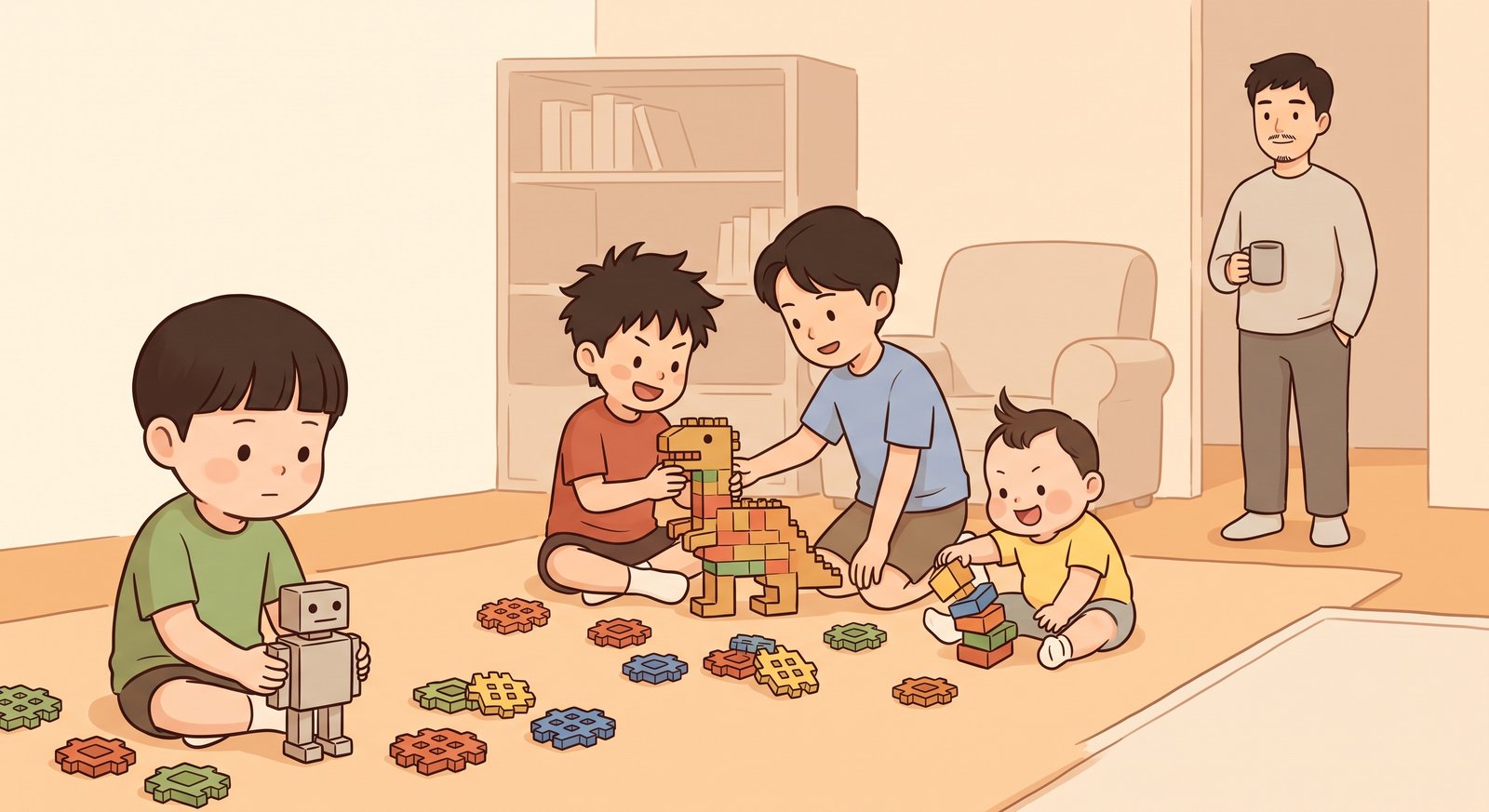
    Creative play with kids is the answer every dad of four boys — ages nine down to two, growing up here in Battambang, Cambodia — eventually gets asked about: what do you actually do with them all day? The honest answer is that most of it isn’t complicated. It’s not curated activities off a Pinterest board. It’s a countdown, a rubber ball, a pile of blocks, and me pretending to lose at video games. The equipment barely matters. What matters is that whatever we’re doing gets turned into a challenge, a rule, a version of the game nobody else plays quite the way we do.

    Games That Need Nothing But Us

    Some of our best games use zero equipment. Hide and seek was the starting point, but it evolved into something the boys love a lot more: the monster hunt. I do a countdown, they scatter and hide wherever they can find, and the second the countdown hits zero, it’s my job to become the monster. The better the acting, the bigger the fun — it’s not really about finding them fast, it’s about making the hunt feel real.

    The other one is red light, green light. Most people know it now from Squid Game, but it’s actually a traditional Korean game I grew up with long before Netflix got involved. Our boys love the thrill of it — the stopping, the freezing, the risk of getting caught mid-step.

    Games That Need One Ball

    A single soft rubber ball covers a surprising amount of ground in our living room. We play dodgeball with it, monkey in the middle, and a version of squash where we bounce it off the wall back and forth. It has to be the soft rubber kind — anything harder and this list gets a lot shorter, given the furniture.

    The Number Game With the Blocks

    Our newest favorite uses number-shaped blocks. We pick a target number — say, 34 — and each boy has to build a tower using number blocks that add up to exactly that. It’s part math, part creativity, part figuring out how to stack four blocks so the tower doesn’t fall over before you get to the total. Even I find it genuinely challenging, and I’m not the one learning addition for the first time.

    Where Screens Fit In

    We’re not a no-screens-ever house when it comes to play, but video game time still runs through the same Gatekeeper System we use for screens generally — it’s earned, not automatic. When it’s game time, I join in and make it a 2v2 — Number Four isn’t old enough to really play yet, so it’s usually me and one of the older three against the other two. Gang Beasts is a current favorite: a ragdoll physics game that’s either co-op or a free-for-all where the goal is throwing each other off a building, and it’s exactly as stupid and hilarious as it sounds. We also play a game called Boomerang, where you pick an item — a fruit, a vegetable, coffee, hot sauce — and throw boomerangs at each other to score. Simple rules, but control is harder than it looks. Mario Kart World and Mario Party are both in rotation, and Just Dance is on the wish list for whenever we can get our hands on it.

    The Age Gap Isn’t the Problem You Think It Is

    People assume a two-year-old and a nine-year-old can’t really play the same game. Boys are boys. If something is interesting, the age gap stops mattering — Number Four needs help with the math on the block towers, but he’s in there building right alongside his brothers. It’s the same kid who won’t sit still through a meal, and somehow he’ll sit and stack blocks for twenty minutes straight if the challenge is right. The trick, if there is one, is making it a challenge. The moment a game feels like a test of skill or cleverness, all four of them are in, regardless of age.

    Who Starts the Game

    I’m usually not the one calling for playtime. It’s Number Two or Number Three who starts it, or the boys just start playing on their own and pull me in because, according to them, it’s more fun with Dad in it. That might have something to do with the fact that I try very hard to lose “unintentionally.” When things get genuinely tense, though, I take the win.

    Where Mom Fits In

    For anything that’s sit-down and brain-exercise — the block challenges, that kind of thing — my wife leads the way. Anything more physical, the running-around, rough-housing kind of play, that’s mostly a dad thing in our house.

    The Game They Invented Themselves

    Traditional games don’t stay traditional for long around here. The boys added a new move to Rock, Paper, Scissors: Bomb. Bomb beats everything. It’s not fair, and it’s not supposed to be — it has to be played at random, and whoever draws Bomb first wins, no questions asked, just some screaming afterward. It gets chaotic, but it’s the same kind of chaos we handle without raising our voices. The Discipline System doesn’t clock out just because we’re playing a game.

    Blocks Over Robots

    If I had to give one piece of toy advice, it’s this: skip the robots unless your kid has a real passion for them, and buy blocks instead. Wood blocks, magnetic blocks, Duplo — whichever kind, they last for years and the challenges you can build around them are basically infinite. Kids today love Roblox and Minecraft, and blocks scratch that same itch for creativity and problem-solving, just in your living room instead of on a screen.

    Eventually, if you can manage it, get Legos — not the licensed sets, the classic ones, so the boys can build their own blueprint instead of following someone else’s. Fair warning: Legos aren’t what they used to be. When I was a kid, you could buy a bucket of them for a few dollars. Now the pricing feels closer to gold, and I’m not exaggerating much. We’ve found decent deals on the used market in Korea, but even those run over $100 for 5 kilograms. With four boys, I’d guess we need at least 15 kilograms of pieces to keep their creativity satisfied — and once something’s built, they won’t want you taking it apart for something new. But things need a reset sometimes, whether they like it or not.

    Back when I was a kid, blocks were a luxury. Boredom forced us to get creative with sticks and rocks instead — I played GI Joe with pebbles, and it was still fun.

    What Creative Play With Kids Is Really About

    I grew up with a dad who invested real time in us — wrestling with us, getting on the floor, being present. That was rare in the early ’90s. Most dads back then were upright and responsible, but busy, checked out the moment they got home. Mine wasn’t like that. He went the extra mile for me and my two brothers, and growing up knowing what it felt like to have a dad who actually wanted to play with us shaped something in all three of us.

    My dad was mature, a grown-up in every sense, but loving in a way that made us want to be around him. I miss those days. That experience is exactly why I gladly invest in playing, roughhousing, and getting down on the floor with my own four boys. It’s part of the same project as everything else in this house — raising boys who’ll grow into respected, respectable men — this just happens to be the part that’s the most fun. It’s memories being built now that I hope will give them strength later, whenever they need it.

  • Mealtime Rules That Actually Work: How We Feed 4 Boys Without a Fight

    Mealtime Rules That Actually Work: How We Feed 4 Boys Without a Fight

    Every family needs mealtime rules for kids that actually hold up under pressure, and ours came together the hard way. Breakfast, I’ve already told you, runs on omelettes and a system tight enough to survive a two-year-old’s hunger alarm. Lunch and dinner are a different problem entirely, because all four of my boys — not just one of them, all four — have declared war on visible vegetables. Onions, garlic, carrots, you name it. If they can see it, they will find a way to explain what it is, object to it, and refuse it.

    So I stopped trying to win that fight head-on and started outsmarting it instead.

    If They Can’t See It, They Can’t Argue With It

    My solution is simple: dice everything small, and pan-fry it into whatever we’re making. Onions, garlic, carrots — all of it gets cut down small enough that it disappears into the dish. As long as the food tastes good and there’s a piece of meat in it somewhere, the boys don’t ask questions. They’re not rejecting the nutrition. They’re rejecting the idea of the vegetable. Take away the idea, and the fight goes with it.

    Because we’re feeding four growing boys real amounts of food, nutrition, and calories every day, we don’t overcomplicate what we make. It’s a rotation — a variety of fried rice, a variety of omelettes, a variety of soups. Traditional Korean dishes like kimchi stew or doenjang stew show up too, but those are the exception, not the rule. Those are dishes the boys still have to learn to eat. Everyday meals aren’t the place to fight that particular battle.

    What’s Actually on the Table

    For lunch, we keep it simple — rice with a side, usually dried or fried anchovies, sometimes small pork cutlets, sometimes just fried rice on its own.

    Dinner is where we lean harder on protein, and in our house that usually means chicken. Chicken breast is affordable here in Cambodia, so I marinate it for at least three hours before dinner. Some nights it gets pan-fried. Other nights I put the marinated chicken straight into the rice cooker with the rice, enough water and stock, and a handful of diced vegetables. What comes out the other end is basically steamed vegetable chicken rice, and it covers the whole meal in one pot.

    Every meal in this house follows the same philosophy: simple prep, simple meal, simple cleanup. I’m usually the one cooking — breakfast, and most of the time lunch and dinner too. I’ve been doing this a long time; I made my first fried rice at seven and my first omelette at nine. My wife takes over when I’m not around, or when I’m too worn out to be in the kitchen — she didn’t grow up cooking the way I did, since she lived in dormitories for years, where cooking for yourself just isn’t really a thing. Between the two of us, someone’s always covering the stove.

    Number Four Runs on His Own Rules

    One of our simplest mealtime rules for kids is that everyone sits down together. Numbers One, Two, and Three are taught to sit down at the table and eat with the whole family. Number Four has his own agenda at every single meal. Sometimes he follows along. Most of the time he’s walking or running around while he eats, distracted by whatever’s happening around him.

    What he will always eat, without exception, is protein — meat, eggs, anything along those lines. He’s not a picky eater in the way his brothers can be. He’s just not a sit-still eater yet, and at his age, we’ve decided that’s a battle for another year.

    You Eat What You Get, and You Finish What You Get

    This is one of the mealtime rules for kids that changed the most in our house. We used to run a one-bite rule — you had to try something before you were allowed to say no to it. That’s not our rule anymore.

    We recently sat down as a family and talked about what kind of men we actually want these boys to grow into. We want them to be role models. We want them to be respected. We want them to have real etiquette — and etiquette means learning to do things even when you don’t feel like doing them. That applies everywhere, and it applies at the table.

    So the rule now is straightforward: you eat what you get, and you finish what you get. Not because we’re indifferent to what they like. Because learning to finish what’s in front of you, even on the nights you’d rather not, is part of building the kind of character we’re aiming for.

    Their Own Dishes

    That same conversation about etiquette and responsibility led to another change. Numbers One, Two, and Three are old enough now, so their plates and bowls are theirs to wash — right after dinner, every night, no exceptions.

    On Saturdays we extend it further. The boys take turns covering dish duty across all three meals — breakfast, lunch, and dinner. It’s not optional and it’s not up for negotiation. If you ate off it, you clean it.

    No Screens at the Table — Mostly

    Mealtime is not screen time in our house. You eat your food, and then you move on to whatever’s next. That rule doesn’t bend at home.

    Where it does bend is when we’re out — eating at a restaurant, or in a setting that’s genuinely more chaotic than our own table. In those situations we allow screens, because the goal was never to be rigid for the sake of being rigid. The goal is a calm, focused meal, and at home that means no screens. Out in public, with more variables we can’t control, we pick the version of calm that actually works.

    The Curry Disaster

    Every parent has a mealtime disaster story. Mine involves curry, and it’s entirely my fault.

    I was cooking curry for the family and got pulled away for about ten minutes — someone needed help with something, and I lost track of time. By the time I got back to the stove, the curry had gone from its usual yellow-orange to dry, black, and smoking. I apologized to everyone, and we ordered pizza instead — with fries and garlic bread on the side. It’s not the best pizza in Battambang, but it’s edible, and it was more than good enough for the kids that night.

    Mistakes happen. Even people who cook every day burn something eventually, especially with kids who want your attention around the clock. The recovery matters more than the mistake did.

    Dessert Is Not a Right

    We don’t have a lot of rules around treats, but the one we do have is firm: you get dessert or snacks after you finish your meal. If you don’t finish what’s on your plate, there’s no dessert and no snacks. No exceptions, no bargaining.

    I keep my word on this every time, which is exactly why the boys believe it. A rule that’s enforced inconsistently isn’t a rule — it’s a suggestion, and kids know the difference faster than we give them credit for.

    What These Mealtime Rules for Kids Are Really About

    These mealtime rules for kids were never really about vegetables, or chicken, or whose turn it is to do dishes. They’re about the same thing we’re trying to build in every part of this house — boys who can do the right thing even when they don’t feel like it, because that’s what respect and etiquette actually require. Feed them well, hold the line, and let the table be one more place where that lesson gets practiced, one meal at a time.

  • Potty Training a 2 Year Old: What My Fourth Kid Taught Me

    Potty Training a 2 Year Old: What My Fourth Kid Taught Me

    Potty training a 2 year old is one of those milestones that looks small from the outside and enormous from the inside. It’s the step where your child literally becomes independent from you — at least for one very important daily function. And I’ll say the part every parent thinks but rarely writes: the money. A kid off diapers is a monthly bill that simply vanishes. Independence for him, a raise for you.

    We’re in the middle of round four right now. Number 4 is two and a half, and he’s our last one — which means this is both a progress report from the trenches and a look back at what changed between training our first boy and our fourth.

    Spoiler: everything changed. Mostly us.

    Where He Is: The Scoreboard

    Daytime: conquered. He knows how to go, he knows how to pee, he knows how to poo. What he doesn’t know is how to clean up after the poo — that’s a course for a later semester, and every parent of a newly-trained kid knows exactly the era I’m describing.

    Naps: conquered. Not a single incident. He’s making it through.

    Nights: in progress. He still makes mistakes — little leaks — but here’s the detail that tells me he’s actually learning: he wakes up the moment it happens. That’s the difference between a kid who isn’t ready and a kid who’s almost there. His body is reporting the news; it’s just reporting it a minute late.

    Potty Training a 2 Year Old at Night: Our System

    Nighttime is where we actually run a system, and it has three parts:

    1. Water diplomacy. We persuade him not to drink too much water at night, because water at bedtime is the direct cause of every mistake. (Regular readers know this battle from our bedtime article — Number 4’s midnight water heists are family legend.)

    2. Bracketing. He goes to the toilet right before bed, and again whenever he wakes — no exceptions, no negotiations.

    3. The moan signal. This one we discovered by accident. He moans in the middle of the night, and at some point we realized: that’s not random sleep noise, that’s the announcement. So now, every time he moans, we pick him up, sit him on his little potty seat — and he pees. Victorious, half-asleep, every time. Your kid is probably broadcasting a signal too; it took us four children to learn to listen for it.

    Fourth Kid vs. First Kid: The Stress Chart

    Here’s the honest comparison, because “potty training your fourth” versus “potty training your first” is a difference measured in blood pressure.

    With Number 1, everything was a first time. The baby was a first time. Nurturing was a first time. Potty training was a first time. Every accident felt like data about our failure as parents. We were worried, unconfident, reading everything.

    By the fourth, you’re an experienced veteran, and you’ve arrived at what I call the what-the-heck stage of life: he makes an accident? Okay. We’ll give it a go again. More laundry. That’s it. That’s the whole crisis. The stress level between one and four isn’t just lower — it’s off the charts different.

    And there’s a strategy lesson hiding in our history. With Number 1, we started late — past three years old — and precisely *because* he was older, he had more control of his body and made almost no mistakes at all. Numbers 2 and 3, same pattern. With Number 4, honestly? We might be rushing him a little. We pulled his schedule earlier than his brothers’ for no particular reason — he was the only one left, so we decided to give it a go. So take this from a four-time veteran: later is easier. A kid trained at three-plus basically trains himself. A kid trained at two and a half trains the washing machine.

    “Daddy, I Peed” — From 3,000 Kilometers Away

    The moment of this whole journey happened while I wasn’t even in the country. I was in Korea recovering from ear surgery when my wife video-called me and turned the camera: Number 4, sitting proudly on his potty, announcing to my face — *”Daddy, I peed.”*

    And something happened in me that surprised me. I’m sure I reacted the same way with Numbers 1, 2, and 3. But with the fourth, it lands differently — there’s finally room to absorb the awe. With your first, milestones arrive buried under worry and checklists. By the fourth, the worry is gone and what’s left is just the pure thing itself: wow. He has grown.

    If you’re on your first kid reading this: that feeling is waiting for you too, once experience clears out the anxiety renting space in your chest.

    He Is Also, However, a Boy

    Balance demands I tell you about yesterday.

    Number 4, for no reason — and I want to stress that, no reason — decided to flip his potty seat over. It was full. It was next to the bed. Physics did the rest.

    By some mercy, the contents missed the bed entirely and hit the wall instead. And here’s where I thank Cambodian architecture: walls here are tiled. We wiped it down, the smell was gone completely, and we all slept refreshed in a room that had been a crime scene an hour earlier. Potty training a 2 year old is a roller coaster in the most literal sense — chill, then thrilling, then terror level, then antagonized, then chill again. Buy the ticket anyway.

    The Internship Pays Off

    Long-time readers know Number 4 is in what we call his internship phase — his only chores are growing up and learning by watching. And I can now report: observation-learning is real. He mimics his brothers using the toilet, picking up toys, cleaning up — and above all he simply loves their company (and bothering them, which at two is the same thing).

    But the internship has a specific supervisor, and it’s not who you’d guess. Numbers 1 and 2 don’t care — they’re busy with their own worlds. It’s Number 3, our five-year-old friendly neighborhood Spider-Man, who goes the extra mile: actively dragging Number 4 around, leading him — do this, do that — and Number 4 follows and does exactly as he says. The peacemaker turned out to be a natural coach. If you have multiple kids, watch for which sibling steps into that role; it’s probably not the oldest, and it’s worth everything.

    The Cambodia Wrinkle: The Hose

    One local detail Western readers won’t expect: every toilet in Cambodia — homes, shops, gas stations — has a water hose mounted beside it. It works like a bidet; you wash, then wipe dry. Our kids grew up with this and it’s completely normal to them.

    Enter Number 4: curious, adventurous, and now in possession of unsupervised bathroom access and a pressurized water source. After he pees — sometimes instead of anything else — he shoots water all over the room. Which is why our final rule stands: he still needs surveillance on every voluntary bathroom trip, because sometimes he’s not there to pee. He’s there to enjoy.

    What Round Four Taught Me

    Potty training a 2 year old, fourth edition, comes down to this: the kid learns the toilet, but the training was always for the parents. Round one trained us to survive the anxiety. Round four is almost peaceful — a system at night, grace for the accidents, a brother doing half the coaching, and enough calm left over to actually feel the wonder when a small voice announces “Daddy, I peed” from the other side of a phone screen.

    He’ll get the nights soon. He’ll even learn to clean up after himself, eventually, probably before he learns to stop weaponizing the hose. And then the diaper line in our budget closes forever, four boys deep — and the internship graduates its last student.

    More laundry until then. That’s it. That’s the whole crisis.

  • How We Survive Road Trips With 4 Kids (And Flights Too)

    How We Survive Road Trips With 4 Kids (And Flights Too)

    A road trip with kids is a different sport entirely — and every quarter or so, our family of six plays it: four to five hours across Cambodia, Battambang to Phnom Penh, sometimes Siem Reap. Four boys, ages nine to two, one driver, one heroic mom, and a 2012 Toyota Sienna that has broken down on me five or six times and counting.

    If you’re planning a road trip with kids and searching for the perfect packing list, I’ll be honest upfront: we don’t have rules for traveling with kids. We have *priorities.* And the difference between those two words is the entire article.

    The Van (a Love Letter With Complaints)

    Our Sienna is amazing. All six of us fit with room for the mountain of luggage that four boys generate — though I’ll note the mountain shrinks as they grow; the diaper-era luggage was far worse.

    It’s also a 2012 model living in Cambodia, which means breakdowns are part of the travel budget. Engine lights. The entire dashboard going dark, no power, in the middle of a trip — full shutdown, pull the battery out, put it back in, jump-start, pray, continue. It’s a hassle. But if it takes us from A to B, it’s good enough. That sentence is basically our family’s whole travel philosophy.

    The Pre-Departure Protocol

    Before any trip, the launch checklist:

    The house: lights out, air conditioners off, everything set for our return.

    The puppy: dropped with a close friend who runs a vet clinic — the best puppy-sitting arrangement known to man.

    Supplies: lots of water, lots of snacks, and bags for the garbage those snacks become.

    And one empty plastic bottle.

    Parents of boys — and I mean specifically boys — you already know what the bottle is for. When you’re in a rush, or on a stretch of road with no stops anywhere, the bottle gets opened and the kid goes in it. Is it hygienic? No. Is it a solution? Absolutely. Pack the bottle.

    The Number 4 Variable

    Here’s the single biggest factor in our travel time: whether the two-year-old sleeps.

    Our departure timing is built around him — we leave around noon and aim to arrive before evening traffic. When we’re lucky, Number 4 falls asleep in the car, and we do not stop. We go all out. Best case, Phnom Penh in four hours flat.

    When we’re not lucky, we stop at every station, and the trip stretches to nearly six hours. And gas station stops with Number 4 are their own event: given the chance, he will grab everything he wants in the store, and he wants everything. So our standing preference is simple — when given the option to stop, don’t.

    Six hours of that, as the only driver, is exhausting. And I’m not driving in peace — I’m driving in chaos. Nobody sits still. Nobody stays quiet. There is screaming, shouting, and a running interview being conducted at the back of my head. This is why we don’t have rules on the road. Rules break. Priorities hold: kids’ needs first, everything else improvised.

    The Seating Chart (a Work of Fiction)

    Technically, we have assigned seats. Mom rides shotgun. Number 4 sits directly behind my driver’s seat, Number 1 beside him, and Numbers 2 and 3 take the back row.

    That’s the plan. The plan never survives. Our kids know how to unbuckle themselves, and Cambodia has no car seat laws — so the back of the van regularly becomes a playground, boys migrating forward and back like weather systems. I’m not recommending this; it’s just our honest reality, and it assigns me my job on every trip: it is Dad’s duty to drive as safely as humanly possible, because the margin for error back there is zero. If you live somewhere with seat belt laws, count that as a blessing and use them.

    The Road Rule Suspension

    Now for the confession: inside the travel van, our house rules don’t apply. The famous no-weekday-screens rule? Suspended. The boys get their iPads on the road.

    I know. It sounds terrible. But hear the structure before you judge: screens cover roughly *half* the travel time, not the whole ride. We start with nothing — no screens, no mention of screens — and just drive. Chatting, looking out the window, the boys singing bizarre songs I’ve never heard, imported from school friends and YouTube. Around hour two or three, someone finally asks: “Can we watch something?” And that’s when screens come out.

    The first half teaches them to just suck it up and enjoy the view — a life skill, honestly. The second half buys the driver silence for the home stretch. Both halves matter. And through it all we try to keep chatting, though I’ll admit the driver’s contributions aren’t always sharp — half my answers are “mhmm” delivered at highway speed.

    My favorite recurring bit: Numbers 2 and 3 are still learning hours versus minutes, but minutes they understand. So when they ask how long is left, I say “a hundred and twenty more minutes” instead of two hours, purely for the reaction. “WHAT?” Never gets old. For me.

    The Korea Comparison (Rest Stops Done Right)

    We’ve also done the long haul in Korea — Busan to Seoul to Chuncheon, about seven hours, in a narrower car the boys did not appreciate. But Korean highway travel has a cheat code: the hyugeso, Korea’s legendary highway resting areas. These aren’t gas stations with a toilet — they’re small towns. Restaurants, markets, cafes, lounges, souvenir shops, sometimes a McDonald’s, sometimes an actual park. Places where you can release four boys to run and feel completely safe doing it.

    When we’re on Korean roads I search out the stations families rate highest, and it pays off — one stop was running a promotion for families with multiple kids and handed us two free pork cutlets. Nearly twenty dollars of food, and pork cutlet happens to be our boys’ love language. A rest stop that rewards you for having four kids: Cambodia, I know you’re trying, but please take notes.

    The Trip That Went Wrong

    You wanted realistic, so here’s the puke story.

    Coming home from Phnom Penh, Number 1 wasn’t feeling right — something from breakfast, we still don’t know what. He said he felt sick, so we moved him to the front seat. Then came the first burst. We stopped right on the highway, I ran around and opened his door — and as the door opened, the second wave came out like somebody had turned on a hose. Not pretty. But outside the car, which in the moment counts as a victory.

    The recovery move: we drove to the nearest gas station that sold ice, bagged it, and laid the ice pack on his chest until the sickness settled. Once he was okay, we rolled on. No panic, no turning back — clean the boy, cool the boy, continue the journey. Add “gas station ice” to your emergency playbook; it’s cheap and it works.

    The Flight: Nine Hours With a 50-Day-Old

    Our longest journey was the move itself — Busan to Cambodia. Domestic flight to Incheon from Busan, an international to Phnom Penh, about nine hours door to door with the transfer.

    The hardest part wasn’t the three boys. Numbers 1, 2, and 3 were old enough to ask for what they needed, and honestly I was confident about them. The hardest part was that Number 4 was fifty days old. Holding an infant on a plane, you’re just up — every sense on alert, the entire flight. At that age all he could do was burp, poop, and cry, with no way to tell us which was coming. Compared to that, traveling with him now is easy mode.

    Our non-negotiable flight rule is that there are no rules. All the viral flight hacks you see online? Half of them have been banned by airlines for safety reasons anyway. Our approach: satisfy the kids. Unlimited seatback screens, whatever they want to watch as long as it’s appropriate. It’s not an everyday thing — when will they next get to watch TV in an airplane seat? — and it genuinely lowers their stress, because a first flight is uncomfortable for a kid: cabin pressure shifting, ears going numb, strange everything. The screens carried them through beautifully.

    The arrival did not. We landed near midnight. My wife had the infant in her arms the whole way — zero hands free — which meant the luggage for two adults, three toddlers, and one infant was all on me, while Numbers 1 through 3 hit the sleepy wall and begged to be carried through passport control. Managing three collapsing boys and a luggage train at midnight in a new country is not an experience I’m looking to repeat.

    Which brings me to the single best travel purchase we’ve ever made: ride-on children’s luggage — the little suitcases with wheels that kids sit on and scoot. Getting our hands on those a few years later was a genuine eureka moment. The kid sits on it, holds the handle, and follows you. One more free hand, one less bag to carry, one less child to carry. They’re a bit expensive, and worth every dollar. I thank God, and I thank the man who invented them, in that order.

    The System Behind All of It

    So here’s our travel system, compressed: the van is old but willing, the bottle is packed, departure is at noon, stops are avoided, screens unlock at halftime, the ice trick handles emergencies, planes have no rules, and the luggage carries the children instead of the other way around.

    But underneath every one of those tactics is the same single priority, and it’s the actual answer to “how do you travel with four kids”: the trip runs on the condition of the children. Not the itinerary, not the schedule, not the plan. When the kids are okay, we drive four hours straight. When they’re not, it takes six, and that’s the trip we were always going to have.

    Everything else — the arrival, the unpacking, the boys cannonballing into a pool while my wife watches and I fire up the Korean barbecue — is the reward for holding that one priority the whole way there.

    A hundred and twenty more minutes. You’ve got this.

  • How We Survive Bedtime With 4 Kids (Without Losing Our Minds)

    How We Survive Bedtime With 4 Kids (Without Losing Our Minds)

    If managing a consistent bedtime routine for multiple kids at your house feels less like a routine and more like a hostage negotiation where the hostages are running the negotiation — welcome. You’re in the right place. We have four boys, ages nine, seven, five, and two. Every single night, all four of them need to end up in bed, and every single night, at least one of them has a different plan.

    We have four boys, ages nine, seven, five, and two. Every single night, all four of them need to end up in bed, and every single night, at least one of them has a different plan. After years of running this gauntlet, I can tell you the secret nobody puts in the parenting books:

    Bedtime doesn’t test your kids’ resilience. It tests yours.

    The kids aren’t the ones who need to be tough at 8:30pm. The parents are. You need to be the most resilient person in the room — because the moment you let a five-year-old control the storyline, the story never ends.

    Here’s our actual system.

    The Sequence: Dinner to Lights Out

    Right after dinner, the boys go straight to brushing teeth and getting ready for bed. That’s around 8:00pm. I’d love to tell you this happens smoothly every night. It does not. Some nights we fight our way through it, tooth by tooth.

    And there’s a pattern every parent of multiple kids will recognize: if one boy finds a reason not to be in bed, the other three will follow him like it’s a union strike. The reason is never legitimate. It’s never actually a reason at all. But rebellion is contagious, and it spreads fastest at 8:15pm.

    So our target is simple: by 8:30, everyone is in the room.

    Notice I didn’t say asleep. That’s important, and I’ll come back to it.

    The Half Hour That Holds It Together

    Between teeth and lights out, there’s a thirty-minute window — and what we put in it might be the most important part of our whole system.

    Every night, we hold a short family service. Nothing formal. No sermon — I’m a pastor, and even I know 8pm is not the hour for one. We sing a little worship together, then go around the room praying for each other and for the days ahead. Then I read the boys one Bible verse — a different one each night — and have them chant it back to me, over and over, until it sticks.

    What it does for them is bigger than it sounds. Going around in prayer makes each boy find something to be thankful for from that day — and having some form of thanksgiving pushes them a step deeper into their own thoughts. What actually mattered today? What’s precious to them? A nine-year-old and a five-year-old, thinking about that every single night, changes them.

    And it does one more thing: a boy who falls asleep chanting a verse is a boy who’s noticeably less afraid of the dark.

    Whatever your family’s version of this is — prayer, gratitude, quiet talking — I’d argue the wind-down half hour matters more than the bedtime itself. It converts “go to bed” from a command into a landing.

    Scaling Our Bedtime Routine for Multiple Kids

    Implementing this system means recognizing that what works for one child won’t always work for a crowd. The secret to a successful bedtime routine for multiple kids relies entirely on killing excuses in advance and holding the line at the doorway. Once the 8:30 room rule is set, consistency becomes your best friend.

    One Bedtime for Everyone (Yes, Even the Nine-Year-Old)

    Here’s something that surprises people: all four boys — ages two through nine — have the same 8:30 bedtime.

    By the book, a nine-year-old’s bedtime is around 8:30 and a two-year-old’s closer to 7:00. But the book doesn’t sleep at our house. Number 4 will never go down at 7:00, because he knows his brothers are coming in an hour — and when a family sleeps in one room, staggered bedtimes just mean the older kids wake the younger one right when he’s finally drifting off.

    So: one bedtime. And nobody pushes back on it, because bedtime in our house isn’t a privilege to be negotiated by age. Bedtime is bedtime, the same way mealtime is mealtime. It’s 8:30, you’re a kid, you go to bed.

    The balance comes on the other end: we never force wake-ups. The boys rise early on their own most days, but if someone needs to sleep in, we let him. Honestly, a morning where the kids sleep in is a small holiday for everyone. They get the sleep their bodies ask for — it just starts at the same hour for all of them.

    The Room Rule: Remove Every Excuse Before It Exists

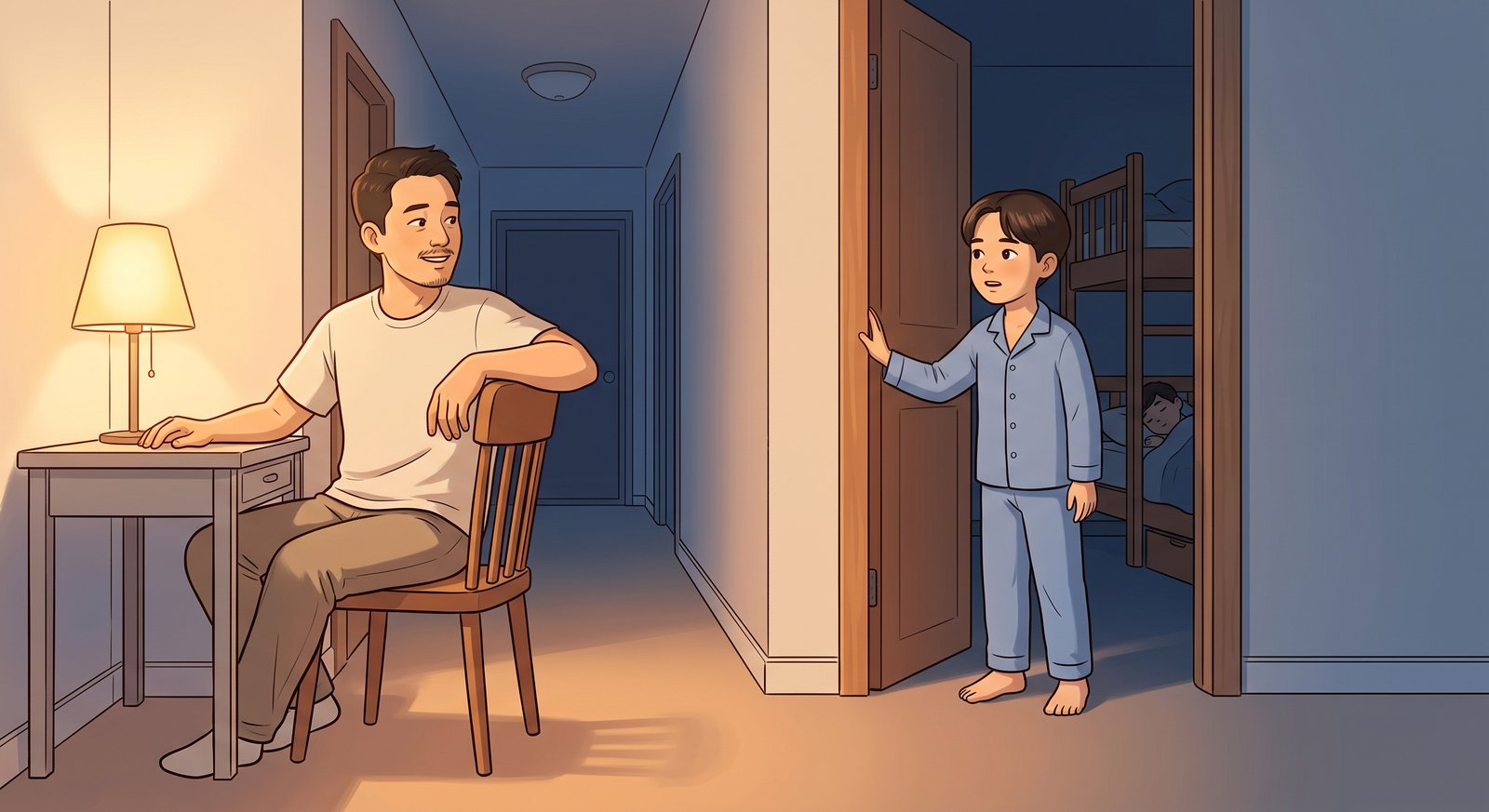
    Here’s the structural core of our whole system: once it’s 8:30, nobody leaves the room. Not for anything. And we made that possible by killing every excuse in advance.

    Thirsty? There’s water in the room. Need the toilet? There’s a toilet attached to the room. Whatever exit ticket a kid might try to print, we’ve already shredded it.

    They still try, of course. The excuses are endless and creative. But I’ve been doing this for nine years across four boys. There is no excuse I haven’t already heard, and I cannot be persuaded. “Dad, I just need to see—” No. That sentence doesn’t get to finish. That sentence is not tolerable.

    And while my wife holds down the room, I head to my office for my evening work window. Which the boys know. So every few nights, one of them drifts out to “check on what Dad is doing” and attempt a conversation engineered to sound natural. I don’t take the bait. They’re not allowed over my head, and they know it.

    Why We All Sleep in One Room

    I should explain our setup, because it shapes everything else: all six of us sleep in one room, on two super king mattresses pushed together. My wife sleeps next to Number 4, our two-year-old, and Numbers 1, 2, and 3 arrange themselves in whatever random order the night produces.

    People sometimes assume this is a Korean thing. It isn’t, really — it’s just a us thing. When Number 1 was born we started falling asleep together, and with each boy it simply stayed. We have a spare room; we don’t use it. We sleep in one room on purpose.

    Here’s the reason: these days it’s genuinely hard to find time when a whole family is together in one place. The bedroom gives us that, every single night, for free. The boys get to lie next to Dad, lie next to Mom, sometimes just get a hug — feel the warmth and find comfort before sleep.

    I know it won’t last forever. The boys will grow, they’ll want privacy, and that’s okay — when that time comes, it comes. Until then, we’re enjoying the privilege of being with our kids while they still want us in the room.

    Know Your Saboteurs

    Every bedtime system has enemies. Ours has a very specific one: water.

    Number 4 wants to drink water before sleep. Normally, fine — except he’s in the middle of potty training, and water at bedtime is the single greatest threat to that entire operation. So he gets one sip. Maximum.

    But he’s two, and he’s crafty. There are nights he drinks his brother’s water when nobody’s watching. And those are the mornings we wake up earlier than anyone planned, rolling up blankets and marching them to the washing machine. Every system has a failure mode. Ours smells like laundry detergent.

    The second saboteur is a sneaky one: the audiobooks.

    Every night, the boys listen to stories as they fall asleep — old fairy tales, folk stories we grew up with, Bible stories, all sorts. Choosing what to listen to is their privilege, and I make sure it stays a privilege, not a hostage situation. Because if you let them, they will never let the stories stop. Ever.

    So I announce it in advance: “This is the last story tonight.” And then — this is the entire trick — I keep my word.

    No negotiations. No “one more.” Protests are not tolerated; silence means they’ve accepted it. And honestly, by the last story, half of them are already asleep. The other half — usually Numbers 1 and 3 — enter the question phase. Random facts. Curiosities. Deep philosophical inquiries from people who cannot yet tie shoes. Before you know it, you’re playing charades in the dark. That’s fine. They’re in bed, they’re quiet-ish, and the room rule is holding.

    Real Needs Are Not Excuses

    Now, an important line to draw — because a strict system without a humanity valve isn’t a system, it’s just harshness.

    The room rule kills fake excuses. It does not kill real needs. If a boy is sick, he gets medication and usually sleeps better for it. But a bad dream is different — a bad dream can leave a boy nervous the whole night, and no rule fixes that.

    Our Number 2 knows this territory well. One day the boys came home from school genuinely shaken — someone had shown horror clips on YouTube, the kind of content no young kid should see, and it got to him. Ever since, he has nights where he’s too scared and nervous to fall asleep.

    For those nights, we change the sleeping positions: the boy with the bad dream moves next to Mom, taking the spot beside Number 4. No lecture, no “you’re too old for this.” As parents, it’s our duty to help them feel safe and loved — to make it okay to be scared, and just as okay to feel safe, because Mom and Dad are right here.

    That’s the difference the system has to know: “I need my brick toy” is an excuse and gets a no. “I’m scared” is a need and gets a spot next to Mom. The boys understand the difference — because we respond to each one consistently.

    When It All Fell Apart: The Midnight Discovery

    I want to be honest about the time our system completely collapsed, because every system does eventually.

    It happens when we travel — a hotel on the way to a conference, a family trip. Away from home, 8:30 becomes 10:30. Then 11:30. And by the time we got back to our house, the boys had discovered a new world. They had experienced midnight. And they wanted it in their system permanently.

    I couldn’t let them have it. But the damage was done, and here’s what the recovery actually looked like, because this is the part every parent coming home from vacation needs:

    It took one full week. Not one night. A week.

    The method wasn’t gradual. It was cold turkey: 8:00pm, we’re in bed. I knew they weren’t sleepy. They knew they weren’t sleepy. It didn’t matter. The trip was the exception; home is the rule. The first nights, they didn’t fall asleep until 10pm — in bed, lights out, wide awake, and that was fine. Then it pulled back. By the end of the week, they were out by 9:00 at the latest, and soon we were back to our normal 8:30-to-9:00 rhythm.

    The principle underneath: a vacation is a vacation. It’s special, so it comes with special privileges — sleeping in, staying up late. But when we’re home, vacation is over, and we return to the system we’ve decided to live in. Not because I enjoy saying no, but because the rhythm is what’s healthy for them. No is no. Sleep is at 8:30.

    Consequences With Teeth (The Boring Saturday)

    The room rule survives because it’s connected to things the boys actually care about: their Saturday privileges — the same leverage that runs our chore system.

    One Friday night, the boys simply refused to wind down. So I told them: because of tonight, tomorrow morning will be the most boring Saturday of your lives. And granted, they’re short lives — but I delivered. No gaming. No TV. Books, toys, and the company of a puppy. That was the entire morning. They earned their privileges back by behaving, and the rest of Saturday resumed — but the message landed.

    And it works at the individual level too. One night, Number 3’s brain clicked onto a specific brick toy, and he had to go get it. I said no — get it tomorrow, you can’t do anything with it tonight anyway. He insisted. I declined and gave him a warning. He insisted again.

    So the consequence came: he lost his pick of what to watch on Saturday. And — this is the entire system in one sentence — I kept my word.

    That’s it. That’s the trick. Not the water in the room, not the audiobooks, not the mattress arrangement. The system is a dad who follows through, every time, even when following through is inconvenient.

    Be the Most Resilient Person in the Room

    Here’s the takeaway, and it’s the least comfortable one I’ve written so far:

    Your bedtime problem is probably not a kid problem. It’s an endurance problem. Kids test the line because testing the line is their job. The question is whether the line moves.

    Our rules are blunt and boring: 8:30, you’re in the room. You don’t have to be asleep — eyes closed, quiet, trying counts. Water’s already there. Toilet’s already there. Last story means last story. Real fear gets a spot next to Mom; fake excuses get nothing. Break the rules, lose the Saturday. Every excuse has been pre-deleted, every consequence gets executed, and Dad cannot be out-negotiated by someone who still needs help with his shoes.

    They’re not controlling the storyline. That’s the whole system.

    And most nights now, by 9:00, the house is quiet, my wife is reading next to a pile of sleeping boys, and I’m in my office with the laptop open — living proof that the 8:30 rule isn’t really for the kids at all.

    It’s how the whole family gets its rhythm back, every single night.